nell haynes
  • home
  • bio
  • publications
  • projects
  • fieldnotes
  • teaching
  • contact
  • español

521 years of resistance

12/10/2013

0 Comments

 
Today is 12 of October. In the Midwest, where I went to elementary school, this is known as Columbus Day. Later, as I gained a bit more worldly perspective I came to call it Indigenous People’s Day or Genocide Day under my breath. A few days ago, I got upset when my mother, who is a second grade teacher, mentioned she had Columbus Day off—partly because it is still institutionalized and partly because she called it Columbus Day without a hint of critique. But I’ll cut her some slack. When I’m in central Illinois she usually lets me come talk to her class about colonization. And the amazing thing is, when you explain that colonization was simply a bunch of Europeans who wanted to take the resources on another continent and felt it was necessary to murder, enslave, rape, and destroy the residents of that place in the process, even 8 year olds are pretty quick to realize that this is not something to be celebrated.

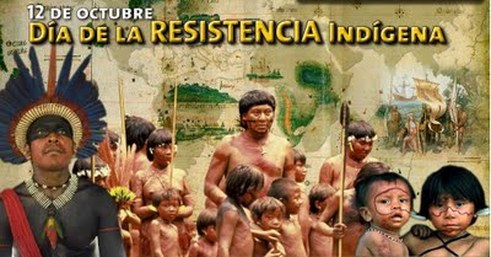
I arrived at the Preuniversitario where it was held around noon and was immediately asked where I’m from. I felt a little defensive and said that Raquel had invited me and hoped it would be ok if I could just stand in the back and watch. And then I realized the woman had asked me because all of the other audience members had pin on badges that announced what country they are from. Chile and Peru dominated the group of 50, but there were a few small nametag-sized Bolivian, Ecuadorian, and Colombian flags pinned to shirts as well. Unfortunately there were no United States pins on hand, but they were happy to have me. The chairs were all full, so I stood along the back and watched a slide projection on the front wall. There were pictures of Alto Hospicio and various local groups interspersed with graphical slogans such as “12 de octubre, 2013: 521 años de resistencia” [521 years of resistance] and “Por la dignidad de los pueblos americanos, 12 de octubre nada que celebrar” [For the dignity of american peoples, 12 October is nothing to celebrate].
 
Picture
The program began with a Chilean Cueca dance performed by two pairs adolescent boys and girls. Then the Ecuadorian woman who had greeted me earlier performed a pop song from her country. Representatives from the Colombian and Ecuadorian immigrant associations in Iquique spoke. An Afro-Peruvian woman sang two more songs, and several community figures and political candidates spoke briefly. Scattered throughout all of these various performances were discourses about the unity of the Americas against Europeans and Gringos (“that’s me!” I thought…). The Peruvian singer shouted several times over the boombox that accompanied her “America Latina es una sola!”

As the last local leader was speaking, Raquel came and stood next to me at the back. She asked if I could stay for the reception afterwards because she’d like to introduce me to a few people. I accepted and met several of the people she works with at the Preuniversitario along with being coerced into eating plenty of bocadillos, ceviche, and grilled shrimp.

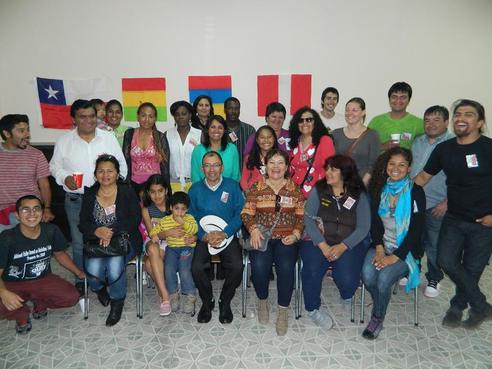
As the reception was ending, Raquel’s friend Juan called everyone to the back room to take a photo. I lingered in the front room, but he singled me out saying “You too, Nell. You’re from the Americas. We need our representative from the United States present.” So I followed the crowd to the back, where we rearranged ourselves a number of times against a backdrop of handpainted paper flags, and finally got a decent shot (well, you can be the judge). 
Picture
There is certainly some multicultural pride here in Alto Hospicio, at least when it comes to public presentation. And the mix of anti-colonial and multi-cultural discourses was interesting, but not surprising given what I’ve seen here so far. But what I find most interesting is the memorialization that occurs through such events. Though the focus is on celebration and community, it is framed by this discourse of resistance to colonization and a memorialization of a past that continues to influence present events. One of the SocNet themes of focus is on the way memorialization occurs through social networks (see Shriram Venkatrama's account from India here). I’ve been keeping my eye out for Facebook pages dedicated to individuals who have died, but perhaps more important are these ways of memorializing political events and figures, not only online but in real life events, and the naming of institutions (more on that in the next post!). 

0 Comments

irony pt 3, surfin wagner

7/10/2012

0 Comments

 
My favorite example of the ironic appreciation of lucha libre, which I saw live on Friday night, is the band Surfin Wagner. I first heard of them because the lead singer was a friend of a friend, but quickly discovered they had quite a following of Paceños. The band’s name is derived from a famous Mexican luchador, Dr. Wagner, otherwise known as Manuel González Rivera. He began wrestling in the 1960s as a rudo, but by the early 1980s—when the members of Surfin Wagner and my friends were young children—he had become a technico. In 1985 he lost his match in a well-publicized event and essentially retired. 

Picture
The band, like my friends who I wrote about here, creates humor using a frame shifting strategy by combining lucha libre aesthetics with surf music. The band members use lucha libre inspired names (Pedro Wagner, Médiko Loko—a misspelling of famous Mexican luchador Médico Loco, Roy Fucker—after a Japanese anime character later used in Mexican wrestling, El Momia, and Comando—both popular characters in Bolivian wrestling), and wear lucha libre head-masks along with their Hawai'ian print shirts. They describe their music as “el Garage, el punk y principalmente el Surf, siempre con un toque de sátira e ironía” [garage rock, punk, and principally surf, always with a touch of satire and irony]. The “biography” of the band on their website suggests that the band members are legitimate luchadores (again with irony), and they point out the incongruity of a surf band in a country without access to the sea. Clearly their use of the lucha libre aesthetic is meant to evoke laughter rather than contribute to a serious musical appreciation. 

So, over these last three posts, I've tried to give a sense that for many Paceños lucha libre in general, and the cholitas luchadoras’ participation specifically, are a light-hearted representation of Latin American culture. In a sense, lucha libre is positioned as authentically Latin American in a now-globalized world. As they combine cholas with punk culture or classic Mexican luchadores with surf rock, they reterritorialize these “traditional” icons by merging them with global symbols.


0 Comments

irony pt 2, bolivian tv

4/10/2012

0 Comments

 
When Super Catch wrestlers made appearances on morning and evening national talk shows, another kind of irony was present. Granted, Latin American talk show hosts are not known for being subtle, but the overacted excitement, fear, and horror these hosts communicated verged on the clowning Edgar was always so adamantly against. 

When Super Catch wrestlers made appearances on morning and evening national talk shows, another kind of irony was present. Granted, Latin American talk show hosts are not known for being subtle, but the overacted excitement, fear, and horror these hosts communicated verged on the clowning Edgar was always so adamantly against. 

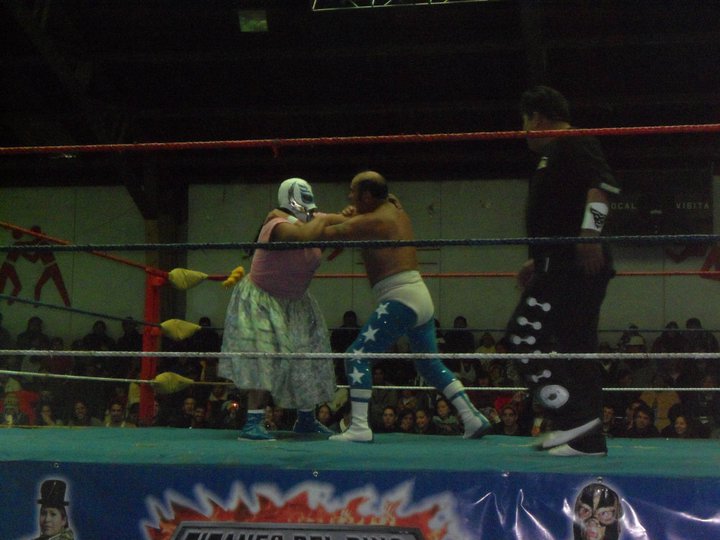
In March and April of this year, Super Catch luchadores (including myself) appeared on the Univision morning program, Revista, five times. Though the show has four hosts, it was always Tony Melo who interviewed us, and sometimes even donned a luchador mask acting as a mark for the luchadores. The segment always featured a brawl between wrestlers, and often Tony would be pulled into the grappling. The peleas always ended with Super Catch luchadores ganging up on Tony, as he was flung around the sound stage and mock kicked after being thrown to the floor. He very much acted as the clown figure in these situations, flailing arms, and making exaggerated faces for the camera. He always wore a curly wig, and t-shirt that said “Soy No. 1.” 

Picture
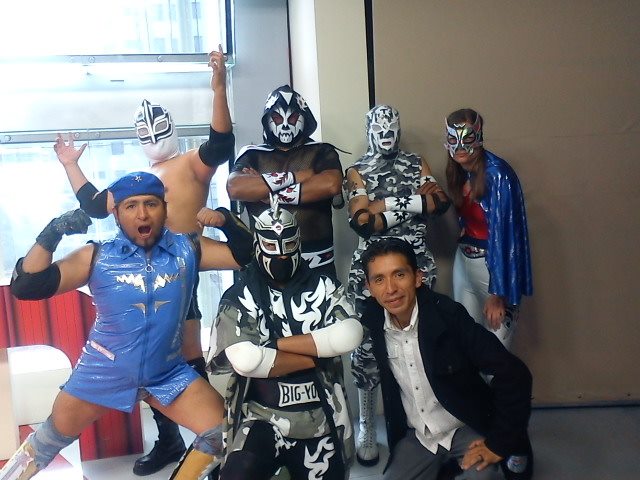
Tony Melo is on the far right with his co-anchor. Super Catch luchadores are: Super Cuate, Big Boy, Desertor, 
Black Spyder, Lady Blade, Tony Montana, Gran Mortis, and Big Man

In contrast, the luchadores seemed more serious. Our costumes were clearly better constructed. Our moves were more practiced and more effective in contrast to Tony’s. But much like Edgar’s worries about the cholitas luchadoras, Tony’s clownish acting gave an air of farce to the wrestling that happened on television. 


No luchadores ever commented on this except to roll their eyes occasionally when Tony was mentioned in the backstage area. Nor did I have a chance to ask Tony or the program producers what their intentions were with the way they presented lucha libre. But the audience for Revista is much larger and far more varied than the in-person audiences which actually attend events. There were viewers that phoned in to win free entry to the event, often saying they hailed from working class neighborhoods like Villa Armonía in La Paz or Villa Esperanza in El Alto. But this is also a television program which professional Paceños watch as they prepare in the morning for work as managers in banks, universities, and international organizations. Thus, the fact that Tony’s acting on the program reflects the ironic appreciation of lucha libre is not surprising. Though TV interviewers always treated all the luchadores with respect, their over-acted treatment of the segments seemed to stem not only from their television personalities, but from a deeper sense of irony they were communicating to viewers.

0 Comments

irony pt 1, cholita punk again

3/10/2012

0 Comments

 
One of the peer reviewers for my JLACA article suggested that I include more information about what “elite” Paceños think of lucha libre. I didn’t think this fit well into the article, but I do think the general public’s reactions to lucha libre are something interesting to be considered. This is part one of a short series on middle class interpretations of lucha libre.

The luchadoras are “un orgullo Paceño en La Paz y El Alto” [A Paceño pride in La Paz and El Alto] David, a local LGBT activist told me. “Es una pasion de multitudes…la gente burguesa y popular” [It’s a passion of the multitudes. The elite and popular classes]. It was not exactly my experience that they were the “passion” of middle class people, but they were certainly within the realm of popular discussion topic. As I wrote about here, one night at a party I put on a pollera and braided my hair. Gonz was the only one there who knew my secret, so when Luis, shouted “Tienes que luchar! Como las cholitas en la lucha libre” I was caught off guard. Amidst much laughter we all started pretending to wrestle.

To my friends at the party, the luchadoras are something of a joke that carries classed inflection. Like a monster truck rally or square dance might be viewed by urban elites in the United States, lucha libre is not disparaged outright, but seen with a certain sense of dismissal or ironic appreciation. Here they express an understanding of the preference for the genres of excess that has often been classed. As Linda Williams explains of film genres, those that have a particularly low cultural status—horror, pornography, and melodrama—are ones in which “the body of the spectator is caught up in an almost involuntary mimicry of the emotion or sensation of the body on the screen” (1991:4). These films, rather than appealing to elite classes as “high art” are seen to be for the less educated, less “cultured” masses. 

Picture
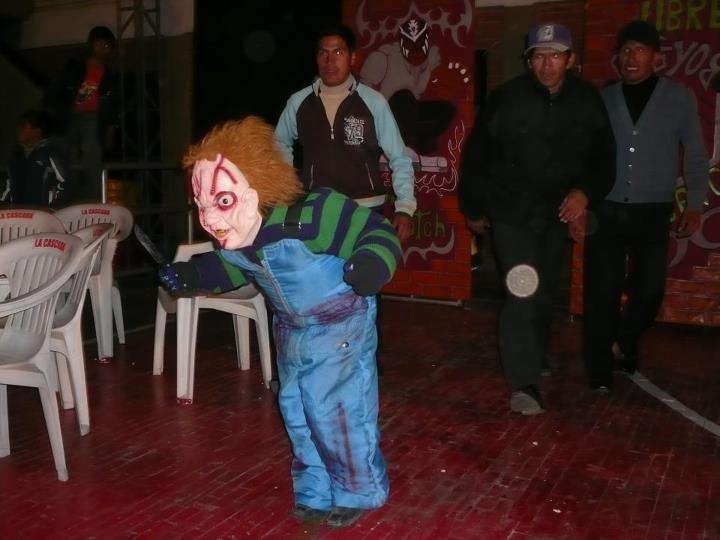
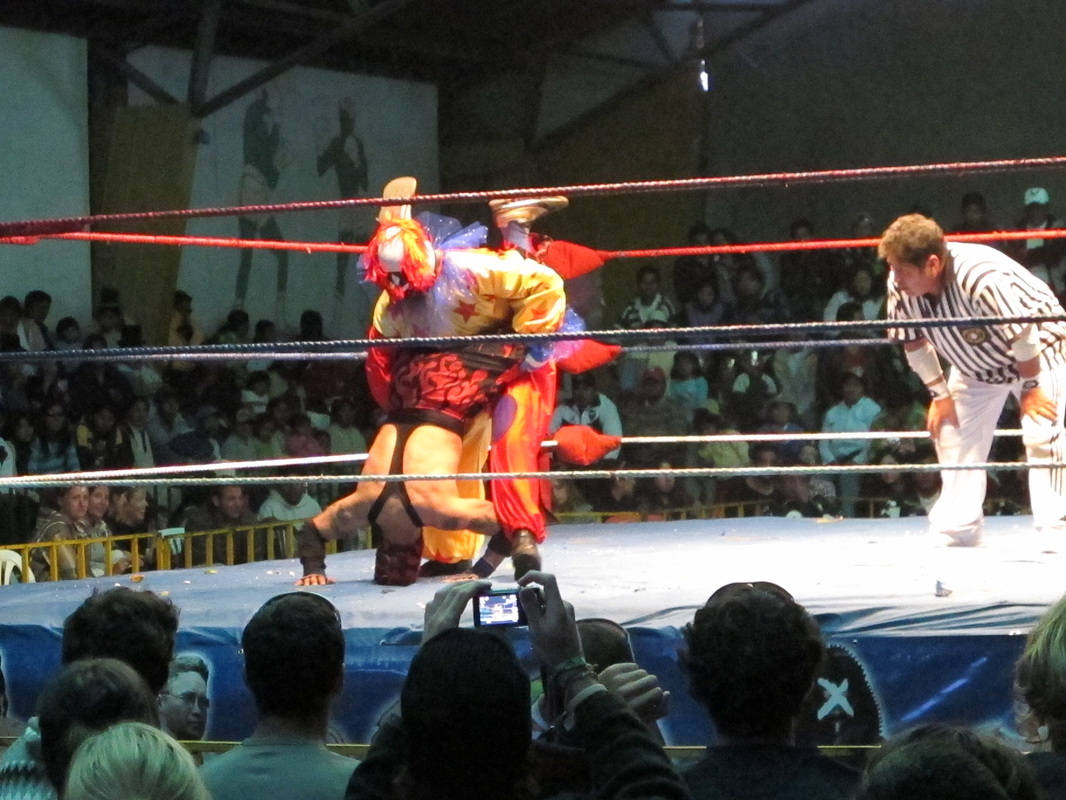
A luchador's son performs as "Chucky" at the 30 March 2012 Super Catch Event

And indeed, lucha libre combines aspects of all three of these film types. The enacted violence of the ring reflects the gratuitous violence of horror films. The intimate contact of bodies, and sometimes explicit sexually charged scenarios can be read as pornographic (see Messner, et. al 2003, Rahilly 2005). And several scholars have pointed to the melodramatic nature of the extreme good and evil portrayed in exhibition wrestling (Jenkins 2007, Levi 2008). Thus, for many of my friends lucha libre lies squarely within the bounds of that which is not to be appreciated—at least on an artistic or serious level. 

However, like North American young people, young Paceños sometimes have ironic appreciation for degraded cultural symbols like lucha libre. Irony often functions as a “frame shifting” mechanism (Coulson 2001) in order to express humor. When I entered the party wearing a pollera, Gonz shouting “cholita punk” shifted the frame from the representation of cholitas as traditional and thoroughly Bolivian icons, to something integrated with the international youth culture of punk rock. Even my own laughter at wearing the pollera and braids played on the disjuncture of a U.S. gringa in clothing with cultural meaning in the Andes. And most certainly, when Luis suggested I wrestle, irony was used to disrupt the usual interpretation of a mujer de pollera.

Coulson, Seana
2001  Semantic Leaps: Frame-shifting and Conceptual Blending in Meaning Construction. Cambridge, England: Cambridge University Press.

Jenkins, Henry
2007  The Wow Climax: Tracing the Emotional Impact of Popular Culture. New York: New York University Press.

Levi, Heather
2008  The World of Lucha Libre: Secrets, Revelations, and Mexican National Identity. Durham: Duke University Press.

Messner, Michael A,, Margaret Carlisle Duncan, and Cheryl Cooky
2003 Silence, Sports Bras, And Wrestling Porn : Women in Televised Sports News and Highlights Shows. Journal of Sport and Social Issues 27:38-51.

Rahilly, Lucia
2005  Is RAW War?: Professional Wrestling as Popular S/M Narrative. In Steel Chair to the Head: The Pleasure and Pain of Professional Wrestling. Nicholas Sammond, ed.  Durham: Duke University Press.

Williams, Linda
2001  Film Bodies: Gender, Genre, and Excess. Film Quarterly 44(4):2-13.

0 Comments

jazz, performance, and the audience

7/9/2012

0 Comments

 
In July of 2008, after a long day of dancing to A Hawk and a Hacksaw, Icy Demons, and Animal Collective at the Pitchfork Music Festival, I found myself with some long lost friends at Belmont and Western. I hadn’t seen or talked to Ravi in years. We had dated briefly in college, but more importantly we were student government co-conspirators. He was the director of an umbrella organization for progressive student groups. I was the executive officer for Students Advocating Gender Equality. Together we led protests across campus and Chicago and tried to lobby both student government and the administration to pass resolutions condemning the occupation of Iraq. We never succeeded at that, but the “camp out” we held at the library plaza did eventually get the university to sign onto the Workers’ Rights Consortium Designated Suppliers Program.

Picture
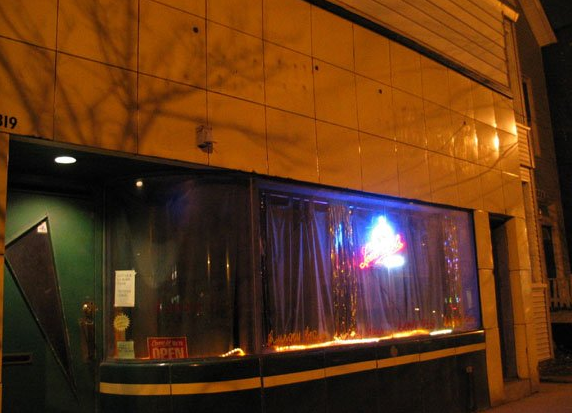
approximately the last time I had seen Ravi

So five years after our graduation we sat across a table at The Hungry Brain catching up (he was about to run for a state representative spot in his home district) and waxing nostalgic (with stories one should never share about a political candidate they support).

And the Hungry Brain is a lovely place. Nestled in Roscoe Village, its a cash only dive bar. The type of place I’d normally flock to. And on this particular night there was a jazz trio playing. I’m sure they were playing quite well, but at least in the back corner we occupied our laughter was the overwhelming sound. And the other patrons weren’t so keen on this. We got dirty looks often, and shhhhs a few times, so at the set break we walked around the corner to some 4 am bar that inexplicably had 3 motorcycles parked in the back room.

Picture
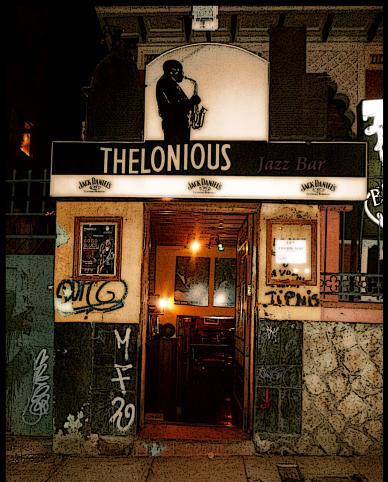
In the intervening years I’d eventually attend summer outdoor jazz in the park type events or find myself gulping wine at Columbia Station in DC. But last night, I finally stopped into the jazz bar I’ve been walking past for 3 years. I’ve always meant to check it out, but never had a reason. When Joaquin told me he knows Pablo, the owner and suggested we go, I jumped at the chance. Thelonious is promoted as the only jazz bar in Bolivia, though I have no idea how accurate that is. In La Paz it is certainly the most well publicized, but as far as I know there could be some hidden in the back lanes of El Alto, or a thriving jazz community in Santa Cruz. Thelonius, like Hungry Brain and pretty much all bars in La Paz, is cash only. But aside from music, cash, and alcohol, my experience there was very different from the Hungry Brain. 

Picture
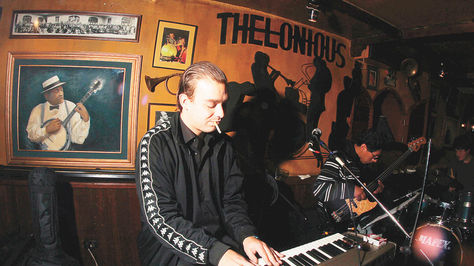
We arrived around midnight and found Pablo, his girlfriend, and another friend at a table by the door. Having arrived with Joaquin, our Colombian friend Jhon, local electronico DJ Chuck Norris, and his date, we pushed several tables together and joined Pablo and company. The Jack Daniels flowed freely and we discussed race politics in La Paz (in as lighthearted a way as we could). The conversation was filled with that distinctive Paceño laugh-a velar nasal “yaaaaaahhhhhhhh.”

Picture
the flyer DJ Chuck Norris gave me that night

Only at the set break was the music mentioned. Joaquin told me that the bass player (of course) was one of the best in La Paz. He then introduced me to the manager—one of the best jazz drummers in South America. I got plenty of (undeserved) Jazz street credit for being from Chicago. 

And our table was not unique. The overall feeling of the place was lively. People were laughing, and at times cheered and whistled for solos. The occasional drink was spilled without much notice. People danced on their way to the baño and stopped at other tables to chat on their way back. 

In essence, it would have been the perfect place for Ravi and I that night after Pitchfork. And perhaps this is just an isolated example, but to me it felt significant. Here in La Paz music is about enjoyment, having fun, creating an atmosphere for smiling and laughing. In Chicago, home of Green Mill, and Old Town School of Folk Music, its about connoisseurship. And this is no moral judgment on either, but to my untrained ear, I’d rather joke with Colombian Jhonny about Paceños’ laughs than quietly get lost in the beat. 

Picture
foto courtesy of La Razon

And to an extent I think this reflects some of the tensions in lucha libre as well. The cholitas luchadoras are there for the laughter, the smiling, the shouts, and raucousness. And luchadores like Edgar understand the importance of the audience, but see their art as something to be appreciated on an elevated level. Again there is no moral judgment here, and I think most artists of whatever sort would prefer to be appreciated for their technical ability and crafting of style—but there are definitely two different approaches to performance at play here. 
0 Comments

the anthropologist's dream

24/6/2012

0 Comments

 
_ Suddenly it all makes sense. Today was the ethnographer’s dream. I returned to the “site” that was the beginning. The rough sketch that will hopefully become some sort of masterpiece of a dissertation. The shaky first attempt and understanding something. Anything.

That is, Edgar asked if I wanted to go to the Multifuncional to see the show and try to work out a deal with Mr. Atlas. And with all the police mutiny going on around here I almost canceled on him and stayed home today. But when he called to tell me he’d be ten minutes late, I pulled on the thick down coat, and headed out the door.

Picture
_ I’ve made central to my thesis his suggestion that the luchadoras of Titanes del Ring are “payasas.” And I’ve been thinking about it as a gendered derogation. But tonight, as I sat on the cold concrete bench, surrounded by women in polleras and seven year olds screaming at the rudos that they are maricones, I understood what he he’s been talking about all this time.

Every match was far more show than lucha. He was right that I should pay attention to the way the luchadores interacted with the audiences. The cholitas arrived in the arena dancing (sometimes with the gringos in the front row), waving, smiling, being cute. The luchadores either greeted people with waves , walking all the way around the ring, or insulted the audience immediately. Throughout the matches they often stopped to interact with the audience. When Cobade jumped on the corner ropes in the middle of the match, the little girl next to me yelled “maricon” over and over. “Tu papá es un maricon. Yo soy hombre.” He responded. Yes, indeed, I need to beef up my interaction and acting.

But the wrestling itself, the claves, the cayes, the castigos, were less than impressive. I have yet to do any quantitative analysis on the subject, and perhaps my very central role biases me, but I would venture to say that my own matches have about twice as many actual wrestling moves per minute as the Titanes del Ring matches. And to me, this made them slow and boring. Certainly there was more humor involved. And the audience was given ample opportunity to shout, throw things, generally become “part” of the act. Perhaps in Super Catch matches they are more spectators than contributors.

Picture
_ But the word “clown” was the obvious descriptor for much of what I was seeing. It very much was clear in a match featuring Jenifer Dos Caras in which, before the actual wrestling began, she repeatedly fell on the floor laughing. This reminded me of Goffman’s analysis clowning, and “the use of entire body as a playful gesticulative device” as a way to indicate a lack of seriousness and childlike demeanor. Jean-Martin Charcot, a nineteenth century neurologist, pioneered work on hysteria, suggesting that the second phase of the condition was “clownism.” As Didi-Huberman (2003:147) explains, this reference to clowning was used to delegitimate so-called hysterical women.

And the very gendered history of all this added to my assumption that Edgar’s statements belied sexism, and a dismissal of the possible contribution of women to lucha libre. But tonight I understood where the sentiment was coming from and it seemed to have little to do with gender. After the first three matches he asked “Como te parece?” But didn’t quite give me a chance to answer. “Son malas, no?” And I agreed. They were funny. Lots of humorous yells at the audience, bodily comedy, and goofy antics. But the actual wrestling wasn’t convincing. The claves weren’t done with skill. “Falta mucha technica” says Edgar.

But Titanes del Ring garners an audience. Edgar and I guessed there were around 500 people there. With about 150 tourists paying 50 Bs. a person. And maybe that’s the key. Maybe the actual wrestling doesn’t matter. Maybe its all about the comedy. Last year, plenty of audience members told me the reason they attend shows is that it makes them laugh. Maybe its something like the “oasis” Veronica Palenque is striving for. But I can see how, even if this is what Bolivian audiences want, Edgar and his colleagues hope for something more. Something they can be proud of as technicos and luchadores trying to advance their sport.

In the end discussions with Mr. Atlas went nowhere and we rode the minibus back to el centro discussing what we liked and what we didn’t. There was a good jump from the top rope. Mr. Atlas had a few nice moves. And the skeleton character, Mortis, definitely has some dance moves. And I suppose the good part is, I’m feeling more confident about my own abilities. I didn’t see a single attempt at tijeras tonight. And the plan is to learn los tijeras dobles this week.

_
Didi-Huberman, Georges
2003  Invention of Hysteria: Charcot and the Photographic Iconography of the Salpêtrière, translated by Alisa Hartz. Cambridge, Mass: MIT Press.

Goffman, Erving
1979  Gender advertisements. Cambridge, MA: Harvard University Press.

0 Comments

heroes para bolivia

24/6/2012

0 Comments

 
_ This morning several Super Catch stars went to Palenque TV (canal 48) to record some messages aimed at children. The channel is going to start airing lucha libre, under the name Tigres del Ring, and the promo spots recorded will come at the end of commercial breaks. 

Picture
picture from appearance on Unitel, not Palenque TV

_ Palenque TV is a project of Veronica Palenque, daughter of the late Carlos Palenque Avilés. Carlos was a presidential candidate in 1989 and 1993, running for the CONDEPA (Conciencia de Patria or National Conscience) party. In 1993, he received just over 14% of the vote, putting him in second place behind Goni (who garnered about 35.5%). Perhaps more interestingly, Carlos spent his time in the 1960s singing social-protest songs and cultivating long hair. He then became part of Los Caminantes, a pop-folk group that quickly became one of the most popular bands of time in La Paz. He eventually went solo, and the Bolivian National TV station (the only TV station in Bolivia at the time), asked him to do a weekly live music show aimed at indigenous and rural-origin peoples living in La Paz. He solicited Remedios Loza, or Comadre Remedios, to be his cohost on La Tribuna Libre del Pueblo [The Community’s Open Forum]. Remedios identified more closely with indigeneity than Carlos and dressed de pollera. She and Carlos remained close, and after his death, so ran for President in his place in 1997. However, it seems that Remedios had sharp tensions with Veronica, and left the program (for more information see Moore's piece here). 

Veronica herself then served in the Bolivian National Congress from 1997-2000. She first formed a radio station in 2000, with the objective to continue the line of social welfare, information, education, and training that Compadre Palenque (referring to her father) left behind as his principles, precents, and ideology.

“Red Palenque Comunicaciones, fue creada el años 2000, con el objetivo de continuar la línea de ayuda social, información, educación y entretenimiento que el Compadre Palenque dejara bajo sus principios, preceptos e ideología.”

In 2011 Veronica began the TV station, in response to the proliferation of pain, suffering, bad news, disasters, catastrophes, and negative news usually available on television. She decided to create a channel that emphasizes fun, entertainment, laughter, joy and positive aspects of life. Veronica explained, “El control remoto tiene que convertirse, a partir de hoy, en una ‘varita mágica’ que transporte al televidente a un oasis de entretenimiento y diversión, porque aquí sólo verá felicidad” [As of today, the remote control has to become a ‘magic wand’ to transport viewers to an oasis of entertainment and fun, because we only see happiness].

Picture
_ And, then, enter the luchadores: bastians of fun, entertainment, laughter, joy, and positive aspects of life (?). We started out recording a clip where we (attempted to) say “Hola Amigitos! Somos Tigres del Ring. Pronto por Palenque TV!” in unison. We pretty much failed and ended up just saying “Hola Amigitos” together, with Luis announcing who we were and Edgar promoting the station.

After our group recording, we each each recorded a short PSA style message for kids. These messages were not our own of course, but were scripted and handed to us to memorize about half an hour before recording. I am unfortunately left to talk about the scripts in a passive sort of voice, because they arrived to us on little pieces of yellow notepad, handwritten by someone other than the camera guy who passed them off. We did have to wait around for Veronica to arrive, and my previous experiences with her have shown that she is quite involved in most aspects of the station. So I would venture to say she was the source of the scripts, but I can’t say for certain. I would also guess that the handwriting was a woman’s, but I’m no expert on gendering based on script.

My little script was written in Spanish as “Practicar deportes, alimentarse sanamente, y alejarse de vicios son las claves de una vida exitosa. Ustedes pueden ser heroes. Es un mensaje de Lady Blade, junta con los Tigres del Ring. Estaremos pronto por Palenque TV.” But of course Omar wanted me to do it in English (I didn’t mind), so I translated it as “Practice sports, eat healthy, and stay away from drugs are the keys to a successful life. You can be a hero! This is a message from Lady Blade and the Tigres del Ring on Palenque TV.”

So yes, my little bit was chock full of certain moralizing messages that seem to conflate bodily health with some sort of emotional or social decency. And I suppose this is not surprising given the social welfare, information, education, and training espoused in the radio station’s mission statement. But what was especially interesting were the references to “our country” most of the other luchadores had in their scripts.

Luis’s was the most explicit. His went something like: “To support our beautiful country, Bolivia, we need to work hard and stay healthy.” Carlos’s began with “Drugs and alcohol destroy your life! But we can be heroes for our country, Bolivia by staying fit and respecting each other.” Edgar’s concentrated on keeping Bolivia beautiful by recycling, caring for water, and not polluting. Finally SuperCuate’s was short and simple, “The values of respect, education, and consideration make us heroes for Bolivia.”

This reminded me quite a bit of the “lessons” of Hulk Hogan’s Rock n’ Wrestling show from the 1980s. Indeed, US wrestling is often fraught with nationalist storylines which help to delineate heels from faces (villains from good characters). And nationalism has certainly had its place in my experiences wrestling in Bolivia. Primarily, I’ve had to walk a fine line promoting the US, but maintaining my status as a technica (good character). I wave at the kids, and they seem to love me, which helps. But when E came to visit and made an appearance as my partner on the program “La Revista," he played the rudo well, telling the Bolivians they had a lot to learn from the US where “real” wrestling takes place.

Picture
_ But mostly its always struck me as strange that wrestlers, people who enter the ring and seemingly commit acts of violence, are poised as role models. As Nick Sammond writes, “Wrestling is brutal and it is carnal. It is awash in blood, sweat, and spit, and…depends on the match—the violent and sensual meeting of human flesh in the ring” (Sammond 2005:7). Is this really the way to teach values like respect, education, and consideration?”

But I suppose meeting “them” where they’re at is a viable approach. And if luchadores are icons that kids look up to, encouraging them to take care of themselves, each other, their country, and the earth isn’t all bad. Especially given the fair amount of inferiority complex some Paceños I've met have about their country, perhaps encouraging a little nationalism isn’t entirely bad (though still complicated).

0 Comments

wayna rap

13/5/2012

2 Comments

 
A friend requested I translate this for use in his anthropology class. I'm not sure it is closely connected to my research, but I thought I'd put it here, since I spent a little time doing it:

CHAMAKAT SARTASIRY

We Aymaras[1] are original peoples of America.
We lived here for thousands and thousands of years
From these lands
He’s saying that its growing in the shade
He is beginning to talk forever
[these last two lines, I’m not sure I’m entirely understanding the poetics of what they’re saying]
No and without shame
Thousands and thousands are millions my Aymara community
With the blood of Tupac Katari[2]
This name we write on the walls
Aymaras, Quechuas[3] are rising up with force
With force they are coming

Our forefathers left us all that is good, beautiful and grand
Their children should learn the Ayllu[4] is an organization
Our forefathers left us all that is good, beautiful and grand
The original Aymaras should continue to guide us
And we should not depart from this life
The voice of the Aymara of the Quechua
Rises up from darkness
Lighting Latin America with a great light that emerges, creates
Now the sun is going to leave
Now for us we arrive on the path
On the path we will illuminate
White clouds that seem like swirls of wind
That lift to fly like the condor Mallku[5]
To be like the cold snow of the mountain range
Aymaras, Quechuas are rising up with force
With force they are coming

My community I don’t want to see suffering
My community I don’t want to see crying
I don’t want to see them sad
Lets go, let’s go blood brothers
We won’t die kneeling, that’s how it will be
Now yes, now we’re going to do it
This great day for everyone will arrive
That [day] which is going to illuminate the dark is coming
The return, now yes.
Now, yes, now we’re going to do it
To complete the dream of our ancestors to walk on the paths of our ancestors
To sing together new winds
Aymaras, Quechuas are rising up with force
With force they are coming


[1] Most populous indigenous group in the Altiplano (high plane) where La Paz and El Alto are located

[2] Indigenous revolution leader agains colonists-he failed and was hanged. His last words were “I will come back as Millions”

[3] Second most populous indigenous group

[4] Allyus (pronounced eye-yous) are pre-colonial agricultural/community groups based on reciprocity

[5] The condor is a sacred animal in the Andes (for several different indigenous groups, including Aymara and Quechua)

Here is also a fairly recent article in the NYT about Wayna Rap. However, I should mention that I disagree entirely with the assessment that it is "not exactly the place you would expect to find a thriving, politically charged rap culture." In fact, it is precisely the place I would expect to find that. But NYT seems to clinging to a notion that "tradition" can exist in a world with neoliberal accumulation and extensive flows of people, goods, and ideas. 
2 Comments

on lies

7/4/2012

0 Comments

 
During the last dissertation seminar I attended before leaving for La Paz in 2011, Dr. Vine implored us all “never lie.” I, being precocious, raised my hand and asked if its ok to lie and say you are married or in a relationship in order to ward off unwanted advances. Even before I had finished the question, he was nodding in agreement. “That’s the one time I would say its ok to lie.”

But I’ve found myself in a bit of a pickle. On my first day of training, I was explicitly instructed “don’t tell your Bolivian friends you’re training.” Your identity should be a secret. And this has been reinforced over and over. Even when Jason, from Chicago, came to visit on his South American backpacking journey, I was told he couldn’t stay in the arena while we marked moves before the match. “It takes away from the show,” Mercedes told me.

But my problem is that my Bolivian friends in La Paz, bleed into my gringo friends. And they bleed into my academic friends. So I’ve had a strict privacy policy. Jason knows, obviously. But almost immediately upon meeting him at the airport, I asked him not to mention my involvement in lucha libre to anyone. And Ramiro knows. But he’s also been good at keeping his mouth shut. I once drunkenly slipped the secret to Gonz. But I also said it was sort of a secret, and I have a feeling he either didn’t care or didn’t believe me, anyway.


Picture
So, in essence, this has led to a rather superhero-like secret identity. Some of the people closest to me here have no idea that I wrestle. Which pains me at times (more than the sore thighs and bruised elbows). I make up stories about the “community group” I’m working with in El Alto. And in my head I tell myself that SuperCatch is a group of people from the Community of La Paz who train in a ring in El Alto. But who am I trying to convince? Last Friday, after my match, a friend asked me how I got the floor burns on my elbows. He raised his eyebrows a few times to suggest it might be something scandalous. Fortunately he was interrupted by another friend with a question about something totally unrelated. Because I had no idea how to answer.

But the worst is the academic questions. As I’ve written before, La Paz is a small town, and my social circles are small and interconnected. Anthropologist friends and NGO friends know Boliviano friends, and random gringo friends know the Reuters journalists who show up to interview Lady Blade. So my secrecy has extended even to the few social scientists I know around here. So I’m always suggesting that the exact topic of my dissertation is constantly in flux. It is something about: empowerment, globalization, gender ideology, sport, development, the feminization of poverty, and performativity of race and gender in Bolivia. And all those things are true of course. But don’t quite give the whole story. And I wonder if I come off as a total flake because I can’t give a concise 1 sentence explanation of my project. But I can’t really risk it. At least, if one abides by the idea that my loyalty lies with the people I work with, and not the academic community. Which I do.
0 Comments

my costume

2/3/2012

0 Comments

 
The first time I put on my traje. Or really saw it all for the first time…was for a photo shoot. I met the Super Catch chicos at plaza San Francisco. We then walked over to the Prado to find a foto studio. They’re actually quite common, so we had our choice and found one that charged 40 Bs. for 50 digital fotos.

We went to the back room, where the studio was and everyone began undressing. Oscar asked if there was a space for me to change, and I was given an alcove with a curtain. It was so shallow I was sure a few times I would fall over and land in the foto area.

I was about to ask if the pants when over or under the leotard when Oscar preemptively instructed me to put the pants on top. When I emerged into the room, the mirror was right in front of me.


Picture
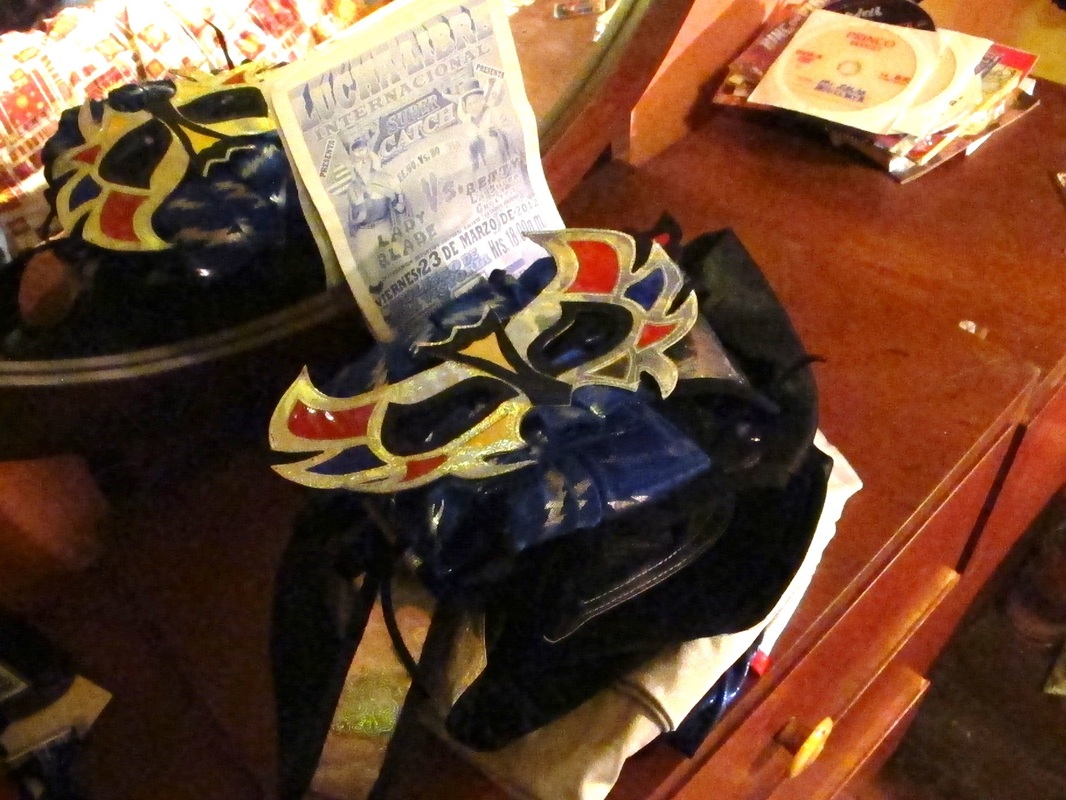
I felt like a superhero. Oh my god. And then, as if my 1980s sparkling US Olympic team gymnastics costume and silver spandex leggings were not enough, Oscar handed me a cape. A bright blue cape with silver lightening bolts. And then my manilas were laced up. And then I put on my mask. I looked in the mirror. Yes, I was definitely some sort of superhero.

When it was my turn to pose, Oscar instructed me to put my fists up. I tried to scowl through my antifraz (half-mask). And then he suggested we do one in "estilo modelo." So I put my hands on my hips and gave a sassy knee bend. I looked sideways at the camera. Though just as distant from my usual demeanor, somehow that felt more natural.

My turn was over and I walked back over to the waiting area. Tony, a mid-40s luchador from El Alto, told me “Eres muy bonita.” I responded “Me siento como WonderWoman.” Everyone laughed. But it was true. The costume does something. It makes you feel like someone else.
0 Comments
<<Previous
Forward>>


    themes

    All
    Aesthetics
    Authenticity
    Body
    Bolivia
    Chile
    Chola
    Class
    Disaster
    Drugs
    Food Studies
    Gender
    Globalization
    Indigeneity
    Inequality
    Lucha Libre
    Methods
    Migration
    Neoliberalism
    Performance
    Politics
    Protest
    Social Media
    Sport
    Tattoo
    Tourism
    United States
    Violence

    archives

    August 2022
    July 2020
    November 2019
    October 2019
    July 2018
    May 2018
    April 2018
    October 2017
    September 2017
    July 2017
    March 2017
    February 2017
    December 2016
    September 2016
    August 2016
    May 2016
    August 2015
    July 2015
    June 2015
    May 2015
    March 2015
    February 2015
    January 2015
    December 2014
    November 2014
    October 2014
    September 2014
    August 2014
    July 2014
    June 2014
    May 2014
    April 2014
    March 2014
    February 2014
    January 2014
    December 2013
    November 2013
    October 2013
    September 2013
    August 2013
    July 2013
    March 2013
    January 2013
    December 2012
    November 2012
    October 2012
    September 2012
    August 2012
    June 2012
    May 2012
    April 2012
    March 2012
    February 2012
    January 2012
    December 2011
    November 2011
    October 2011
    September 2011
    July 2011
    June 2011
    May 2011
    April 2011
    August 2009
    July 2009

    RSS Feed

Powered by Create your own unique website with customizable templates.