nell haynes
  • home
  • bio
  • publications
  • projects
  • fieldnotes
  • teaching
  • contact
  • español

informants with (not so beneficial) benefits

4/11/2014

0 Comments

 
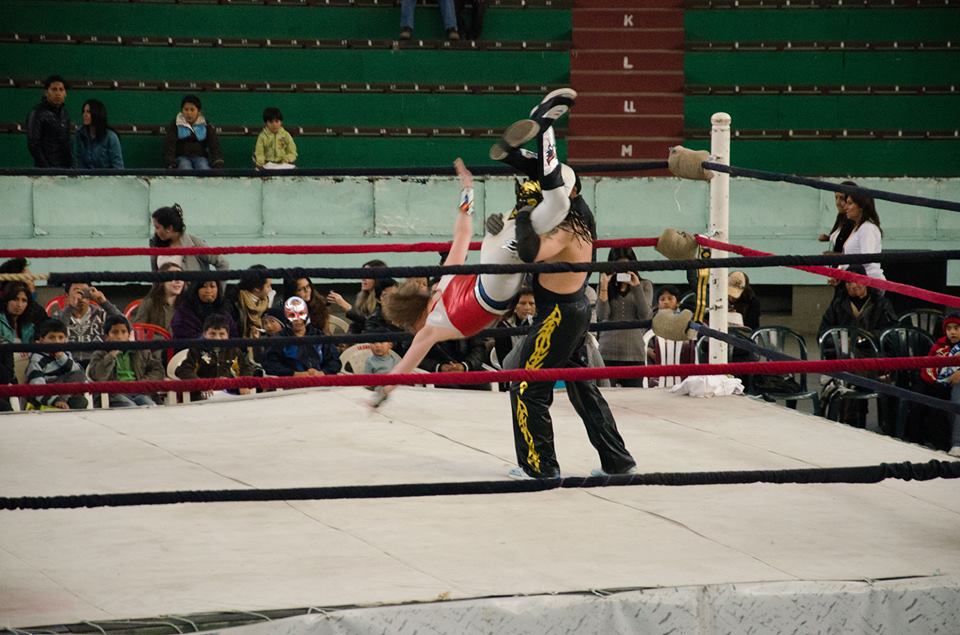
To be clear, I was always treated with kindness and respect by the luchadores while training and performing. Of course there was always an element of tension around issues of gender and sexuality. I was a white woman, highly educated, from a middle-class background in the United States. I wrestled with working-class mestizo men from La Paz and El Alto, of varying ages. Our relationships were always professional. Occasionally one would invite me to dinner at his house, and I would have to weigh several factors—our interactions up to that point, the time he had suggested, whether other people would be present, and what I might know about his current familial and romantic situation—before deciding whether to accept or reject. 

Photo courtesy of Niko Scruffy D
Picture
I rejected a request from a 50 year old luchador to accompany his family to a festival that would go late in the night, but agreed to meet him for tea later in a public restaurant in El Alto, trying not to alienate him to the detriment of my research. I accepted an invitation to a 27th birthday party for another luchador, which took place in a bar, and to which several of the other luchadoras were invited. I hoped this would allow us to be friends more than just wrestlers who train together. He tried to kiss me goodnight, but I quickly slipped away, and neither of us ever mentioned it again.

These experiences were in part because I was doing research in a male-dominated social setting. Indeed, in many ways, they served to inform my analyses of what Bolivian women might experience in their own involvement in wrestling. Of course my gringa-ness, foreignness, and lack of familial ties to anyone in the group make my situation slightly different. But these instances still tell us something about gender relations within the context.

But these experiences are not related just to my subject matter. In my current research, I have to be wary, not only of walking alone at night in Alto Hospicio, but also of the advances of police officers and public city officials when they send me non-work related Whatsapp messages. I have spoken with countless women about their similar experiences, one of whom was even evicted from her apartment in her fieldsite in a small conservative Middle Eastern  area after refusing the advances of her landlord.

To say that these experiences are frustrating is an understatement. They are not just an annoyance of daily life, but they profoundly impact one’s ability to do research, and maintain community ties. In just three short days it will be the two-year anniversary of the day I finished fieldwork. Yet I still feel the effects of these types of gendered relations.

Today I received a facebook message from one of the more senior and well respected luchadores in La Paz. At first I was flattered to receive a message because he asked when I will be wrestling again. “Quiero venir a verte” [I want to come watch you]. But the conversation quickly turned

Luchador: Your husband is Jorge*?

Nell: No, I don’t have a husband. And unfortunately I don’t know when I will wrestle again.

Luchador: Oh, then he’s your friend with benefits? That’s what he told me.

[unclear if he’s referring to ‘friend with benefits’ or marriage]

Nell: Um, no. We don’t know each other well, so I don’t feel comfortable commenting on my private life with you.

Luchador: Yes, I know you. You’re the gringuita.

Nell: Yes, of course, but we are not friends. I’m not sure why it matters to you and I find it disrespectful.

Luchador: Sorry. Bye.


*Pseudonym

And with that I most likely lost an important contact. Of course, I’m in a better position now, because my fieldwork is finished, some of it is published, and I’ve moved on to a new project. But I’m stuck now in a position of whether I even mention this to Jorge*, my former wrestling partner, and a fairly good friend. Do I continue as a friend always wondering if he is telling others that I am something of a significant other or sexual plaything to him? Do I mention it to him and confront the problem head on, most likely with little benefit either personally or professionally? Or do I assume what this older luchador said to be correct and silently stop being his friend.

I realize this is the type of problem many anthropologists face, regardless of gender, regardless of region, and regardless of topic. But as I recently wrote about the perception of women anthropologists flirting, extroverted actions of men are interpreted differently than those by women. This is something that will not be “solved” easily, particularly when we consider that many times this happens in places where there is less awareness of “rape culture,” less ability for women to participate in social life, and more complicated relationships between race, class, cosmopolitanism, and locality. I do intend to keep up a conversation about it though. 
0 Comments

tears for the red sea: watching chile lose in the world cup

4/7/2014

0 Comments

 
Picture
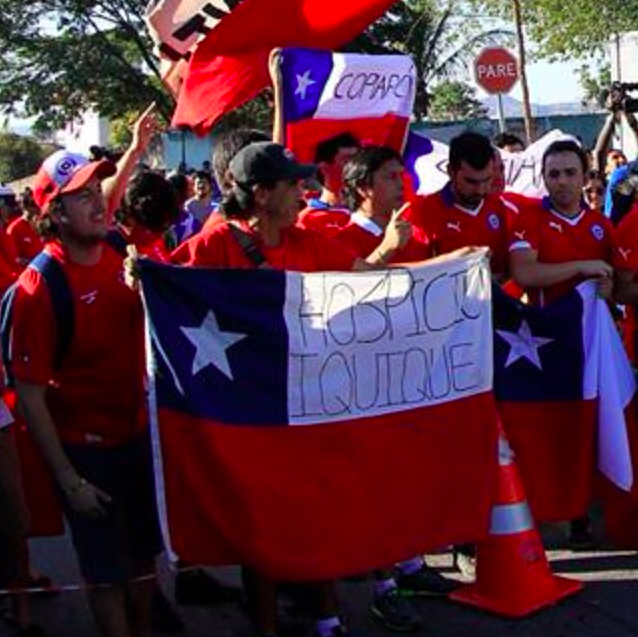
I wrote recently about the ways Chileans were watching and reacting to their team in the World Cup (both here and here). Essentially I described the way their behaviors, both on the street and on social networking sites violated the norms I have observed for nine months. While people are often ambivalent about citizenship—including both politics and belonging (see various definitions of “citizenship” including Goldberg 2002:271, Hansen and Stepputat 2006:296, Moodie 2006, Ong 2004, Richardson 1998, Stychin 1998)—when it comes to the national fútbol team, people very visually support them, decorating their homes, donning red clothing or Chilean flags, and posting wildly on Facebook, even the people who usually post very little content online.

Yet, a winning national team can easily produce such a response. The 2014 Olympics, in which the Chileans fielded only two athletes—both skiers—provide an excellent counter example. Coverage of the games was hard to find, even on the nightly news, and I didn’t know a single person who knew when the Olympic games were scheduled, let alone planned to watch. On the other hand, the national fútbol team was impossible to ignore. The supermarkets and home improvement store were covered in promotional products. Corner tiendas were suddenly filled with flag themed hats, banners, and noisemakers, and on game day, at least half of the people I passed on the street were clad in red, after the team’s uniforms. Facebook was filled with funny memes relating to the team before the game, during play with nervous statements and goal celebrations, and after with photos of people celebrating in the street. There was clearly excitement about the team’s chances. Excitement over the World Cup was not at all about being part of a world event, but was an expression of national pride and focused on the Marea Roja’s potential to come out on top.

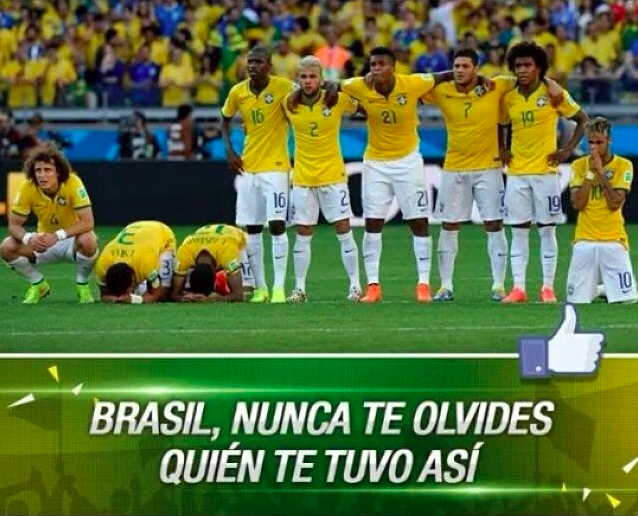
So, then, I wondered what would happen when the team lost. I hoped, of course, that wouldn’t actually happen. That they would fulfill that potential and defeat every opponent they encountered. Unfortunately, last Saturday in a nail-biting game against Brazil, in which the home team was literally brought to their knees, the Chilean team lost. As the game ended with Gary Medel crying on screen, I expected complaints from fans. Perhaps they would blame the referees. Perhaps particular Brazilian players would be singled out for exaggerated trips or other unfair play. Maybe the coach, Jorge Sampaoli would be chastised. Or possibly, even, certain Chilean players would be blamed for mistakes.

Picture
"Brazil, never forget who had you like this"

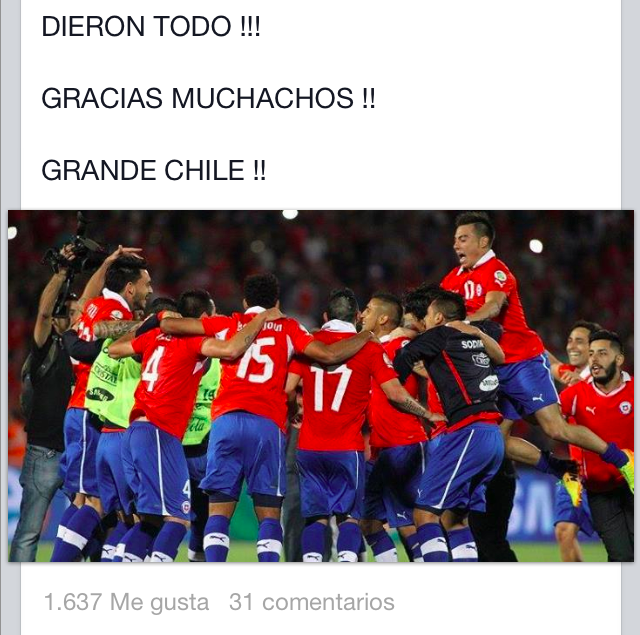
But what I found was a great outpouring of pride. “They left everything on the field,” countless memes proclaimed. Other variations included 

“Proud to be Chilean”

“They gave everything. Thank you men. Chile is grand!”

“Thanks Chilean [team] for leaving Chileans with a proud name.”

“We lost but I’m happy about the last match. Chile gave everything that they could. They beat Australia, the put the fear in Holland, they put Spain on the airplane home, and they had Brazil on their knees. I love you Chile. Conchatumareeeeee”

Picture
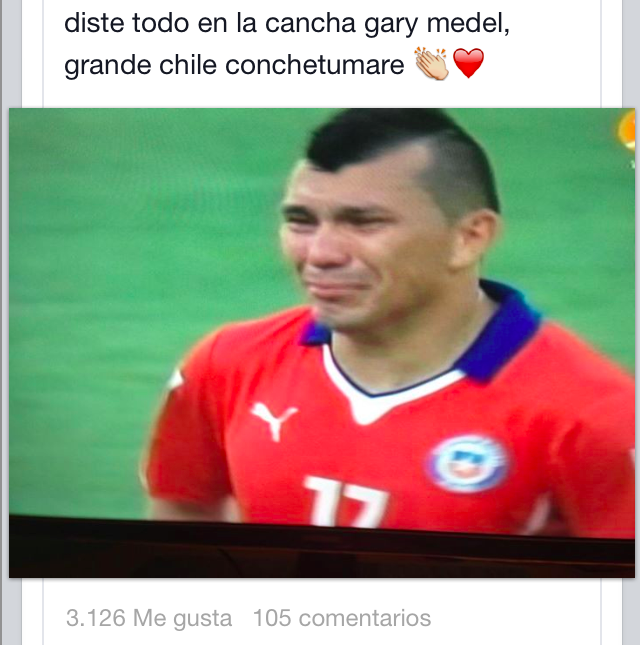
Gary Medel, who cried, was hailed as a “great great warrior.” Though I expected the typically machista northern Chileans would poke fun at his emotional outpouring, I saw no joking about him crying. Plenty of memes included pictures of his face distorted and moist with tears, but the accompanying texts were ones of pride. He posted one such picture on his own Facebook page with the text “The tears are for all of you.” This photo was shared without negative comment by six of my Facebook friends. One popular meme even depicted him with the presidential sash. Another photo shared by a neighbor depicted the whole team walking off the field with Medel shedding tears in the center. “Seeing this photo gives me great pain. Chile is grand!”

Picture
Drawing on Bernett (1966) and Riordan (1977), Joseph Alter observes that athletes are often “made into a symbol who unambiguously stands for his or her country” (1994:557) in a way that is divorced from Politics with a capital P and works at the popular political level (Rowe 1999). Athletes easily become national icons because they occupy the position of fantasy figures and are divorced from the economic infrastructure (Alter 1994). Sports can ideologically reach communities in ways that politicians and government agencies cannot (Levermore 2008:184). Cho calls the “nationalist sentiment or ideology” created and perpetuated through sport, “sporting nationalism,” and suggests that unlike hegemonic forms of nationalism such as government propaganda, this form fosters “an emotional, expressive attachment…[which] often elicits voluntary patriotism” (2009:349). Gary Medel indeed is an excellent example of the ways an athlete may become even more iconic in their moments of defeat, when their emotions both reflect those of their fans, and are reproduced on television and social media in a way that I would describe as simulacramous (see Deleuze and Guattari 1987—and yes, I did just invent the world “simulacra-mous”).

Northern Chileans still maintain that they are forgotten by national politics and leaders. Their “national pride” is not one of blind adherence to national logics, agendas, or belonging. Rather the underdog status of the Marea Roja worked in parallel with Hospiceños underdog status within the nation. Just as they proclaimed during the recent earthquake that “Hospicio is Chile too,” with the national team’s successes and even close loss, it was as if they claimed “Chile is a formidable fútbol nation too!”

Picture
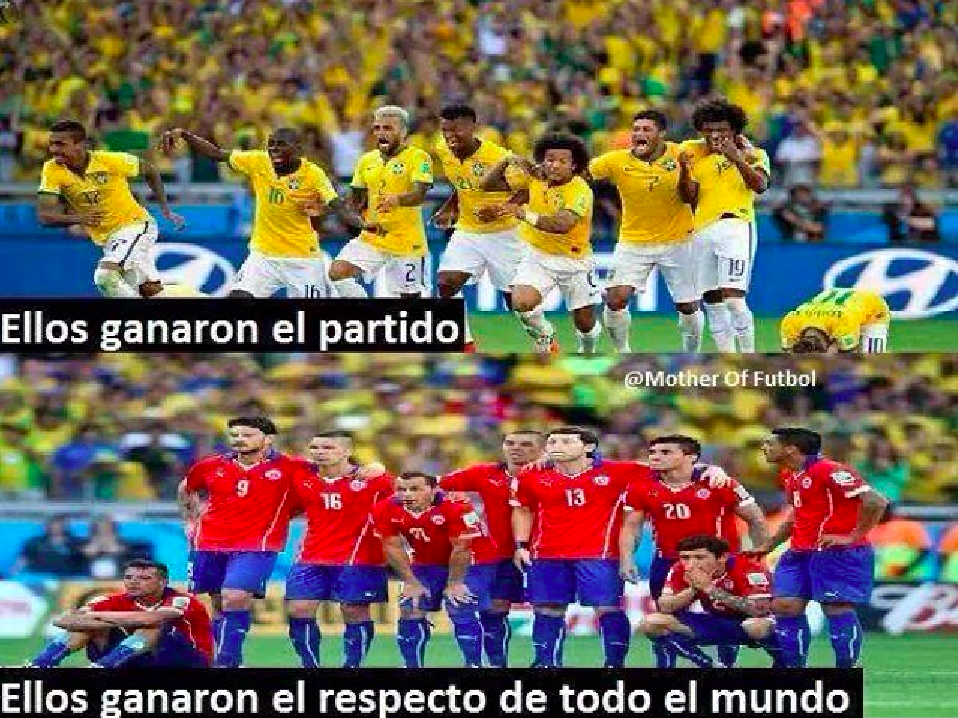
"[Brazil] won the game. [Chile] won the respect of the world."
Here is  a slide show of the "best" memes about Chile's performance in the World Cup


See my other blogs on the World Cup:
The World Cup on Social Media Worldwide
Seeing Red: Watching the World Cup in Northern Chile
Part of the Red Sea: Watching the World Cup in Northern Chile
Where is the South American Futball Unity?


Alter, Joseph
1994 Somatic Nationalism: Indian Wrestling and Militant Hinduism. Modern Asian Studies 28(3):557-588.

Bernett, H.
1966 Nationalsozalistische Leibserziehung Schorndorf bei Stuttgart: Verlag Karl Hofmann.

Cho, Younghan
2009 Unfolding Sporting Nationalism in South Korean Media Representations of the 1968, 1984 and 2000 Olympics. Media, Culture, and Society 31(3): 347–364.

Deleuze, Gilles, and Felix Guattari
1987  A Thousand Plateaus: Capitalism and Schizophrenia. Brian Massumi, trans. Minneapolis: University of Minnesota Press.Dibbits 1986

Goldberg, David Theo
2002  The Racial State. Malden: Blackwell Publishers.

Hansen, Thomas Blom and Finn Stepputat
2006  Sovereignty Revisited.  Annual Review of Anthropology 35:295-315.

Levermore, R.
2004  Sport’s Role in Constructing the “Inter-state” Worldview.  In Sport and International Relations: An Emerging Relationship. R. Levermore and A. Budd, eds. pp. 16–30 London and New York: Routledge.

Moodie, Ellen
2005  Microbus Crashes and Coca-Cola Cash: The Value of Death in “Free-Market” El Salvador. American Ethnologist 33(1):63-80.

Ong, Aihwa
2004  Cultural Citizenship as Subject Making: Immigrants Negotiate Racial and Cultural Boundaries in the United States. In Life in America: Identity and Everyday Experience. Lee D. Baker, ed. Pp.156-178. Malden, CT:Blackwell.

Richardson, Diane
1998  Sexuality and Citizenship. Sociology 32:83-100.

Riordan, J.
1977  Sport and Soviet Society. Cambridge: Cambridge University Press.

Rowe, David
1999  Sport, Culture, and the Media: The Unruly Trinity. Buckingham: Open Univeristy Press.

Stychin, Carl Frederick
1998 A Nation By Rights: National Cultures, Sexual Identity Politics, and the Discourse of Rights. Philadelphia: Temple University Press.

0 Comments

part of the red sea: watching the world cup in northern chile

26/6/2014

0 Comments

 
The very first night I spent in my field site in North Chile, the national team qualified for the World Cup. I had no television, no radio, and internet only through my smartphone. But I knew every time the team scored. Horns honked, dogs barked, whistles cut through the evening air, a dull roar of shouts bouncing off one another between the small homes, and six floor apartment buildings hung around the city like the fog that rolls in every afternoon from the Pacific Ocean. When the opposing team scored, you could hear the low rumble of grumbling viewers. By the game’s end, the horns were honking again, fireworks were being set off, and I ventured to my balcony to see people waving large flags in the street. 

Picture
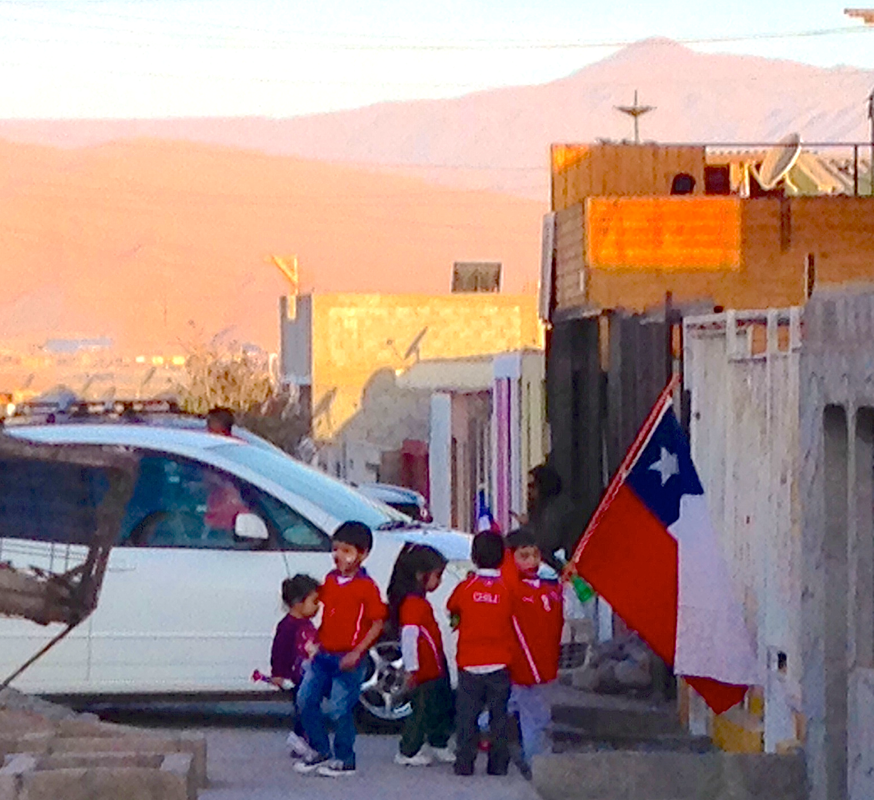
neighborhood children prepare for last week's game

On this first night it was very clear that the national fútbol team was important in this site. But I didn’t realize I would eventually see a contradiction in this. The widespread support and excitement about the team is very surprising given that most people in Northern Chile feel about they are often forgotten by the wealthier or more cosmopolitan people in the central region of the country, and are disenfranchised from national politics. My fieldsite is a working-class marginal city just seven kilometers up a steep hill from the region’s major port city, and those perched on the hill feel they have been politically discarded even within the region. It was recently voted the least liveable urban area in Chile, in part because, as I’ve written before, there is very little that is pleasing about the aesthetics of the place. Yet when it comes to fútbol, their very visible practices—wearing red fútbol jerseys, setting off fireworks, and posting a great deal on social networking sites—stand in stark contrast to their usually minimal visual expression.   

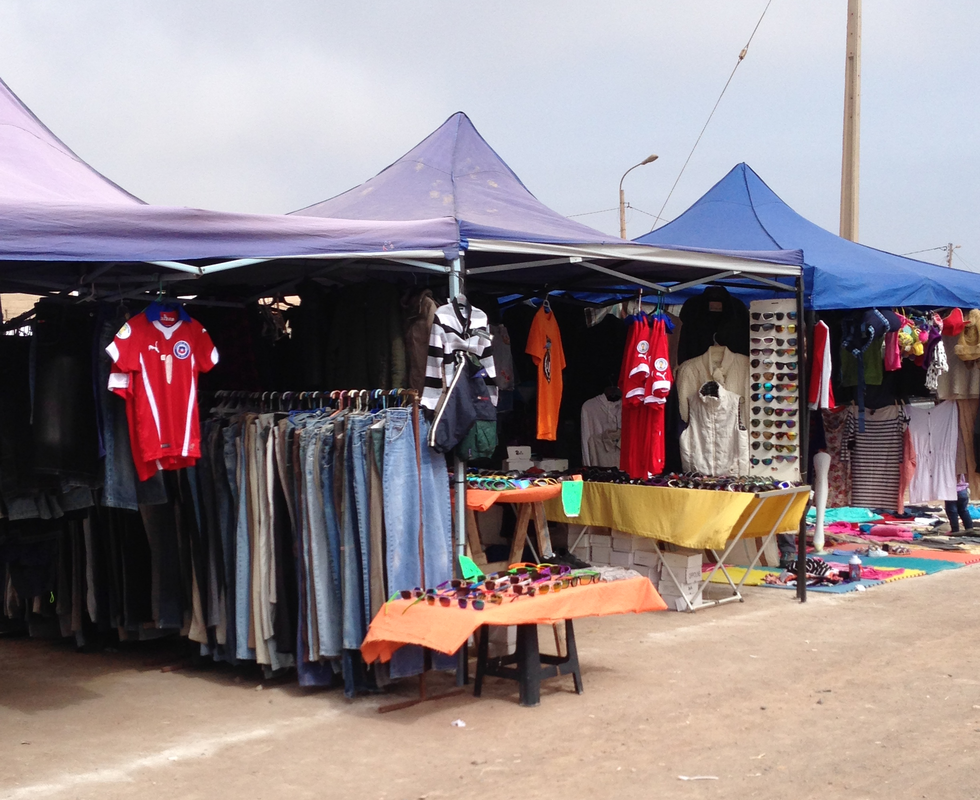
A week before Chile’s first game, Facebook was filled with humorous memes related to the world cup, from comparing the team’s bald coach, to bald reggaetón singer Pitbull. Others, in anticipation of a match against the Australian team, featured pictures of kangaroos in compromising positions. On game day, the city becomes a sea of red. At the local informal market, I noticed Chilea fútbol jerseys being sold at the beginning of June. The five supermarkets in town also offer jerseys for both the national team, as well as select others, including Brazil, Argentina, and Spain. Hours before an afternoon game begins, the sounds of plastic trumpets and car horns fill the air. The smell of meat being cooked on grills makes my stomach growl. Children, wearing pint-sized jerseys, and with faces painted like the flag, ride their bikes around the neighborhood. Seemingly every middle-aged man walking down the street carries a flag and a case of Cristal or Escudo beer, either on his way home from the corner store or to his friend’s house. Young men, and middle-aged mothers alike invite friends over to their homes to watch via Facebook post, often enticing them with photos of beer cans or food accompanied by a Chilean flag or pelota. 

Picture
fútbol jerseys for sale alongside used blue jeans in the outdoor market in Alto Hospicio

When the game starts, the whole family, and maybe some friends or neighbors gather around the flat screen television that’s positioned in the living room, or more often in the kitchen. Younger brothers are forced to wear silly wigs of hats that look like pelotas. The streets become quiet for a few minutes, until the first big play. During the first game, Chile scored after 12 minutes and during the second, Chile barely missed a goal about five minutes into the game. Once viewers have something to cheer about, the world erupts with trumpets and yells of “conchetumare” (a somewhat all-purpose expletive). After every score or close save, my Facebook feed instantly fills with simple statements such as “weon” (somewhat equivalent to ‘dude’), “vamos chile mierda” [let’s go chile. shit!], and “goooollllll”. After a victory, of which I was fortunate enough to see two, whole families exit to the street to “see what’s going on.” Fireworks are lit, people walk to the nearest plaza or to the downtown area, singing the national anthem or simply changing “Chi Chi Chi Le Le Le. Viva Chile!” Instagram is filled with photos of the crowd, selfies while wrapped in the flag, and screen captures of the television displaying the national team. A few hours later, after they’ve finished their twelve hour shift, workers in the nearby copper mines post their cell phone videos of hundreds of their coworkers erupting as they watch a goal being scored from the dining hall of the mining operation. 

These practices are much like they would be in countless other neighborhoods around the world. Except that these practices defy two of the major factors I see defining daily life in this place: an absence of attention to aesthetics, and a feeling of disenfranchisement from the nation. So what is it about sport, or perhaps the World Cup specifically, that inspires this transformation? Most people have told me they are particularly excited by the World Cup this year because Chile’s team is good, and because it is a nice reason to share time with family. Others suggest Chileans have a “spirit of clawing fanaticism…to fight and overcome hardships.” This explanation makes more sense of course in the specific context of my fieldsite where being an underdog is a way of life. Chile is a team that usually qualifies about once a decade. They often find themselves in the second round (of 16) in the tournament, but have not placed since 1962. Among the world’s best 32 fútbol teams, they are not a total long-shot, but neither are they a sure thing. And this year, being placed in what some call a “group of death,” makes that fight to overcome hardship even more exhilarating.

Yet Chileans have had reasons to hope. Rachel Riley of Countdown statistically determined that based on characteristics of past World Cup champions, Chile was most likely to win. Northern Chileans also took it as a good omen that their first game was to be played in Cuiabá which according to reports holds 33,000, inspiring allusions to the 33 miners that were trapped underground in the region just after the World Cup of 2010. Though the stadium actually holds over 39,000, Chilean sports journalists repeatedly began reports form the stadium with “Estamos bien en el estadio los 33 mil” [We are well in the stadium, the 33 thousand of us], echoing the miners’ first communication with surface search parties “Estamos bien en el refugion, los 33” [We are well in the shelter, the 33 of us]. The 33 miners even made a video in the weeks leading up to the World Cup kickoff, widely shared on social media, in which they declare, “Spain is tough? Holland is tough? We don’t fear the ‘death group’! We don’t care about death because we defeated death before!”

For more English language info on the commercial, see José Manuel Simian's writing on the NPR blog.

The Chilean national team now prepares to face home team Brazil in the second round, sure to be a tough match. Northern Chileans prepare with their red t-shirts, silly hats, 6-packs of beer, and meat to be grilled. Fútbol might just be an excuse to enjoy a rousing afternoon or evening with friends and family for some, but for others, the national team embodies the struggles and hopes of daily life. Links circulate now, about strategies Chile could use to defeat favorite, Brazil, and people are already making plans for a Saturday afternoon game. While the outcome remains unsure, it is certain that the city will be awash in red, and if by change the Chileans manage to win, I’ll join the crowd in fireworks, singing, and general merriment in the small plaza near my house. Of course, for once I’ll have to worry about my clothing. I have make sure my red t-shirt is clean for Saturday. 

See my other blogs on the World Cup:
The World Cup on Social Media Worldwide
Seeing Red: Watching the World Cup in Northern Chile
Tears for the Red Sea: Watching Chile Lose in the World Cup
Where is the South American Futball Unity?
0 Comments

the aesthetics of alto hospicio

11/6/2014

0 Comments

 
a shorter version of this post appears on the WHY WE POST blog at University College London

Sometimes, leaving “the field” and returning can be incredibly productive. Sometimes it is because it gives you time to think and plan, while in a different mindset. Other times, it is because the return throws differences into stark relief with the life one leads in other places.

Both have been true for me in the last three days. After spending a month at University College London with my colleagues, I have a much better grasp on where The Global Social Media Impact Study is going, where my part fits in, and how it relates to the other eight fieldsites involved.

But what is even more impressionable, possibly even phenomenologically so, is the sense of aesthetics that I immediately notice upon returning. In London I lived in a quaint house with IKEA furniture, on a quiet little lane in a central suburb with plenty of independently owned shops on the high street. I wore my favorite uniform—1960s style shift dresses, leggings, and mid-calf height boots—almost every day. I got a haircut, and bought new mascara, and an old guilty pleasure of Body Shop tea tree oil face wash (fully acknowledging the problematic politics of the Body Shop).

In essence I lived, looked, and thus felt, a little more like myself. The nine of us on the project collectively wrote a blog on “real methods in anthropology” wherein we describe the ways we are a bit like chameleons, and do certain things to more closely fit in as we live in our fieldsites. While this may appear as “inauthentic” to some people, we know that the self in everyday life is always a performance (see Goffman 1959), and that people are always a different version of themselves in different contexts. Yet, returning to Alto Hospicio has reminded me just how different this self is from the selves I perform in Chicago, Washington DC, La Paz, and London.

Being away has also helped me to pinpoint what it is about this place that makes me so different, and perhaps fortunately, I think what I’ve realized has quite extensive impacts for my research as well. Put simply, the aesthetics of Alto Hospicio are incredibly different from those in the other cities where I like to spend time. 
Picture
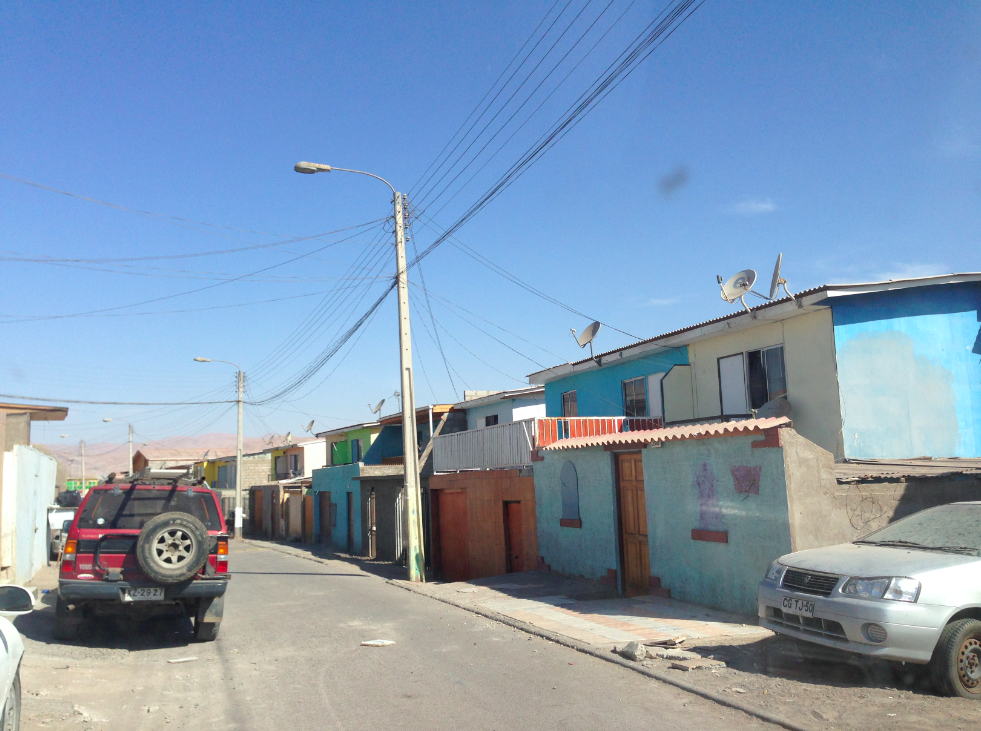
At first glance, I think to myself ‘This place has no sense of aesthetics.’ But obviously this is not true. Plenty of people tell me that they have personal styles and tastes. Houses are often painted bright colors on the outside and decorated with plenty of artificial flowers on the inside. The new municipal building in the city is architecturally pleasing. Cars are clearly modified with exterior lights, and decals. Clothing ranges from black tshirts displaying heavy metal band names to sunny beach attire. These are styles, not just reflections of function.

Indeed, to me, these styles appear as an absence. This has caused me to ruminate on what makes “middle class North Atlantic” style so different. And my initial supposition, is that it has something to do with nostalgia. My parents live in an Arts and Crafts era bungalow and have thus decorated the place in furniture reflecting that era. My best friend is slightly obsessed with Danish Mid-Century Modern design, which has influenced his furniture, clothing, and even the brand of headphones he owns. As a child, my favorite book--Anne of Green Gables—created a desire for my bedroom to have a certain country Victorian feel to it. And since my early teens I’ve enjoyed sifting through second hand shops for vintage clothing (often influenced by tv shows, from the Brady Bunch, to the Mary Tyler Moore Show, and most recently Mad Men). 
Picture
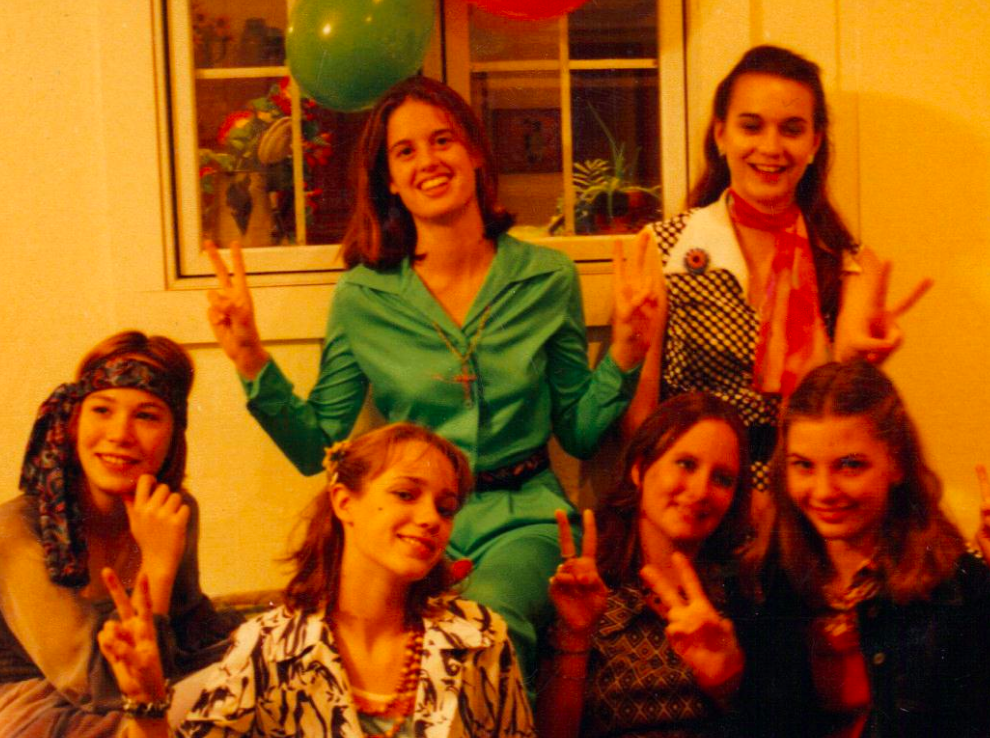
high school friends and I (far right) showing off our 1970s style in the late 1990s

In many ways we (in the cosmopolitan centers I know well) live in an age of nostalgia, however convoluted this form of nostalgia may be. We live in the age of Steampunk and Hipsters. A recent trip with my sister to the H&M clothing store in her Madrid neighborhood revealed hundreds of square feet of fashion that reminded me of my high school closet (the mid-late 1990s, for anyone who’s counting). Instagram, which appears in the square format reminiscent of now-defunct Polaroid photos, offers a plethora of filters with names like, Lo Fi and 1977 that presumably (and in my opinion, often successfully) give photos an aesthetic quality similar to those home photos of the 1960s-80s. Films like Wes Anderson's and Spike Jonze's (aside from his frequent forays into Jackass-ery) trade in nostalgic art design, and even more mainstream movies like American Hustle and The Great Gatsby use their historical settings to forefront nostalgic aesthetics. Similarly, music-of which I represent possibly the least qualified person in the world to analyze-as of late (or maybe for much longer?) has seen plenty of popular acts that pull from eras gone by (ie Sharon Van Etten, , or that damn Pharmakon remake of Nancy Sinatra/Sonny & Cher's 'Bang Bang' that no one else seems to be getting tired of). Of course, these examples are not coincidental. Indeed, nostalgia is a calculated art produced in mass by Ad executives. 

This is not to say that all aesthetics in the North Atlantic are a product of nostalgia. There are others that reflect “foreign influence” such as Japanese inspired home interiors, or Ikea minimalism. Plenty of clothing in the “latest style” is made from new synthetic fabrics in styles that have not been broached in previous eras. And much recent architecture and car design has reflected 'green' or 'eco aesthetics,' that combines cuteness (pastel colors), efficiency (small=more fuel efficient), aerodynamics, functionality (hatchbacks carry more in a smaller space), and a sense of futurism. Yet, often, to me these types of style also appear as a sort of nostalgia for former visions of the future, as they appear in representations such as The Jetsons or 2001: A Space Odyssey (but maybe that’s just me?).
Picture

In sum, these forms of nostalgia appear as absent in Alto Hospicio. Instagram photos present uninspired subjects in mundane settings without much attention to the filters or other enhancements available in the application. Facebook posts—both photos and text—appear to lack curation. One person’s clothing style is indistinguishable from the next (at least to my eyes). Houses each equally resemble lego blocks (as Daniel Miller commented to me). And even the city’s parks and plazas do very little to appear as natural refuges from city life.

The challenge however, is to first, find a way of describing this form of aesthetics without implicitly privileging the forms of North Atlantic aesthetics I described earlier, both in language and ideology. And second, to find what are the underlying currents that define these forms of aesthetics that are present. I certainly would not characterize the aesthetics of Alto Hospicio as a form of Protestant asceticism (see Weber 1958). But it is a new city, so perhaps it would be naïve to think that nostalgia would be an important structure of feeling there. Most families in Alto Hospicio are working-class so frugality and functionality may be an important part of aesthetics.

I am more than welcome to comments that might propose different forms of aesthetics, whether they be possibilities for Alto Hospicio, or presented in contrast to what I have outlined here!

0 Comments

resurrecting and remixing for youtube fame

10/5/2014

0 Comments

 
this fieldnote has also been posted on the WHY WE POST blog at University College London
Picture
The latest music craze here in Northern Chile is actually a song from 1993. Italian band Corona’s Rhythm of the Night has been stuck in the collective brain of young Chileans for the last two weeks. Though reading the song title or artist’s name might not immediately ring a bell for blog readers, the song reached number 11 on the US Billboard chart and number 2 on the UK singles chart for 18 weeks in the early 1990s. The song is admittedly catchy (to refresh your memory: the original music video on youtube ). But the circumstances of it’s recent popularity in Chile are both coincidental and very much due to a convergence of typically Chilean sociality and the ways social media functions in relation to Polymedia.

read the rest of this entry on the WHY WE POST blog
0 Comments

the 'too much information' paradox

22/3/2014

0 Comments

 
this fieldnote has also been posted on the WHY WE POST blog at University College London

Here in Northern Chile, Facebook still reigns among social networking sites. Particularly for people over 25, sites like Instagram, Snapchat, and Twitter are rarely used. And through interviews and surveys, as well as actually observing what people here do online, I’m finding that people feel far more comfortable ‘liking’ and commenting on posts rather than creating their own new content.

Picture

During an interview just last night, a man in his late 20s who I will call Sebastian told me “I see everything but I don’t write anything… If my friend writes ‘I’m angry’ I just don’t see the point. Why tell everyone? For me I like reading what my friends post, but I hardly ever post anything.” He then made fun of his sister-in-law who was also present for sometimes writing ‘Goodmorning’ or ‘Goodnight’ on Facebook. “It’s just silly. Why do you have to tell everyone something so basic? And sometimes—not you Celia, but others, it’s just annoying when my Facebook is filled with all these pointless posts and I can’t see the interesting things posted about films I want to see or friends in Argentina.” This sentiment has been echoed many times by both men and women from their early 20s to late 60s. In fact, when looking closely at around 50 different Facebook profiles from Northern Chileans, the average person only created a new status message 4 or 5 times in 2 weeks.

read the rest of this entry on the WHY WE POST blog
0 Comments

carnival los verdes: an 'adventure'

22/3/2014

0 Comments

 
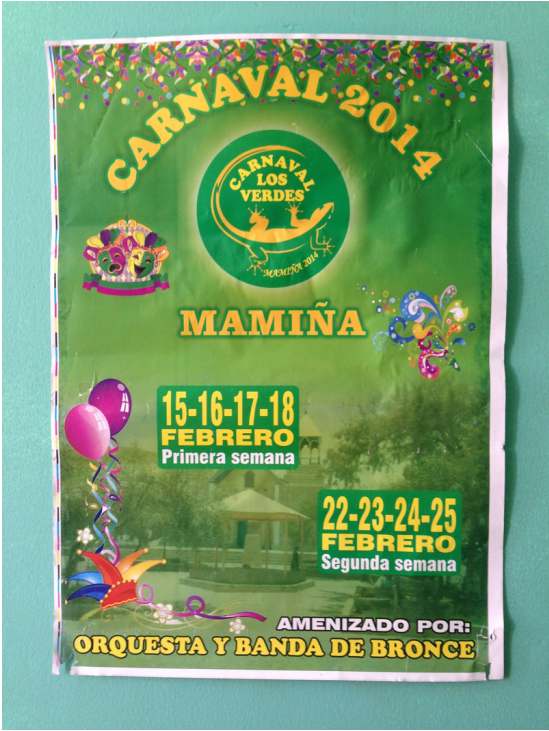
Carnaval in northern Chile does not look much like images of carnivals in Trinidad or Brazil. Celebrations range from local fiestas to parades of folkloric dancers and music, to outdoor concerts featuring national pop stars. 
Picture

I describe here, a trip by city residents to a town of 500 people for a carnival celebration. Nicole’s father grew up in this small town and the whole family was returning for the celebration. As I met Nicole and her boyfriend at the corner between our nearby apartment buildings she was already filming with her brother’s GoPro camera. 

Nicole’s boyfriend Martin and I had decided to come along just the day before, and all of the hostels in the town were booked. So, when the three of us drove into town in Martin's Jeep, we immediately set about looking for a camping spot. We found one next to a small building labeled as the city’s Social Sport Club. We set up the tents as the sun was setting and ate some rice with tuna. After cleaning up the food we walked to the center of town.

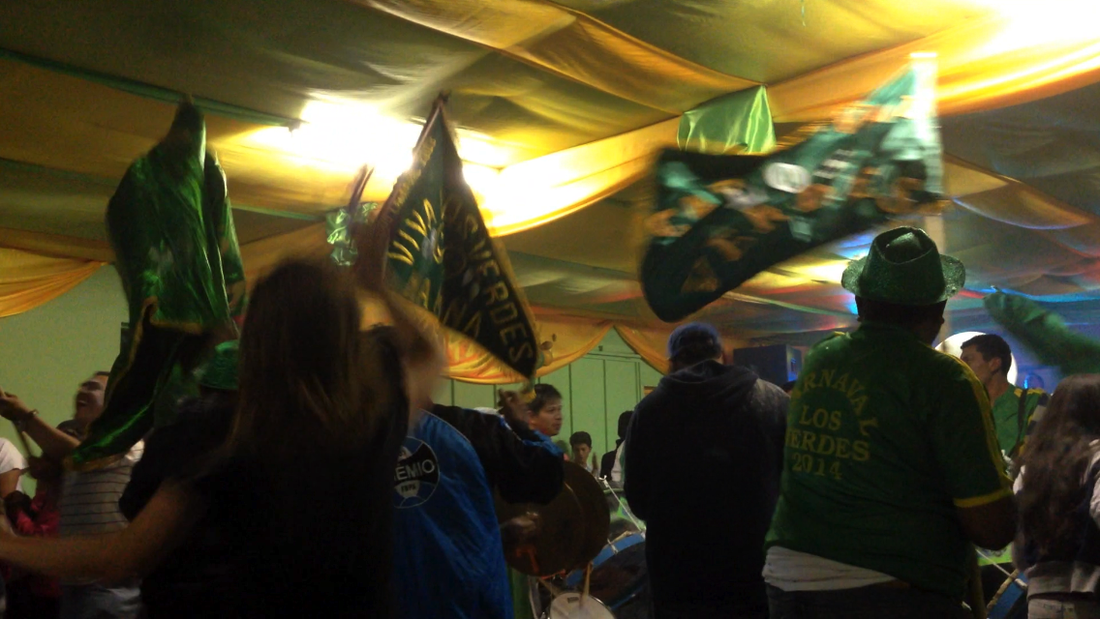
Though the permanent population is only 550, there were several thousand people in the town that night. Like Nicole and her father, many people who grew up there or have family connections return for carnival. In this town, carnival takes the form of a rivalry between los Rojos and los Verdes (the Reds and the Greens). The town is filled with triangular banners, red and green on different streets depending on the residents’ loyalties. The only explanation I was given about the different groups is that it is a rivalry to see who has the best party, the best band, the best food, and the best dancing. “I have no idea how it started,” most people told me. What strikes me as interesting however, is that in describing this rivalry, people use he word ‘pelea’ (fight) rather than ‘competencia’ (competition). Nicole told me that some times individuals from opposing groups will get into fights, but this is not necessarily condoned. Indeed, mischief rather than violence, was the overwhelming theme of the event. Silly string, shaving cream, confetti, and colored powder were constantly being sprayed or rubbed in people’s hair and faces. Yet this was within the Verdes group rather than between Verdes and Rojos. 

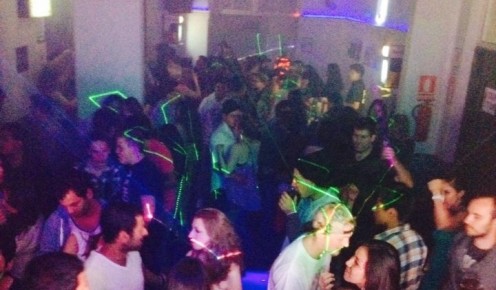
In the Verdes’ party, there was a live band playing folk music to which everyone danced, and plenty of drinking. A few people wore Halloween-type costumes, but most people wore blue jeans and tshirts. By the end of the night, everyone was covered in silly string and colored powder.

Picture

A few days later, after we had returned to the city, Nicole, Martin, and I all posted our photos on Facebook. Most were taken while at the party focusing on people drinking, dancing, or covered in powder and confetti. Two very short videos Nicole took on her cell phone also showed the event as full of people dancing, yelling, waving flags, and throwing powder. Nicole’s family also tagged her in several photos. These all seemed to capture the experience I had somewhat accurately. Certain aspects were missing, such as the stack of empty beer bottles on the table, and the delicious rabbit stew, but they were pictures of the party.

Nicole also edited her GoPro video and posted it to Youtube. Yet, this video focused far more on the trip itself. She begins by announcing to the camera “We are starting our adventure!” Set to a club remix of a pop song, the 5 minute video reminds me of a road trip montage sequence from some sort of teen movie. Desert mountains cruise by the passenger window. Images of the passengers getting out to stretch show more of the landscape. Then the video cuts to preparing and eating food at the camp site. Finally, around the 3 minute mark of the video we arrive at the carnival celebration. We enter the dance hall, where the celebration is just starting. About 15 people are dancing. There is no confetti or powder flying through the air. In fact, many people at the tables look bored. And the video fades out while each of us begins drinking a beer.

When I saw this the first time I was struck by how different the party looked through these two different media. Comments from friends made it even more clear how the two functioned in different ways. While comments on facebook photos were generally along the lines “what a great party!” comments on the video complimented the beauty of the scenery and the style of the video. It seemed that Facebook represented the place to show off the great party atmosphere of carnival while Youtube was a place for more artistic expression, focusing not only on the party, but the trip in general. Nicole confirmed in fact that she knew pictures on Facebook were more fun, but more temporal. They would disappear to the bottom of her wall in a few days, but the Youtube video would be something she would go back to and share with people in the future. She took time editing it to make it look more artistically beautiful, whereas with the fotos on Facebook, she simply loaded all that she had taken with her cellphone. Facebook was for the quick and easy. Youtube was for lasting memories. 

0 Comments

a man moves in: a photo essay from northern chile

11/2/2014

0 Comments

 
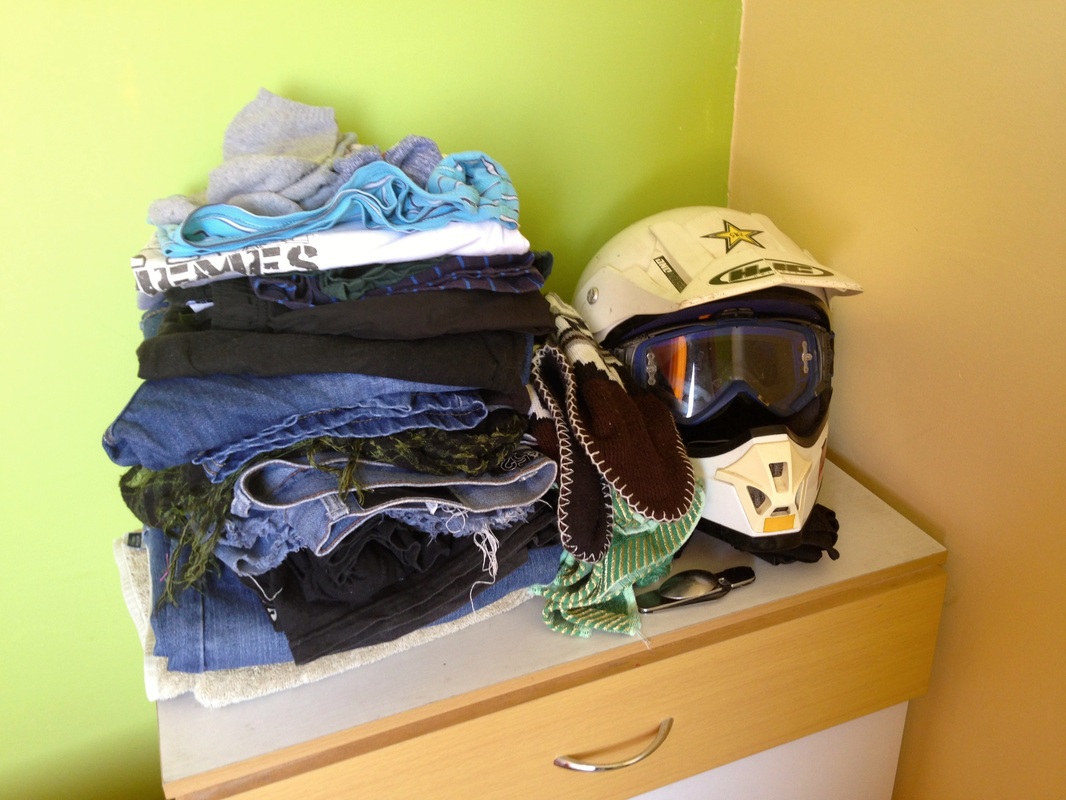
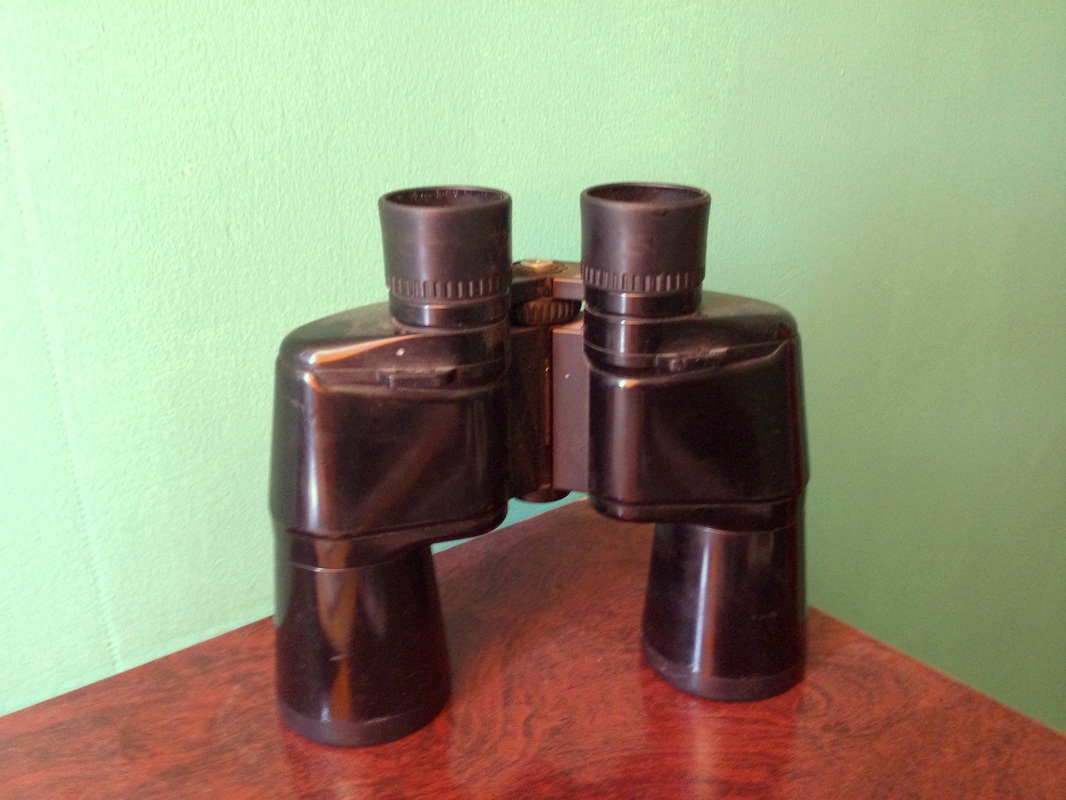
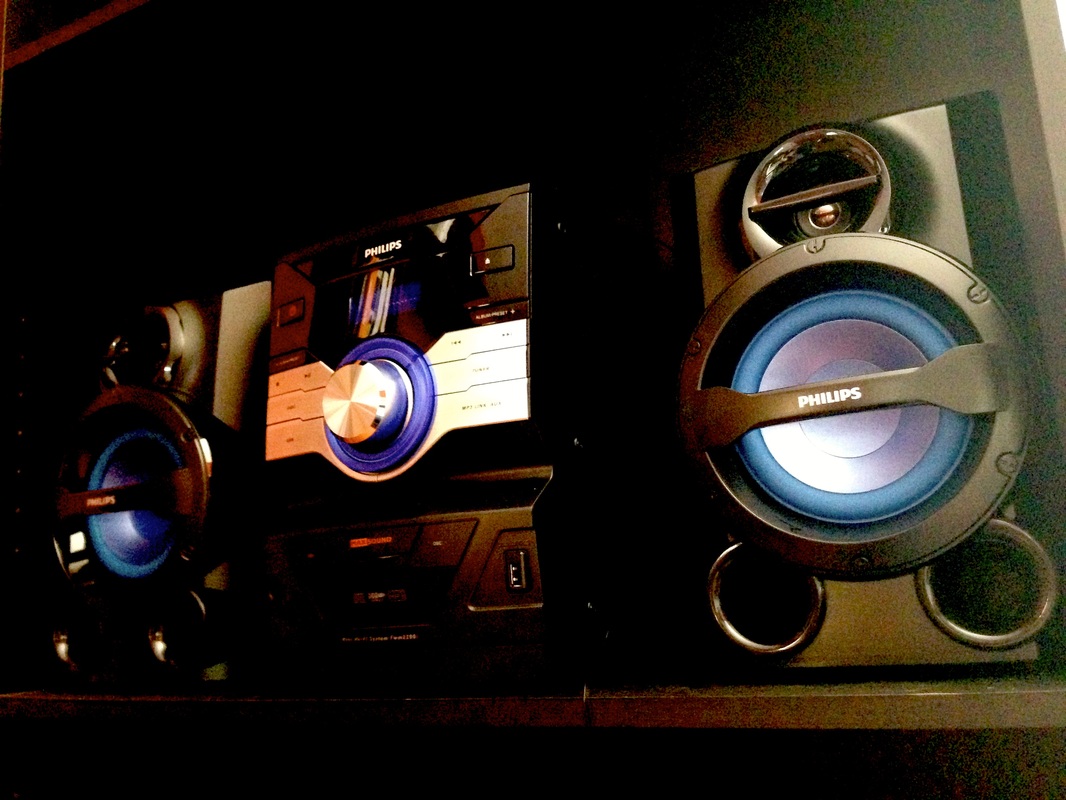
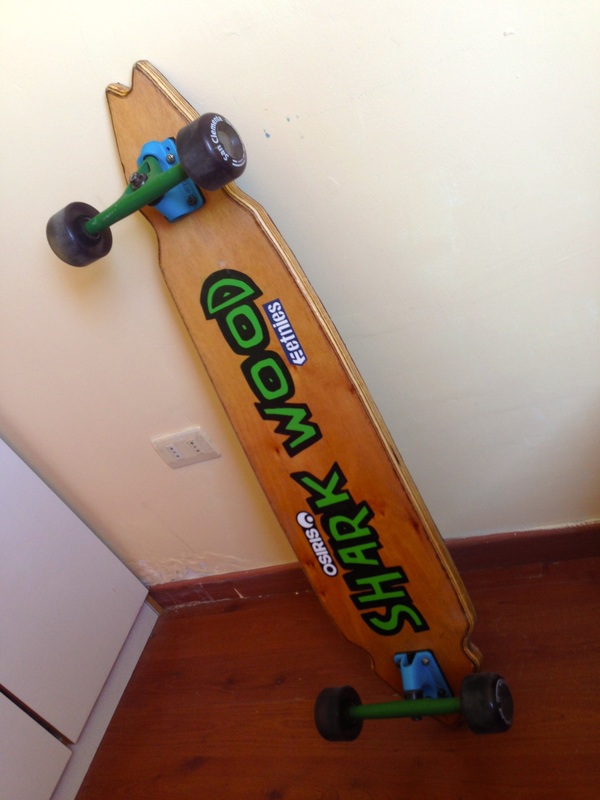
I had a unique opportunity this morning. I was given access to an apartment of a friend whose boyfriend (pololo) had started moving some of his things in. I took the opportunity to snap some shots of his stuff: the most important things for daily living he had transplanted into her space. I thought something a little different might make for an interesting post. 

Picture
the first things to appear: toiletries.

Picture
the second thing he brought over: a large, flat screen television.
mostly used for watching dvds of the walking dead.

Picture
various articles of clothing and a motorcycle helmet. 
he sold the motorcycle about a year ago, but keeps the helmet on prominent display

Picture
binoculars. 
i'm informed that so far they have only been used to watch neighbors on their balconies. 


Picture
stereo. 
a recent birthday present to himself

Picture
skateboard. 
his polola says she's never seen him use it, but he occasionally comments on hills that he deems worthy of using it on.

I suspect these items would be common in Northern Chile, but I cannot be sure. I am curious what might items might be the most important for a woman moving into her boyfriend's apartment. Would the amount of toiletries and clothing be bigger? Would the number and size of electronics be smaller? Or perhaps different in nature (hair dryers instead of stereos)? I am equally curious how these things vary from culture to culture.

I am reminded of my summers during grad school when I would pack up my car with the essentials and drive twelve hours from Washington D.C. to Chicago to spend two months with my boyfriend. Two boxes of books, a suitcase of clothes (another small duffle bag for shoes), my computer, and my bike helmet were the essentials. 

Obviously these things vary person to person, but this instant of beginning to move in with a significant other is not only important for the relationship. The things we move with us first, the things we deem most essential to daily life, these items of material culture give a unique and deeply revealing look into a person. 

I'm curious what other people have taken or would take when beginning to move in. Whether it is with a significant other, a friend, or simply an extended stay with family-what are the essential material possessions you take with you? Please leave a comment!
0 Comments

visibility and the mundane selfie

7/2/2014

0 Comments

 
The selfie has been the subject of much discussion in recent times, from valuations of vanity to criticisms of public figures taking self-portraits at solemn events. But the selfie is more than narcicism or pathology. For anthropologists, it can actually tell us quite a bit about daily life, leisure (or not so leisureful) time, and notions of beauty.

About a month ago, I began analyzing the Instagram feeds of almost 75 residents of Alto Hospicio, most of them under the age of 25. Certain aspects of their Instagram usage were not terribly surprising. The example I present here is the selfie. Of their last 15 photos, all users averaged about 6 selfies (this was also fairly consistent between young men and woman, with only a .07 average difference). But what was surprising was the lack of artistry that seemed to be attributed to these photos. Filters were used, but subject matter was not particularly “beautiful.” Shots were not composed with symmetry, with horizontal lines leveled, or with the rule of thirds in mind. Neither were shots noteworthy for their “rarity.” As Jon Snow of Chanel 4 tells Nimrod Kamer in his short Guardian video about selfies, “I think if you’re somewhere rare, it’s worth [taking a selfie], or if you’re doing something rare, it’s worth doing it.” (see min 2:55-3:05 of the video below). 


But these photos are taken in family living rooms, while at work, and the backseat of an older sibling’s car. The exact places the users traverse every day. The definitive opposite of “rare.” Instead, they are taken in utterly mundane places. The ubiquity of mundane photos corresponds closely to Daniel Miller’s assertion that the intention behind photography is now not so much to produce a photograph, but that the photography legitimates the act of taking a picture. The transience of Instagram also legitimates the mundane self-portrait. It is not a portrait meant for a display of beauty, but rather a document of the moment. In this sense, it’s intention to amuse in the moment (or short period of time thereafter). It not only is briefly entertaining in the instant of taking the photo, but provides entertainment for a friend or follower who might view the photo. Further, through collecting likes and comments, the mundane photo may serve to break up a mundane day for the user. 
Picture
mundane photos in cars and at work

The other most common form of self-portrait was the “sassy” photo. These appear like fashion magazine photos aimed at showing off clothing. They are often either taken in the mirror or by a friend. Hands are often on the hips, or in another “fashion model” sort of pose. It is important to note the difference here between sassy and sexy. Though the line between the two can at times be ambiguous, sexy photos usually involve the subject with little clothing, lying on a bed, or showing cleavage or abs. Sassy photos on the other hand are the type your mother might comment “Oh, you look so cute!” Notably, in these sassy photos, the clothing that is being shown off is rarely overly stylish. Hair is usually not noticeably done for a special occasion. Though these certainly pop up when people attend formal events (such as weddings or graduations), they more commonly appear with every day clothing and style. 

Picture
sassy photos

The point of understanding self-portraits, including selfies, is that it lends us information about conceptions of attractiveness and beauty among particular groups of people. And attractiveness is something that most people think about when posing for a portrait that they will then share with their networks. This is evident here from bodily poses and facial expressions. Both are chosen in these photos, meaning there is an explicit, self-conscious presentation of the self.

However, what seems quite clear to me, given the number of mundane photos and sassy photos that display everyday clothing and hair, is that people’s sense of what forms of attractiveness are worthy of display are actually quite “normal.” This is reinforced by my observations in Alto Hospicio in general. People are rarely dressed nicely. Jeans, shorts, and t-shirts are the norm. It is rare to see women in dresses or fancy tops. Most men wear sneakers and most women wear flip flop sandals. Women especially wear bright colors. Men also generally wear t-shirts, though during the week it is not uncommon to see men on their work lunch breaks wearing plaid short sleeved collared shirts with jeans. 

I’m reminded here of two different critiques of “critiques of selfies,” which both have come from self-identified “feminist” bloggers. The first, The Young Girl and the Selfie written by a woman who is an ex-PhD student in sociology, suggests that the selfie, represents the perfect contradiction of late-capitalism: young women’s bodies’ are both a target for consumption (particularly for “beauty” and “style” products) and judged not by those who inhabit them, but by those who gaze upon them. Thus, the selfie is the logical outcome of this combination of pressures. And when the selfie is demonized, it becomes “simultaneously the site of desire and pity.” Teen girls are “Young-Girls” [a type, not individuals], are spectacles, are narcissists, are consumers, because those are the very criterion that must be met to be a young woman and also part of society.

The second blog, The Radical Politics of Selfies goes beyond this first piece, arguing that while perhaps selfies may reflect “the way society teaches women that their most important quality is their physical attractiveness…not all [people] are allowed to see themselves as beautiful, desirable, sexy, or fit for human consumption.” For many, mass media representations of people who look like them are nowhere to be found. Magazines, television, movies, and advertisements depict people who are so far from physically similar to women of color, queer women, differently-abled people, and even people with a high percentage of body fat, that they are not only an unrealistic ideal, but have little to no resonance. Thus, the author concludes, that social media allows for people who do not fit these molds to find (and produce) proper representations of themselves.

Alto Hospicio is the kind of place where people do not look like the actors in television shows they watch. They do not look like the news anchors on CNN Chile, let alone the South American telenovelas that most middle-aged women watch. They are generally darker skinned, shorter, wider, and have more indigenous features. And to dress or otherwise present themselves as such might not be authentic. Even though the city is a melting pot of Northern Chileans, Southern Chileans, Bolivians, Peruvians, and Colombians, they generally all blend together in a homogenizing soup of “normalness.” No one really stands out. Skin tones range from the light tan of mixed Spanish/Indigenous/German heritage to the dark tone of Afro-South Americans, but the casual clothing, low-maintenance hair styles, and lack of other physical beauty accents brings everyone together. Thus, perhaps the selfie acts as resistance against erasure: within this homogenizing crowd, for the region that is often forgotten politically and lacks representation in media.

0 Comments

how to dress like an anthropologist

4/12/2013

0 Comments

 
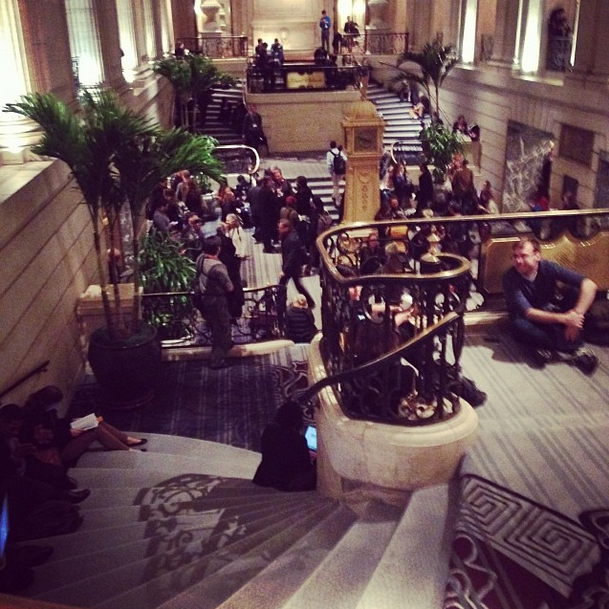
As the AAA (American Anthropological Association) annual conference descended upon Chicago a few weeks ago, the blogosphere and twittersphere (are those words?) were abuzz with everything even remotely anthropological. My favorite post of all, not surprisingly came from Savage Minds, and was titled “Conference Chic, or, How to Dress Like an Anthropologist.”
Picture
anthropologists buzzing around the hotel lobby at AAA

Now, this is not the first time I’ve scooped Savage Minds (the post in question)...But back in February 2012, I wrote a fieldnote titled “How to Dress like a Tattoo Artist.” Therein, I analyzed, discussed, and lightheartedly critiqued the ways my tattoo artist friends in La Paz dress. I concluded that “their bodies, in some ways more than other [people’s bodies], are obviously constructed…but though the specifics might differ, their bodies are constructed through the same processes as everyone else’s.” 

These processes include, as outlined by Donald Lowe (2005), the work we do, the commodities we consume, and the politics of gender and sexuality [and I would add religion, race, class, etc, etc] to which we ascribe or aspire. In other words, these bodies (all bodies) flexibly accumulate markers through consumption, production and processes of identification. And though obviously much of this works through commodified symbols, most anthropologists are aware of, if not actively critiquing, the contradictions of the capitalist system and the social problems associated with consumptive practices of the late modern era. In short, many of us would not be caught dead in the middle of an anthro conference wearing something that everyone knows was made under unfair labor conditions, mass-marketed, cost more than a day’s salary, or looks too ‘mainstream.’ 

Thus, the non-commodified symbols carry perhaps more weight with anthropologists than with many other groups (though even with both tattoo artists and backpackers in South America, these are incredibly important). Savage minds lists six categories of anthropological fashion/fashion concern: “anthropological” fieldsite flair, professional-but-not-too-professional balance, critique of capitalism and consumerism, career-stage, subdisciplinary distinctions, and scarves. 

Yes, scarves get their own category, as they well should.

Picture
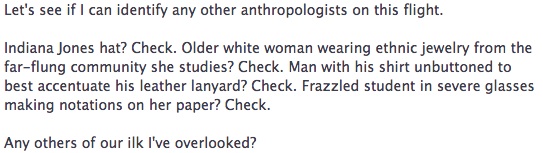
a colleague’s facebook post about her flight from DC to Chicago for AAAs

For me, the two that most reflect what I wrote about tatuadores are fieldsite flair and the critique of consumptive practices (though I think professional balance could be a subset of this). Both are in the service of authentification, but work in different ways. 

Firstly, to keep in mind the problems that arise from the ubiquitous consumptive practices of late-modern capitalism is not only about acknowledging global inequalities and all of the exploitation (of people, non-human animals, and natural resources) that is necessary to produce and sustain such a system of production and consumption (and that obviously is a very important part of it), but is also about performing as a person who is concerned about these things. Because as anthropologists, at least in this century, we are concerned with issues of social justice, to be ignorant or dismissive of these problems would mark one as uncritical, and thus something of a not so great anthropologist. Thus, to dress smartly, thoughtfully, but not entirely professionally, and certainly not in a way that overtly supports unjust productive and consumptive conditions, is to perform authentication (Bucholtz and Hall 2005:500) as an anthropologist. 

The flair component of dress performs authentication of another requirement of anthropology: fieldwork. Because anthropology prides itself on use of ethnography, long-term engagement with a fieldsite, and integration into communities in which we study, to wear things that come from or reflect the places we work becomes an important performance as well. Of course at times these things remind us of those to whose kindness and help we owe our information and lifework. But they also are something of a symbol to show to others not only where we work, but it’s importance to us, and that yes, we actually spent enough time in the field to find a beautiful stone necklace, to acquire a beautifully embroidered blouse, or even to be given a tshirt promoting a local business. 

And so, in the ways we dress, anthropologists often reflect the twin pillars of anthropology: theory and practice. Savage Minds quotes Carla Jones: “I suppose it is unsurprising that anthropologists are invested in what we wear at AAA, after all this is our social community. Who better than we understand that social meaning is generated through symbols?” Like the very tattoos that tatuadores wear, some symbols are important because of the social capital they connote, rather than their economic worth (use value rather than exchange value to put things in Marx’s terms).

And scarves are just important because they are awesome.
Picture
I show off fieldsite flair with my bolivian necklace, and of course, it’s paired with a scarf

And now, as a nod to perhaps my only consistent blog reader, I shall end with a question. What do you wear (at academic conferences or otherwise) that involves some sort of symbol? Is it conscious or ingrained that you do so? And what do you definitely not wear because of what it symbolizes?


References:

Bucholtz, Mary and Kira Hall
2005 Identity and Interaction: A Sociocultural Linguistic Approach. Discourse Studies 7(4-5):585-614.

Lowe, Donald M.
1995 The Body in Late-Capitalist USA. Durham: Duke University Press.

Further reading:

Adkins, Lisa and Celia Lury
1999  The Labour of Identity: Performing Identities, Performing Economies. Economy and Society 28(4):598-614. 

Atluri, Tara
2009  Lighten Up?! Humour, Race, and Da Off Colour Joke of Ali G. Media, Culture, & Society 31(2):197-214

Halberstam, J.
1998  Female Masculinity. Durham: Duke University Press.

Mort, Frank
1998  Cityscapes: Consumption, Masculinities and the Mapping of London since 1950. Urban Studies 35(5-6):889-907.
1995  Archaeologies of City Life: Commerical Culture, Masculinity, and Spatial Relations in 1980s London. Environment and Planning D: Society and Space 13:573-590. 
0 Comments
<<Previous
Forward>>


    themes

    All
    Aesthetics
    Authenticity
    Body
    Bolivia
    Chile
    Chola
    Class
    Disaster
    Drugs
    Food Studies
    Gender
    Globalization
    Indigeneity
    Inequality
    Lucha Libre
    Methods
    Migration
    Neoliberalism
    Performance
    Politics
    Protest
    Social Media
    Sport
    Tattoo
    Tourism
    United States
    Violence

    archives

    August 2022
    July 2020
    November 2019
    October 2019
    July 2018
    May 2018
    April 2018
    October 2017
    September 2017
    July 2017
    March 2017
    February 2017
    December 2016
    September 2016
    August 2016
    May 2016
    August 2015
    July 2015
    June 2015
    May 2015
    March 2015
    February 2015
    January 2015
    December 2014
    November 2014
    October 2014
    September 2014
    August 2014
    July 2014
    June 2014
    May 2014
    April 2014
    March 2014
    February 2014
    January 2014
    December 2013
    November 2013
    October 2013
    September 2013
    August 2013
    July 2013
    March 2013
    January 2013
    December 2012
    November 2012
    October 2012
    September 2012
    August 2012
    June 2012
    May 2012
    April 2012
    March 2012
    February 2012
    January 2012
    December 2011
    November 2011
    October 2011
    September 2011
    July 2011
    June 2011
    May 2011
    April 2011
    August 2009
    July 2009

    RSS Feed

Powered by Create your own unique website with customizable templates.