nell haynes
  • home
  • bio
  • publications
  • projects
  • fieldnotes
  • teaching
  • contact
  • español

521 years of resistance

12/10/2013

0 Comments

 
Today is 12 of October. In the Midwest, where I went to elementary school, this is known as Columbus Day. Later, as I gained a bit more worldly perspective I came to call it Indigenous People’s Day or Genocide Day under my breath. A few days ago, I got upset when my mother, who is a second grade teacher, mentioned she had Columbus Day off—partly because it is still institutionalized and partly because she called it Columbus Day without a hint of critique. But I’ll cut her some slack. When I’m in central Illinois she usually lets me come talk to her class about colonization. And the amazing thing is, when you explain that colonization was simply a bunch of Europeans who wanted to take the resources on another continent and felt it was necessary to murder, enslave, rape, and destroy the residents of that place in the process, even 8 year olds are pretty quick to realize that this is not something to be celebrated.

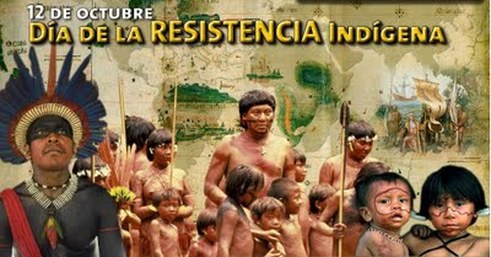
I arrived at the Preuniversitario where it was held around noon and was immediately asked where I’m from. I felt a little defensive and said that Raquel had invited me and hoped it would be ok if I could just stand in the back and watch. And then I realized the woman had asked me because all of the other audience members had pin on badges that announced what country they are from. Chile and Peru dominated the group of 50, but there were a few small nametag-sized Bolivian, Ecuadorian, and Colombian flags pinned to shirts as well. Unfortunately there were no United States pins on hand, but they were happy to have me. The chairs were all full, so I stood along the back and watched a slide projection on the front wall. There were pictures of Alto Hospicio and various local groups interspersed with graphical slogans such as “12 de octubre, 2013: 521 años de resistencia” [521 years of resistance] and “Por la dignidad de los pueblos americanos, 12 de octubre nada que celebrar” [For the dignity of american peoples, 12 October is nothing to celebrate].
 
Picture
The program began with a Chilean Cueca dance performed by two pairs adolescent boys and girls. Then the Ecuadorian woman who had greeted me earlier performed a pop song from her country. Representatives from the Colombian and Ecuadorian immigrant associations in Iquique spoke. An Afro-Peruvian woman sang two more songs, and several community figures and political candidates spoke briefly. Scattered throughout all of these various performances were discourses about the unity of the Americas against Europeans and Gringos (“that’s me!” I thought…). The Peruvian singer shouted several times over the boombox that accompanied her “America Latina es una sola!”

As the last local leader was speaking, Raquel came and stood next to me at the back. She asked if I could stay for the reception afterwards because she’d like to introduce me to a few people. I accepted and met several of the people she works with at the Preuniversitario along with being coerced into eating plenty of bocadillos, ceviche, and grilled shrimp.

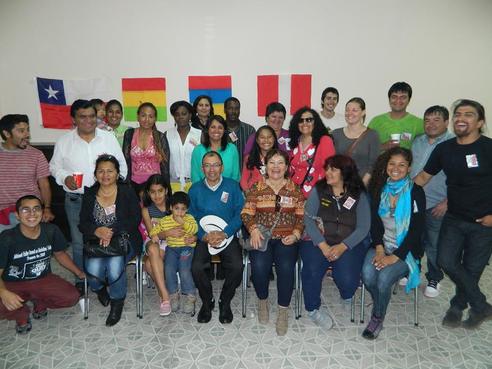
As the reception was ending, Raquel’s friend Juan called everyone to the back room to take a photo. I lingered in the front room, but he singled me out saying “You too, Nell. You’re from the Americas. We need our representative from the United States present.” So I followed the crowd to the back, where we rearranged ourselves a number of times against a backdrop of handpainted paper flags, and finally got a decent shot (well, you can be the judge). 
Picture
There is certainly some multicultural pride here in Alto Hospicio, at least when it comes to public presentation. And the mix of anti-colonial and multi-cultural discourses was interesting, but not surprising given what I’ve seen here so far. But what I find most interesting is the memorialization that occurs through such events. Though the focus is on celebration and community, it is framed by this discourse of resistance to colonization and a memorialization of a past that continues to influence present events. One of the SocNet themes of focus is on the way memorialization occurs through social networks (see Shriram Venkatrama's account from India here). I’ve been keeping my eye out for Facebook pages dedicated to individuals who have died, but perhaps more important are these ways of memorializing political events and figures, not only online but in real life events, and the naming of institutions (more on that in the next post!). 
0 Comments

staining the sacred cow

13/8/2013

0 Comments

 
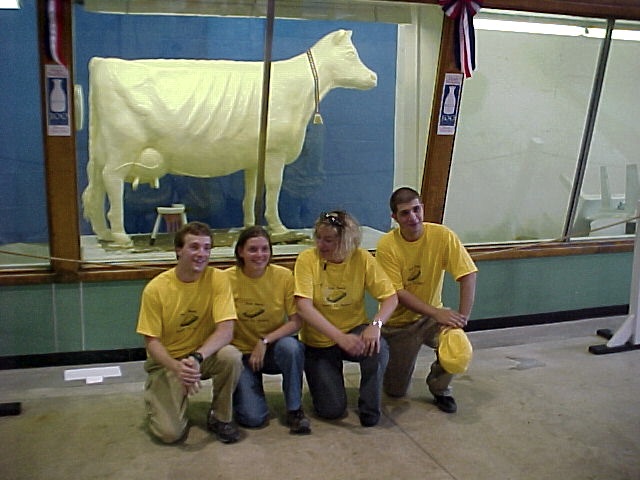
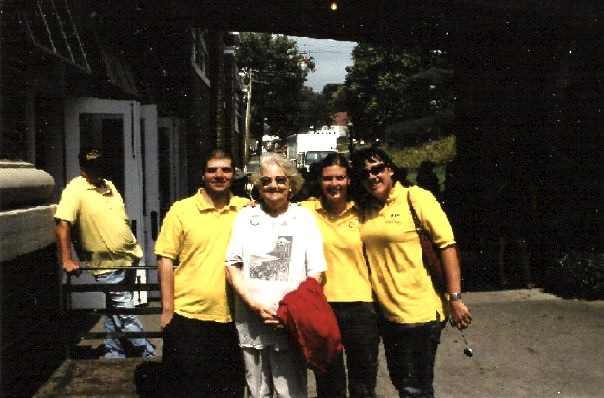
It has been exactly 10 years since I first attended the Iowa State Fair. It has been 7 years since I last attended. I am still adamantly in love with the ISF to a fault. Ten years ago the film crew I worked with spent hot, sweaty august days lugging cameras into refrigerated rooms filled with molding butter and accompanying Norma Duffy Lyons to her daily lunch of state fair Chinese food. We spend the nights sipping Stroh’s beer around a campfire and listening the The Hawk radio station 97.3. And by the end of the summer we had over 40 hours of tape (which, as far as I know is still unlogged and unedited). I joined this crew because I had loved the Buttercow in Illinois as a child, but by August 20, 2003 I was a true believer in the Buttercow of Iowa.

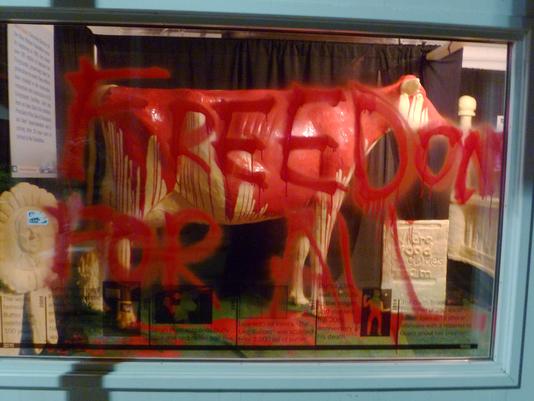
So you can imagine my horror when I learned yesterday that an animal welfare group poured red paint on the Buttercow in protest (read the story via NPR). 

Picture
USAToday photo

I was at a baseball game with my parents when I received word via email on my phone. “Oh no!” I gasped, and my mother thought I had read that a friend was in some sort of trouble. I told her the news and my honest first commentary was “don’t they know they reuse the butter for four years?”

I think it’s important to contextualize my comments here and note that at the time of documentary making, I had been vegetarian for seven years. I was never vegan for more than a month (yogurt! goat cheese! honey! beautiful leather frye boots!), but I made it a full twelve years of vegetarianism before giving up during fieldwork in Bolivia. I now quite enjoy fried chicken, pork chicharones, cuy (roasted guinea pig), and anticuchos (grilled beef heart), among many other forms of meat. But I also still truly believe that vegetarianism is far more environmentally friendly and sustainable than regular meat-eating. That said, I ultimately recognize that one’s ability and desire to eat meat or not are substantially culturally influenced. Things like purchasing power, national location, regional location, local location, racial identity, gender, religion, subcultural affiliation or identification, and who knows what else profoundly structure not only what we perceive as desirable food but also what we are physically able to eat.

So my reaction is more complicated than it may appear. Though I don’t generally condone destructive practices as protest, I also don’t wholly disagree with the protestors’ intentions. Helping to thaw 600 pounds of overly cooled butter by running my hands through it may have improved it’s consistency for sculpting but also made me shun the stuff for more than a month. There is something foul and inedible about massive amounts of dairy product. But in the end, with my apologies to anti-speciesist friends, I have to conclude that the protestors’ actions were misguided. 

Picture
the original film crew

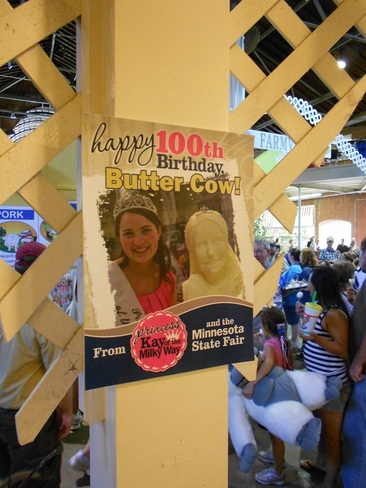
Back in 2007 I argued that the Buttercow was a symbol of citizenship in the sense that in it’s iconicity it represented pride and intimate knowledge, moving beyond citizenship as simply claims to rights and responsibilities. I returned to this argument when writing for the Food Culture Index blog, suggesting that Minnesota Dairy Princess Katie Miron connects butter art to Midwestern values using words like “hard work,” “dedication,” “wholesome,” and “nutritious.” Butter art for her is a way to both reinscribe these values within the community, and communicate the values to outsiders. Like the colonial map, it demarcates “us” from “them,” and acts as a logo, and becomes a “pure sign” or emblem for a certain kind of community affiliation.

And, like all icons, the Buttercow adapts to symbolize prevailing social issues and political perspectives. What was once a symbol of progress, now has come to be a nostalgic representation of a disappearing way of life. As family farms disappear and Concentrated Animal Feeding Operations replace them, the Buttercow stands as a testament to the value placed on farmers who practice true animal husbandry and forms of agriculture that stand in opposition to the CFO’s that have become so ubiquitous. The 600 pounds of butter used in Illinois’s Buttercow comes from Prairie Farms, which is a farmer owned cooperative whose cows are free range and 100% hormone free. Put simply, to it's supporters, the Buttercow is a symbol of family farmers who intimately know and care for their animals, and is seen as oppositional to the forms of industrialized agriculture that exploit animals to their breaking point before discarding them.

Of course, many animal liberation groups see no distinction between large scale animal exploitation and that which is family owned. But that is precisely my point. In ignoring or misunderstanding the distinction, I believe such protestors are alienating those who could be powerful allies. And besides, pouring red paint on the butter only means that instead of reusing it next year, they’ll have to get a brand new 600 pound batch.


see my writing at food culture index or hit the "butter" tag to the right to see my earlier fieldnotes
0 Comments

why i don't wear a pollera

2/7/2013

0 Comments

 
On my first day of training, when Edgar asked if I’d rather my traje have pants or a pollera, I immediately knew pants made more sense. Perhaps they would not provide the visual beauty of a pollera swirling through the air, but they certainly would be easier to wrestle in. And Edgar was not the only person who suggested I wrestle in a pollera. The LIDER luchadoras, Juanita and Benita were constantly trying to get me into one. On a Friday afternoon while we sipped coffee at a stall in Mercado Lanza, the two giggled trying to decide what color pollera would look best on me. Juanita was wearing a blue sparkly shawl and Benita’s was white. They took turns holding them up to my fact to see what color would look nice on a gringa. Even at my dissertation defense, I was asked why I didn’t wear a pollera to wrestle. 

Picture
during my dissertation defense, I explain-oh so eloquently-why I do not wear a pollera to wrestle 

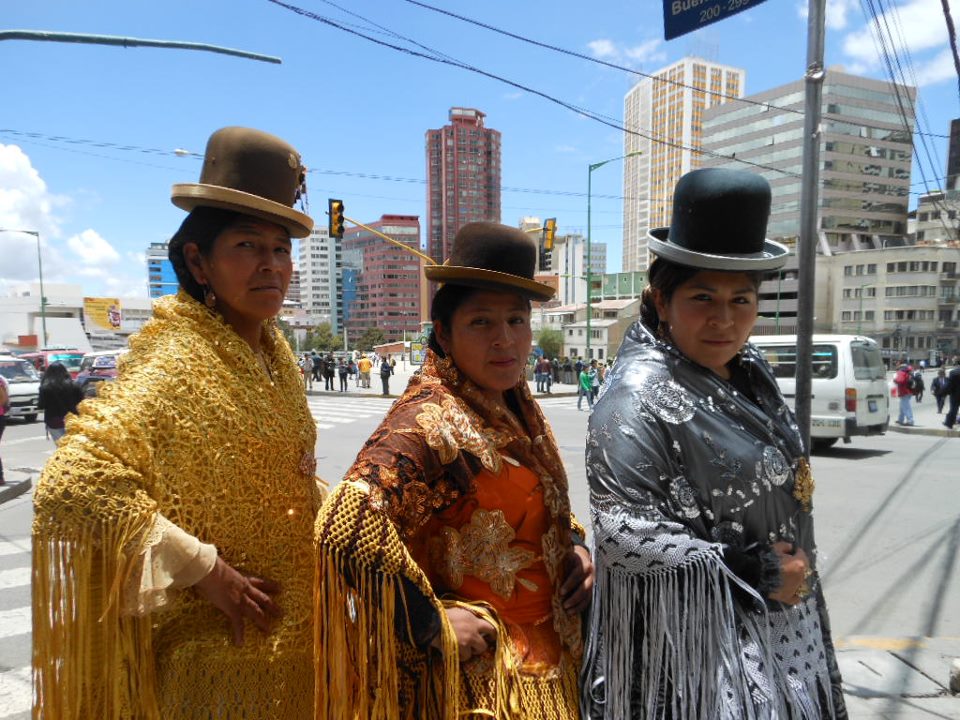
My answer, simply, is that I have no right to wear a pollera. The pollera is often considered to be the most visible symbol of Bolivian indigeneity, which is not just a racial category, but a class-based subjectivity and a political identification. The pollera has a long history, from being institutionalized dress for hacienda workers to a visible symbol of working-class women’s political protest throughout the twentieth and into the twenty-first century. Wearing the pollera is not just a clothing choice, but is a performance of identification with these histories and contemporary associations. As a gringa with no stake in any of these categories associated with the pollera, it seemed that for me to wrestle in one would appear as a farce.

Sure, seeing a gringa in a pollera might be just as amusing for Bolivians as the “cholitas luchadoras” are for the foreigners that flock to their shows. But that doesn’t mean that I have a right to wear one. As Jaya Bedi writes so eloquently, “The political context in which cultural symbols exist is important. Cultural appropriation happens — and the unquestioned sense of entitlement that white Americans display towards the artifacts and rituals of people of color exists too. All ‘appropriation’ is not merely an example of cultural sharing, an exchange between friends that takes place on a level playing field.”

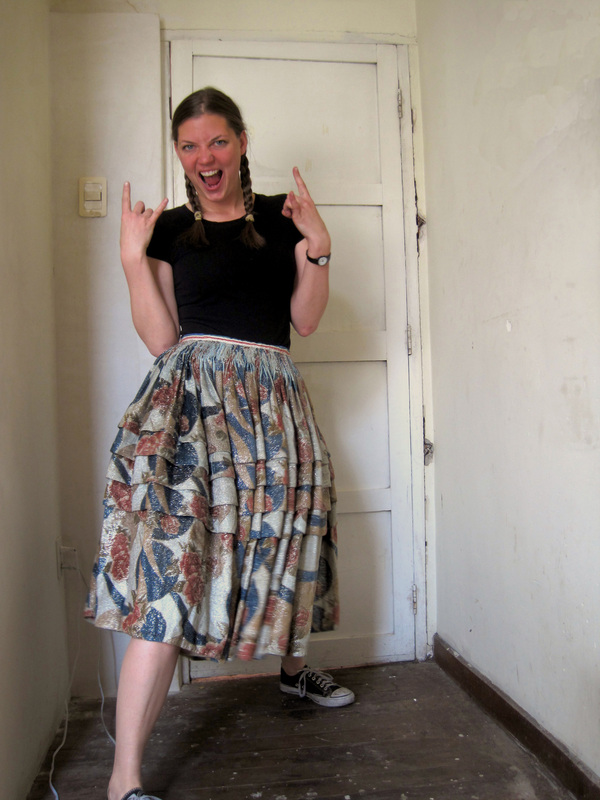
And I think my position is actually strengthened by the time I did wear a pollera (outside of the ring). When I appeared at Shirley’s party in a pollera and Gonz shouted “cholita punk.” My friends were amused because my representation was ironic. As I write in my dissertation (I think it’s still in there, but Cholita Punk was sadly cut), “Irony often functions as a ‘frame shifting’ mechanism (Coulson 2001) in order to express humor. When I entered the party wearing a pollera, Gonz shouting ‘cholita punk’ shifted the frame from the representation of cholitas as traditional and thoroughly Bolivian icons, to something integrated with the international youth culture of punk rock. Even my own laughter at wearing the pollera and braids played on the disjuncture of a U.S. gringa in clothing with cultural meaning in the Andes. And most certainly, when Luis suggested I wrestle, irony was used to disrupt the usual interpretation of a mujer de pollera.”

Picture
Now there’s nothing wrong with acknowledging the ways cholitas are no longer merely a form of local subject, but now are globally active citizens (I have 2 chapters on that). But the point remains that for a gringa to appear in public (versus the private party) in a pollera most certainly degrades the rich history of the skirt and the complex ways of identifying employed by the women who wear them daily. And we must not forget that ways of identifying are not neutral. The “chola,” the mujer de pollera, the indígena are marginalized and historically stigmatized categories in Bolivia. And the “Bolivian woman” in general is discriminated against all over the hemisphere, from Buenos Aires to Phoenix. 

Again I refer to Bedi, who writes, “If the use of the bindi by mainstream pop stars made it easier for South Asian women to wear it, I’d be all for its proliferation — but it doesn’t. They lend the bindi an aura of cool that a Desi woman simply can’t compete with, often with the privilege of automatic acceptance in a society when many non-white women must fight for it.” To paraphrase her, what makes a white woman’s use of the pollera problematic is the fact that a gringa wearing one is guaranteed to be better received than if a Bolivian woman were to step out of the house rocking one. On me, it would be a bold new look (sure to catch lots of stares, but no one’s going to shew me away from a fancy restaurant). On a Bolivian woman it’s yet another marker of her Otherness. A symbol of her failure at whiteness, at cosmopolitanism, to participate in a global citizenship. 

Picture
Dina, Juanita, and Claudina (from LIDER) show off their bad, cosmopolitan selves

Of course the cholitas luchadoras work hard to combat this image of the mujer de pollera as local not global, stigmatized not empowered, marginalized not powerful. And they have made excellent advances. But we’re not there yet. Despite the mujeres de pollera that have been elected or appointed to high profile government positions, it is still an Other form of dress. One worth celebrating. But not yet ready to be paraded in public as the funny thing the gringa’s wearing. Maybe some day…..but for now my beautiful pollera will stay in a closet in Illinois. 

0 Comments

buena onda en la paz

27/1/2013

0 Comments

 
I am so much cooler in Bolivia.

“Really, I am!” I want to shout at people I meet here in DC.

I suppose it’s a matter of social positioning, and I can’t really help it. Here I am a grad student and adjunct professor. I either stay in sweat pants all day or try to fight my younger-than-I-actually-am appearance by trying to dress like an academic. I hate when librarians ask me if I’m looking at information for a class paper. But in La Paz, I am one of the cool kids. I wear vintage, rockabilly dresses or ripped jeans and t shirts given to me by tattoo artist friends. I’m a live music junkie, a tattoo shop groupie, booze-slinging benefactor, restaurant aficionada, mural-painting sidekick, dj enthusiast, and a legitimate luchadora who rarely pays for a drink.
Picture
I wrote in May that I’m famous in La Paz (only half-jokingly), and its (half-jokingly) true. La Paz has the feeling of a small town, and if I don’t know everyone, I at least know someone who knows them. DC is small too, but rather than being comforting, its almost oppressive. When I left here in April 2011, I had good friends and a comfortable repertoire. I return to a place that feels empty. Most of my friends have left (such is life in such a transient city). With others I have grown apart. Evenings feel empty here as I crave distraction, camaraderie, excitement.

I came back in a depressed state, and googled “post-fieldwork depression.” Most of what turned up was written by people who disliked their field site and were depressed in the field. I felt the opposite. I longed to return to my friends, my usual days of training, reading, writing, visiting friends workplaces or homes, nice dinners served by my favorite Belgian, and the free tequila shots that went along with it. I missed the guessing games of who I’d run into on the street (there was always someone, but you never know who). Slowly it gets better. Easier. I instinctively put paper in the toilet, and don’t turn my nose at tap water. I wait patiently at bus stops, and thoroughly appreciate my electric heater. But I’d happily give it all up, even knowing there are horrific electric showers waiting for me on the other side.

But this is how it happens. We re-integrate ourselves to the best of our abilities. We find the little things that make us happy (hot water in sinks) and try to forget the things that were so magical about our other home (evening light on Illimani). And at the very least, I’ve found a bartender here who hooks me up as well as I was taken care of in LPZ.
0 Comments

re-adjusting 1: consumerism...or...why its a bad idea to return to the united states just in time for the holidays

4/12/2012

0 Comments

 
It had been over a month since the last pair of jeans I brought to La Paz got one too many holes and I had been subsisting on one ill-fitting too-low-rise pair and leggings with dresses combinations as long as I could. And finally I arrived in Lima. The beautiful neighborhood of Miraflores. The Pacific Ocean was four blocks in one direction, and the Fallabella department store at Parque Kennedy six blocks in the other direction. After a shower, a nap, and a falafel sandwich, just as the sun was setting over the ocean, I made my way to the glowing building on Avenida Jose Pardo.

Picture


This was the first department store I ever went to in South America. I remember walking through the door in 2006, wondering if they might have scarves, sweaters, or something of the like to keep me warm that first July I spent in Lima. It always seemed like it was five degrees too cold no matter how many layers of clothes I wore or layers of blankets I piled on. The only purchase I made that day was a Perú track jacket for my sister (which I've since restaked claim to).  

On this early November day though, my mission was different: Jeans. I tried on at least 15 pairs and studied the waistline, torso length, and leg cut of exponentially more. In the end my favorites were a pair of Bennetton jeans that were the equivalent of $70. I ended up buying a pair or S/70 skinny jeans instead. And even they were far, far better than any jeans I had tried on in a year.

Picture

I arrived in La Paz last January with two pairs of jeans: my favorite, slightly baggy, six year old gap jeans, and a newer, but still broken in pair of straight leg jeans. The baggy ones were the first to go. A few months in the knees were wearing then. and then they ripped. But on warm days or evening when I didn't leave my apartment they worked just fine. Then the right back pocket withered away. and finally, just below the right back pocket a but hole began to erupt. I declared them dead.

But they lived on in the patch I made from them to cover the newly emerging hole in the straight leg jeans that resided on my right hip bone. This held up quite well. But then around September the knees of those started disappearing as well. and then suddenly on both upper thighs there were rips every few inches.

And so, off to the El Alto market I went. I was in search of cheap jeans, and cheap used jeans there were. Most in what seemed to be my size were American Eagle or Aeropostale brand. But without fitting rooms I just didn't trust that the "low rise" waists would be sufficient on my long torso. So I went to my old standby, the second hand store on Calle Commercio. There my fears about these Juniors sized jeans were confirmed. Not a single pair fit me appropriately. So I thought I'd try a new pair at Shopping Norte (the centro commercial in Zona Central), just a few blocks away. I tried on what felt like every pair of jeans in at least 10 stores and finally, in a moment of exasperation bought a pair at Zap. But even these, which seemed to be made for real adult women had a very shallow crotch area, and after wearing them for a week couldn't bear it any more.

My birthday was approaching so I decided to treat myself-I walked over to the Levi's store. But to my surprise, the largest waist size they carried was 28. It seemed a 29 or 30 would have been fine, but I decided if I were going to buy jeans that cost about a quarter of the average Bolivian police man's monthly salary, they sure better fit me well. And the 28s did not. So I gave up. Back to the ZAP jeans (only for a few hours at a time), yoga pants, and skirts with leggings.

Picture

And I got on like that until Lima. Lima has always been a good, transitional city for me. It was my first South American city. And now, coming from La Paz it feels like a vacation in North America, only closer and speaking Spanish. But there is Starbucks, Chili's, McDonalds, Dunkin Doughnuts, department stores, fancy sushi restaurants, cheap falafel joints, more pizza places than you could imagine, music stores, book stores. "Its a proper city." Amanda once told me in an effort to get me to visit on a long weekend. So I thought spending five days there between Bolivia and the US would ease me into la vida norteamericana. But it didn't work out so well.

I arrived at LAX around midnight on the 11th, and J and her husband picked me up. We drove to J's parents' house where I was given the pull-out bed in the office room, complete with a TV and cable. Amused by this luxury I ended up watching some true crime show and marveling at how silly the late-night Made for TV offer commercials were. The next day we had lunch at a little cafe, we took a hike in the hills, drove over a windy road, walked to the beach, and had tacos and margaritas to finish it all off. The next day we arose early and hopped in the car to drive to San Francisco, stopping first for bagels, then pizza, then just to see the Madonna Inn, later at In 'n Out Burger, and finally at our hotel near Union Square in San Francisco. We walked across the street and had a few $7 beers (expensive, but not outrageous for big pints of local Anchorsteam). We went to bed early to get up for the conference the next morning.

After seeing J's panel, I decided I should try to do something about my lack of communication device (ie phone), and walked over to the T Mobile store. And along the way I noticed a line to get into the UNIQLO store. And then a giant clapping crowd huddled both inside and outside the door to the Apple Store. I just didn't understand...why would anyone wait to get into a store?

And then I started looking around some more. There were stores everywhere! H&M, Gap, Old Navy, not one, but 2 Forever Twenty One shops within a four-block radius. There was Nordstrom, Bloomingdales, Target, Best Buy, and Banana Republic. There was just so much to buy. And so many places to buy it.

And even a month after leaving La Paz, I still marvel at this. I'm now in a town of 2,000 people. An exhaustive list of the businesses here includes: 3 gas stations, 4 bars, 2 restaurants (if Subway counts as a restaurant), 1 pizza delivery place, 1 hardware store, 1 Dollar General Store, 3 Barbershops/Hair salons, 2 car washes, 1 bank and 1 grocery store. But the opportunities for consumption still run rampant. Its the holiday season, so the morning newspaper comes with a stack of department store advertisements whose pages outnumber those of the news. The television blares with some snappy song advertising brightly colored pants at old navy. I somehow find emails in my inbox with special seasonal sales. It feels unescapable. And it almost feels normal again. That's the scary part.  

0 Comments

lucha libre history, the myth of origins

7/10/2012

0 Comments

 
I was contacted late last week by a reporter for a well-respected British news outlet. He is writing a story on the cholitas luchadoras (which as I side note I'm intrigued by, because there is definitely an article from this same source for a few years ago I've referenced a few times). He asked questions on several topics, including the history of lucha libre in Bolivia. This is something about which I have found very little authoritative information. After many conflicting interviews and hours of pouring over Bolivian newspapers from the 1950s-1970s both here and in the US Library of Congress, here is what I know. You can find recent history here, and history of Bolivian lucha libre in the 1970s-1980s here. 

Though almost every veteran luchador in Bolivia tells the story a little differently, it was during the time of nationalism in the decade following the 1952 Revolution that lucha libre made its first appearance in Bolivia. The form of wrestling that developed in Bolivia already had a long history. Charles Wilson (1959) has traced exhibition wrestling to army men in Vermont in the early 19th century. During the civil war organized bouts became popular among Union troops. After the war, saloons in New York City began promoting matches to draw customers. By the end of the 19th century PT Barnum was using wrestling “spectaculars” in his circus. At first, wrestlers would fight untrained “marks” from the audience, but by the 1890s they began to fight trained wrestlers planted in the audience. It was then that it changed from a “contest” to a “representation of a contest.” These spectaculars were very popular and were replicated at county fairs, which eventually resulted in intercity circuits by 1908 (Wilson 1959). By the 1920s, promoters began to add gimmicks to make characters more memorable.

In 1933, after character development, rules, and other conventions had been established, a promoter named Salvador Lutteroth brought exhibition wrestling to Mexico. He and his partner Francisco Ahumado set up their first wrestling event in Arena Nacional in Mexico City on September 21, 1933. The next year they began the Empresa Mexicana de Lucha Libre (Levi 2008:22). In the next few years, innovations in costuming, character, and technique further “Mexicanized” the genre. Levi argues that at this time the audience was likely made up of both popular classes as well as elites (2008:23). By the 1940s, lucha libre spectators were more from the popular classes, but it still retained a sense of urbanism and modernity (2008:23). In the 1950s, it began to attract a middle class audience on television, but it only remained broadcast for a few years. It was also during this time that it became a popular subject for hundreds of Mexican films (2008:23).

During this era, exhibition wrestling arrived in Bolivia. Most wrestlers suggest that lucha libre was first performed in Bolivia sometime between the mid-1950s and mid-1960s, as Mexican wrestlers traveled to South America, performing and then training the first generation of Bolivian luchadores. Many of the most veteran Bolivian wrestlers who are still active in lucha libre identify these Mexican luchadores as their childhood inspiration. Rocky Aliaga, a Bolivian who currently wrestles in Spain told reporter Marizela Vazquez, “From my childhood I was fan of wrestling and what excited me most was to attend events…of Mexican characters such as Huracán Ramirez, Rayo de Jalisco, and Lizmark.” In particular, Huracán Ramirez is often mentioned as one of the most important influences. Mr. Atlas, a veteran La Paz wrestler recalls, "I ​​started fighting when I was 13 in 1965, when the greats of Mexican wrestling arrived in La Paz. Particularly I remember Huracán Ramirez, the man who fathered me."

An interview with Boliviana Euly Fernandez, the widow Huracán Ramírez

Younger wrestlers, like Anarquista from Santa Cruz, also note that the reputation of lucha libre in neighboring Perú was important to the formation and popularity of Bolivian wrestling. Mexican wrestlers toured South America, but it was the periodic visits by Peruvian wrestlers to La Paz that gained a hold in the 1960s. (7-23-2011). 

Today, there are four major wrestling organizations currently operating in La Paz: LIDER (Luchadores Independientes de Enorme Riesgo), LFX (Lucha Fuerza Extrema), Super Catch, and Titanes del Ring. LIDER, LFX, and Super Catch are smaller than Titanes del Ring, and only Titanes and LIDER have permanent places of performance. These two groups host foreign tourists in their El Alto performance venues each week, though Titanes del Ring boasts a much larger crowd and much larger group of travelers than LIDER. Super Catch usually produces shows in neighborhoods such as Villa Victoria (nicknamed Villa Balazos because of the frequency of shootings in the area), Villa Copacabana, or Villa Armonía—all working class neighborhoods of La Paz. However their schedule is somewhat sporadic. They have also recently opened a training program for young wrestlers that remains small. LFX is the smallest and least known of the operations with rare performances. Titanes del Ring, conversely, consistently attracts hundreds of audience members each Sunday at their show in the Multifuncional de la Ceja de El Alto (the multifunctional arena located in the Ceja market area of El Alto). 
0 Comments

butter pt 5, conclusion

6/12/2011

0 Comments

 
This is the final installment of my blogs on Buttercows (yes, now back to Bolivia...). For previous posts, click here: Part 1, Part 2, Part 3, Part 4.

The iconicity of the buttercow is even more apparent as it remains in the context of the state fair. As agriculture shifts in the United States, from a family-based mode of production to a more and more mechanized and large-scale industrial complex, the meanings associated with “authentic” representations of agricultural livelihoods change. The icon of the buttercow has shifted from an emblem of pride in the dairy industry’s success to a nostalgic symbol of the disappearing culture of family agriculture. Singer writes that such cultural displays “[cast] much light on the way in which cultural themes and values are communicated as well as on processes of social and cultural change." The context in which butter sculpture now exists gives immediacy to the art form as the social dramatic action of transformed farmland takes shape in and legitimizes butter sculpture as culturally and artistically important. 

Picture
The buttercow, as an icon, also forms the locus for the construction of cultural identity. Identity is, at its foundation, the ways that people index or perform sameness and difference from one another. Scholars such as Clifford have written on the ways that “international” or “non-western” art marks difference by emphasizing the “primitive,” “exotic,” or “tribal” nature of the art. The buttercow works in the converse, illustrating a sense of commonality for its enthusiasts. Bucholtz and Hall suggest that the dichotomy between genuineness and artiface is a key site for the instantiation of identity. The authenticity of the buttercow as confirmed by the context of the state fair, then, is central to the successful performance or indexing of a rural Iowan or Illinoisan identity. To know the buttercow is to say something about your own history, experiences, and values. Not every state has a buttercow. And not everyone in the state even knows what the buttercow is. Like playing euchre in La Paz, it is not just a pastime, but a performance of real Midwestern identity. 

And so I will end with one of my favorite quotes from Renato Rosaldo:
Culture lends significance to human experience by selecting from and organizing it.  It refers broadly to the forms through which people make sense of their lives, rather than more narrowly to the opera or art museums.  It does not inhabit a set-aside domain as does, for example, that of politics or economics. From the pirouettes of classical ballet to the most brute of brute facts, all human conduct is culturally mediated. Culture encompasses the everyday and the esoteric, the mundane and the elevated, the ridiculous and the sublime. Neither high nor low, culture is all-pervasive. (1989: p. 26)  

Picture
The 2011 Iowa State Fair Buttercow

Clifford, James
1991  Four Northwest Coast Museums: Travel Reflections. In Exhibiting Cultures, I. Karp & S. D. Lavine, eds. pp. 212-254. Washington, DC: Smithsonian Institution Press.

Rosaldo, Renato
1993  Culture and Truth: The Remaking of Social Analysis. Boston: Beacon Press.

Singer, Milton
1972  When a Great Tradition Modernizes: An Anthropological Approach to Modern Civilization. New York, Washington, London: Praeger Publishers.

0 Comments

butter pt 4

5/12/2011

0 Comments

 
Part 1, Part 2, Part 3, Part 5.
Perhaps reading the buttercow within its state fair context as Americana, rather than art, is what has kept it so sacred to ISF viewers. Its authenticity remains assumed, because it has not been removed from its specific spatial and temporal context. Though the notion of authenticity has been tossed around and contested by anthropologists in recent years, to go back to earlier instantiations of the term may be useful. Shepard suggests that we must move beyond the idea that subjectivity to market forces destroys authenticity. However, in this instance, the fact that the buttercow remains in its original context outside of the “art world” preserves a sense of authenticity for its enthusiasts and viewers.

Picture
Desai argues that “high culture” art objects are revered based on the aesthetic experience they provide, in ways that could not be achieved by a reproduction. The buttercow as well, is read as authentic because the context of the state fair is part of the experience of viewing the buttercow. It is an object that to many people is symbolic of home, family, roots, and notions of community based in actual physical proximity and personal knowledge.

Thus, much as Anderson argues the census, the map, and the museum shaped notions of identity and community, the buttercow stands as symbol of “us-ness.” Like the colonial map, it demarcates “us” from “them,” and acts as a logo, and becomes a “pure sign” or emblem for a certain kind of community affiliation. Its presence at the state fair attests to its authenticity, and to view the buttercow in an art gallery or other space outside of the agricultural milieu, would be to surrender it to the Other who cannot appreciate its intricacies, thus commodifying and degrading its form. 

Picture
Inside the Illinois State Fair Dairy Building. Photo courtesy of Dick Moore

Despite the dichotomy I have constructed between state fair and museum, Anderson’s discussion of the museum as a contributor to imagined communities is helpful as well. Anderson focuses on archaeological exhibits, rather than artistic ones, and presents the colonial museum as a context in which peoples were able to systematically study their history. Further, the state constructed museums with the maintenance of ideological structures in mind. As Desai writes, “Authenticity, whether cultural or aesthetic, is a notion that serves political interests.” The buttercow, as displayed at the state fair, evokes place-based pride and nostalgia in its viewers, (re)connecting them to the state (of Iowa, or Illinois), and the agricultural lifestyle being promoted within the fair. Much like the Monumental archaeology Anderson presents, the buttercow “allow[s] the state to appear as the guardian to a generalized, but also local Tradition,” in an attempt to revive prestige. 

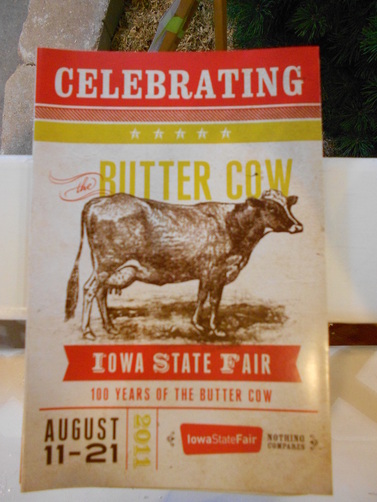
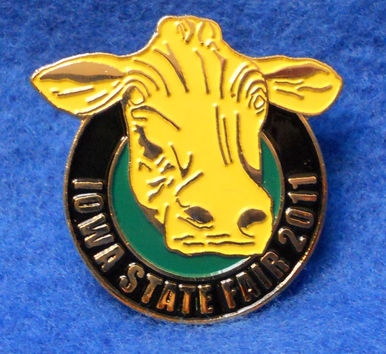
But where the buttercow parts from Anderson’s examination of colonial iconicity is in the work of reproduction. Anderson writes that it was the states ability to reproduce the icon—exemplified in the postage stamp—was instrumental in the logoization of state symbols. The buttercow presents an interesting example, because in some ways it has been logo-ized. The 1993 & 2011 Iowa State Fair collectors' pins were images of the buttercow. And the Iowa State Fair edition of the Monopoly board game features a space for the buttercow. But even these commodifications remain on a small scale among collector-enthusiasts, and are not necessarily readily available to outsiders. These ephemera stand not as widely circulating objects, but as limited edition symbolic items that allow enthusiasts to perform legitimate claims to identities connected to the buttercow or fair [much like travelers’ collections of photographs and hostel bracelets].  Thus, even in the process of logoization the authenticity of the buttercow is not only preserved, but bolstered through the limited circulation of ephemera. 
 
Picture
Desai, Dipti
2000 Imaging Difference: The Politics of Representation in Multicultural Art Education. Studies in Art Education 41(2):114-129.

Shepherd, Robert
2002 Commodification, Culture and Tourism. Tourist Studies 2:183-196.

0 Comments

butter pt 2

18/11/2011

0 Comments

 
My guest post has now appeared on Food Culture Index. Its a much shortened version of this series on butter art: Part 1, Part 3, Part 4, Part 5.

_ Butter sculpture made its premiere in the United States in 1911 at the Iowa State Fair with the first Buttercow [ed note: I stated 1908 incorrectly in the Food Culture Index post]. The sculpture was sponsored by the Beatrice Creamery, who wished to display the success of the local dairy industry and promote local products. The buttercow as advertisment worked, with a six percent increase in sales the next year, but it also came to occupy an iconic position for locals. In essence, the Buttercow came to symbolize enthusiasts see as Midwestern values. When 2010 Minnesota Dairy Princess (Princess Kay of the Milky Way) Katie Miron speaks of the Dairy industry she uses words like “hardwork,” “dedication,” “wholesome” and “nutritious.” She connects these concepts to longstanding “American Values” and suggests that dairy farming, in many ways, represents the long held ideal of hard work leading to success. Butter art for her is a way to both promote these values within the community, and communicate the values to outsiders.

Picture
photo courtesy of Gerard Dougher
_
And, like all icons, the Buttercow adapts to symbolize prevailing social issues and political perspectives. What was once a symbol of progress, now has come to be a nostalgic representation of a disappearing way of life. As family farms disappear and Concentrated Animal Feeding Operations replace them, the Buttercow stands as a testament to the idealization of the past and the values associated with it.

Picture
Ray, a fair employee in Illinois, points out why the new sculptor's cow, compared to Duffy's, looks like a "mule with tits."

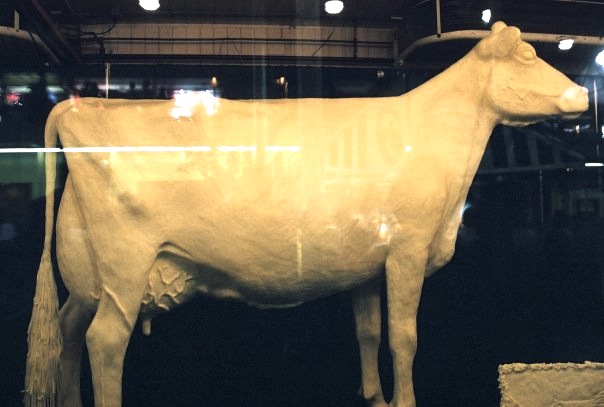
With intimate knowledge of dairy farming and cows declining, those with the expertise to sculpt accurate likenesses in butter are disappearing as well. Duffy sculpted a buttercow for the Illinois State Fair as well, from 1969-2001. In 2003, many people felt the new sculptor’s work did not live up to the standard Duffy had set. I overheard numerous dairy farmers and others experienced in bovine anatomy talk of the sculpture;s shortcomings. Duffy, who had earned a degree in Animal Science from Iowa State University, had an intimate knowledge of bovine anatomy. She sculpted specific breeds, and even the veins on her sculpted udders were anatomically correct. However, when the new sculptor’s cow was unveiled, a long time Dairy Association employee scoffed: “This one just looks like a mule with tits!” As lifeways change, old customs become endowed with new meaning. Butter sculptures may act as a reflector of the agricultural community.  As knowledge of small family farms disappears in the wake of the rise of factory farms, these artworks lose part of their realism.  However, as contexts change, art and tradition take on new implications and their relevance becomes increasingly valuable as symbols for examining the past and considering the future.


0 Comments

butter pt 1

10/11/2011

0 Comments

 
I will shortly be writing a post for the blog, Food Culture Index on Midwestern US butter sculpture. As such, I've been thinking through a lot of the issues associated with Buttercows and Butterheads: the transition from factory farming to CAFOs, women's role in agriculture, iconicity and nostalgia, tensions between popular culture, folk crafts, and high art--thus class, distinction, authenticity. I should be writing a dissertation right now, but I thought I would work through some of these issues in Fieldnotes as well. Here is Part 1. For more, read Part 2, Part 3, Part 4, Part 5.

On Monday, 27 June 2011, I was riding in the passenger seat while my new friend Alejandro gave me evening tour of La Paz, Bolivia. My Viva cell phone rang and it was a number from the U.S. When I answered, my mother had bad news. I braced myself, and she told me “Duffy died.” 

Duffy, or Norma Duffield Lyon was “The Buttercow Lady,” who sculpted life-sized cows from butter for forty six years at several Midwestern state fairs. As one could imagine, describing this phenomenon to Alé was a challenge.

Picture
I first met Duffy in the summer of 2003, when I was a recent college graduate. With few job prospects on the horizon for a reasonably good student with Bachelors degrees in anthropology and performance studies, I joined up with a team of recent film Bachelors and MFA students and headed to the Iowa State Fair.

Picture
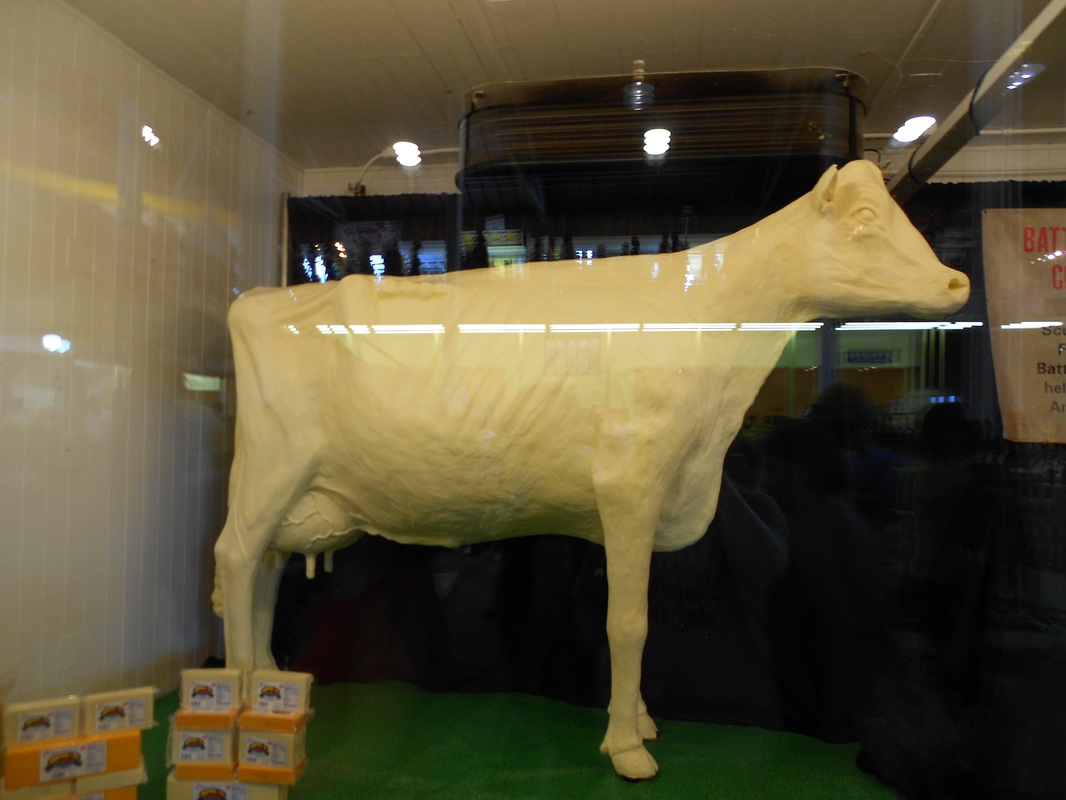
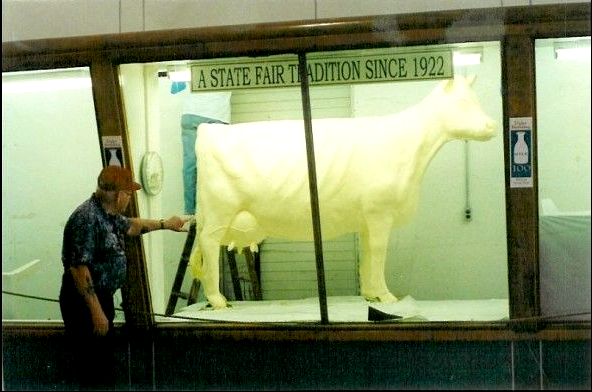
Duffy, “The Buttercow Lady” was a legend in her own right. For decades she had been sculpting life-sized cows out of butter. She starts with choosing a dairy cattle breed (Holstein, Guernsey, Jersey, Brown Swiss, Ayershire, and Milking Shorthorn), then works from sketches or photographs. She places 500-600 pounds of butter (about 2,400 sticks) on a wooden and chicken wire armature. At first, Duffy adds large handfuls to the frame to approximate the shape of the cow, and eventually fine-tunes the form with smaller additions of butter. Working both with her hands and sculpting tools in a refrigerated display case, the process can take between two days and two weeks.

Picture
Duffy would usually schedule her work to be finished in the first days of the fair, so that attendees could see her in process.  Many fairgoers consider the Buttercow to be the definitive fair experience. Information booth volunteers told us that the most common questions they are asked are, “Where are the bathrooms? and Where’s the Buttercow?” (in the dairy building, of course). Some life-long devotees of the buttercow travel from the west coast, or will pay hundreds of dollars to assist with sculpting the tail through the fair’s Blue Ribbon Foundation. When the film crew stopped at a local sandwich shop for lunch, the twenty-year-old cashier told us, “Oh the buttercow. That thing used to make me so happy when I was a kid.”
0 Comments
<<Previous
Forward>>


    themes

    All
    Aesthetics
    Authenticity
    Body
    Bolivia
    Chile
    Chola
    Class
    Disaster
    Drugs
    Food Studies
    Gender
    Globalization
    Indigeneity
    Inequality
    Lucha Libre
    Methods
    Migration
    Neoliberalism
    Performance
    Politics
    Protest
    Social Media
    Sport
    Tattoo
    Tourism
    United States
    Violence

    archives

    September 2026
    August 2022
    July 2020
    November 2019
    October 2019
    July 2018
    May 2018
    April 2018
    October 2017
    September 2017
    July 2017
    March 2017
    February 2017
    December 2016
    September 2016
    August 2016
    May 2016
    August 2015
    July 2015
    June 2015
    May 2015
    March 2015
    February 2015
    January 2015
    December 2014
    November 2014
    October 2014
    September 2014
    August 2014
    July 2014
    June 2014
    May 2014
    April 2014
    March 2014
    February 2014
    January 2014
    December 2013
    November 2013
    October 2013
    September 2013
    August 2013
    July 2013
    March 2013
    January 2013
    December 2012
    November 2012
    October 2012
    September 2012
    August 2012
    June 2012
    May 2012
    April 2012
    March 2012
    February 2012
    January 2012
    December 2011
    November 2011
    October 2011
    September 2011
    July 2011
    June 2011
    May 2011
    April 2011
    August 2009
    July 2009

    RSS Feed

Powered by Create your own unique website with customizable templates.