nell haynes
  • home
  • bio
  • publications
  • projects
  • fieldnotes
  • teaching
  • contact
  • español

a primer on the bolivian-chilean maritime conflict

3/3/2014

0 Comments

 
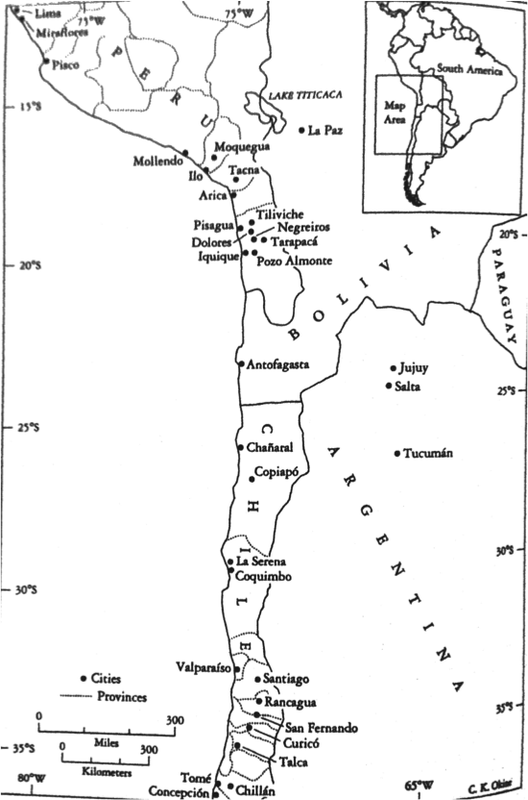
Chile gained independence from Spain in 1810, and it's northern border was defined near the city of Taltal. When Peru gained independence 1821 it's southern border was near the present city of Tocopilla (meaning that Arica and Iquique were also within Peru's boundaries). Further to the South, the territory of Antofagasta gained independence with Bolivia in 1825.
Picture
map from A History of Chile, 1808-2002 by Simon Collier and Willaim F. Slater (p 130)

The border between Bolivia and Chile ran through the Atacama Desert, and was somewhat undefined, because neither country had much vested interest there. However, the natural fertilizer, sodium nitrate (salitre), was discovered in the desert in the 1830s, and attracted many foreign investors to the area. Nearby, Iquique-still a part of Peru-grew as a cultural and financial center because of increased mining business. The city was one of the first in the region to have electricity in homes and businesses. The Teatro Municiapal (Municipal Theater) of Iquique was built to showcase plays and musical acts. A railway station was built by John Thomas North, and Englishman known as the “King of Nitrate." 

But this attention and growth caused some diplomatic tensions. With the nitrate boom, both Chile and Bolivia took an interest in the wealth they could acquire from this area and attempted to re-negotiate the border. In 1874 President Tomás Frías Ametller of Bolivia and Frederico Errázuriz Zañartu of Chile agreed that the border would be set at 24° S. Bolivia would retain the area around Antofagasta, but would not tax the Chilean company that was already operating in the area. This arrangement worked for a short time, but when the Hilarión Daza became president of Bolivia in 1876, he began heavily taxing the Chilean company. 

Angry over the breached agreement, the media and popular sectors called for the newly elected Chilean president Aníbal Pinto to take the territory. He ordered the army to seize Antofagasta in February 1879. Bolivians suggest this was successful because most of their armed forces were celebrating Carnaval at the time. After two weeks of Chilean occupation of Antofagasta, Bolivia declared war. Because of a “secret” treaty signed in 1873 (meaning it was not publicized, but most politicians in the region knew of it), Peru was obligated to come to Bolivia’s aid. At first, Peruvian president Manuel Prado tried to mediate, but the general population of Chile protested, calling for further action and persuaded the president to declare was on both Bolivia and Peru in April 1879. 

Hoping to create a buffer zone so that Bolivia would not be able to inch into Chilean territory again, the Chilean Navy set out to control maritime access further north. They blockaded Iquique then continued further North to Callao. By 1880, Chilean forces were trying to capture Arica, another strategic port north of Iquique and eventually were successful. Eventually, the Chilean Navy made it all the way north to Lima in January 1881, where they demanded the cession of the Peruvian regions Tarapacá, Arica, and Tacna, but Peruvian president Nicolás Piérola did not cede. Peru was still occupied in July 1882 when they won the battle of La Concepción, causing public sentiment in Chile to change. Finally, Chilean government proposed to occupy Tacna and Arica for ten years and retain Tarapacá indefinitely. In 1884 Chile signed an “indefinite truce” with Bolivia, granting them only temporary occupation of the Bolivian coastline. Yet, this area still remains under Chilean control, as do Arica, and Iquique (despite current Bolivian president Evo Morales’s appeals to the United Nations).  

Further Reading
The Peruvian-Chilean Maritime Border: A View from Facebook
They Paved (Nationalist) Paradise to put up a Parking Lot: Cultural Dimensions of the Bolivian-Chilean Maritime Conflict

0 Comments

public and private: space and media

10/2/2014

0 Comments

 
this fieldnote has also been posted on the WHY WE POST blog at University College London
Picture
When Daniel Miller came to visit my fieldsite in Northern Chile a few weeks ago, I took him on a walking tour of the city. He had just arrived from his own fieldsite in Trinidad, and as we walked he kept remarked that two places are quite different. They share certain aspects: warmth, nearby beaches, revealing clothing, and gated homes. Yet, he told me that compared to the razor wire or broken glass-topped fences in Trinidad, these just didn’t seem as intimidating. Similarly, we discussed the ubiquity of car alarms as the continuously sounded that evening as we sat in my apartment. “Are they really protecting anything if one goes off every three minutes?” I asked.

​read the rest of this entry on the WHY WE POST blog
0 Comments

the peruvian-chilean maritime border: a view from facebook

27/1/2014

0 Comments

 
for a primer on the maritime conflicts between Bolivia, Chile, and Peru that exist as a legacy of The War of the Pacific at the end of the 19th century, see my post here. 

I often get the sense here in Northern Chile that politically people are very polarized. Not in the sense that they are either quite liberal or quite conservative, but rather in the sense that they are either very politically active, or have entirely written off politics as something that doesn’t not pertain to their lives.

One night while gathering to hang up posters for Raquel’s Regional Representative campaign, Juan told me that Chile has a “lost generation” when it comes to politics. Those that came of age during the Pinochet regime were often too afraid or too disorganized to see themselves as a political force in any way. “We are still rebuilding” he told me.

Juan, Raquel, and some of their other friends are certainly making an effort to rebuild political participation among Chile’s young adults. They run for city office, they organize protests, art exhibits, performances, and observances to promote things like indigenous rights, and stand in opposition to things like neoliberal multinational capitalism.

But then there are the others like my neighbor Sarita who told me before the recent election that she wouldn’t vote because it doesn’t really matter who wins. “No one pay attention to us in the North, anyway.” Similarly, when I asked my friend Alex if he’d like to watch the movie NO with me, he declined. The film is the tale of a 1988 referendum to decide Pinochet’s permanence in power. It follows the opposition—the “No” vote, and their advertising campaign that wins the election. Alex said he had no interest because he didn’t really understand politics. “People of my parents’ and grandparents’ age, they lived through it. But I don’t really know the history, so movies like this…well, I’d rather watch The Walking Dead or something.”

And yet, today, people from both sides of this (a)political divide seemed to have something in common. At least they did as viewed from Facebook activity.

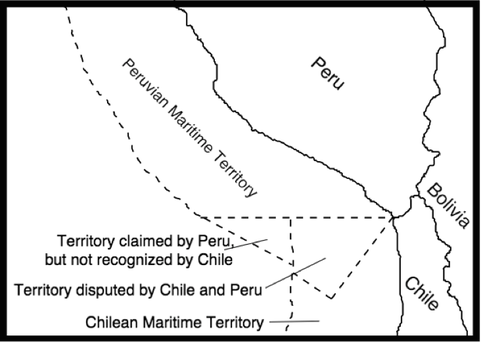
Today was historic for maritime relations between Chile and Peru (and to an extent, Bolivia). The area in which Alto Hospicio lies was Peruvian at the time of independence. However, during the War of the Pacific between 1879 and 1884, Peru lost the land to Chile. The final borders drawn during the peace accords at the end of the war are still somewhat disputed, particularly by Bolivia which lost all of their coastline. Today, the Hague decided upon a dispute between Chile and Peru, not over coastline or cities, but over sea territory. Granting Peru more sea territory, but keeping rich fishing areas in Chilean control, the international court redrew the maritime border (BBC's coverage).

Picture
illustration from pew law center

I am not one to assess or even speculate on the consequences of this decision politically or in terms of economics and trade. However, as an ethnographer, when I got on the bus from Alto Hospicio to Iquique this morning there was no doubt everyone was listening to the radio report live from the Netherlands that played over the vehicle’s sound system. Facebook was also abuzz with references to the trial. Both politically active and somewhat apolitical Chilean users asserted a similar view, but in different ways. Both groups seemed to be communicating that though perhaps the Chilean and Peruvian governments were in a dispute, the people were not.

Some friends did admit to me that they felt the decision to cede some water area to Peru was unfair. But they also felt that avoiding conflict was important. Many said that the decision was irrelevant because economic gain from the sea territory only ends up in the hands of seven families of the oligarchy. But these nuanced opinions were not published on Facebook either through original writing or links to online sources. Instead, solidarity between Peruvians and Chileans overwhelming dominated the Facebook posts from my friends.

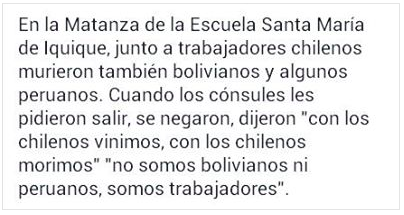
On the political side, Raquel and her friend Marcelo both shared a piece of text essentially thanking Peruvians and Bolivians for standing with Chileans during the Santa Maria School Massacre in Iquique in 1907.

Picture
In the Santa Maria School Massacre of Iquique, together with Chilean workers, Bolivians and some Peruvians also died. When the consuls asked them to leave, they denied saying “We came with the Chileans and we will die with the Chileans. We are not Bolivians or Peruvians, we are workers.

A band known for promoting indigenous rights and political content in their songs posted a long piece of text from which I will draw out some relevant parts:

Patriots, fellow Chileans…Why do we not go to war against Monsanto? Why not fight to recover copper from your country? Why do you not wage war on Spanish companies that rob us when we pay for light and water? Why were you not in solidarity with artisanal fishermen when the Chilean government perpetually delivered the sea to the seven richest families?...Chileans and Peruvians stop being so easily swayed by media sensationalism of the bourgeois press. We should continue fighting together against those that make our lives impossible!

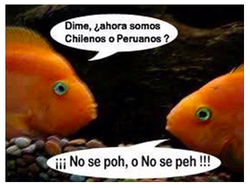
Most people who usually stay away from political discussion stuck to humor. Many memes declared something along the lines of “The sea is neither Chilean nor Peruvian, it belongs to the fish!”
Picture
Tell me, are we Chilean or Peruvian now? 
I don't know [with typical Chilean filler word], I don't know [with typical Peruvian filler word]!!!

My friend Jaime asserts, “It’s so hipster to say that people shouldn’t complain about the decision of the Hague. I bet if you take the issue of sushi those assholes will start a revolution.” About those who feel an end to conflict is more important than specific borders, he implicitly suggests they stand in a privileged position (‘hipster’ being aligned with the northern hemisphere, urban culture, and detachment from the material consequences of everyday life), yet continues to make light of the situation sarcastically suggesting that what they would really care about is sushi. 

Peruvian friends shared the link to an article in the online magazine The Clinic, which listed "Ten Things That Perú Has Won That Hurt More Than the Decision of The Hague." Among the 10 were #2 Rich Chilean chicks prefer to summer in Mancora [Peru], and #8 Pisco-In 2013 the European Union recognized Peru's rights over the marvellous liquor."

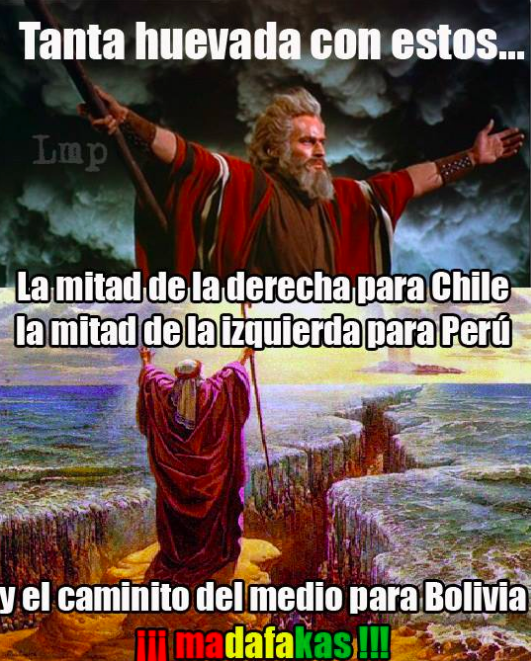
Even the Bolivians had their say through sarcasm and parody:

Picture
illustration from la mala palabra revista
So much bullshit with this. The half to the right for Chile. The half to the left for Peru. And the path in the middle for Bolivia!!!

So if my friends are representative of Northern Chileans, or at least those between the ages of 20 and 40, it seems that though everyone was paying attention, no one really cared. Perhaps because this border only affects the oligarchy, or perhaps because they believe an end to dispute is more important than the ways the sea area is divided, these people express their interest by enthusiastically posting and commenting. Yet what they assert is that the outcome does not really matter. I am curious to see if in coming days more serious, nuanced, and critical discussions will take place on Facebook or on the street. But for now, people seem to be avowing “Yes, I am paying attention!” without taking sides on a matter that to most is “supposed” to be important, but in their daily lives simply doesn’t matter.   

Further Reading
A Primer on the Bolivian-Chilean Maritime Conflict
They Paved (Nationalist) Paradise: Cultural Dimensions of the Bolivian-Chilean Maritime Conflict
0 Comments

names, dates, and politics

29/10/2013

0 Comments

 
In general, Chile seems to be a place where politics is always a topic of conversation. I would say this is true even more than when I was living in Washington, DC, and certainly more than my experiences in Bolivia. Memorializations of political events are constantly popping up on facebook (see screen shots below), and particularly the dates of certain political events become names of social organizations. While in Bolivia there are many streets named after the dates of important political events (i.e. Avenida 6 de Agosto—which is the date on which Bolivia gained independence), in Chile the dates used for less formal naming are often the dates on which important political figures were assassinated. 
Picture
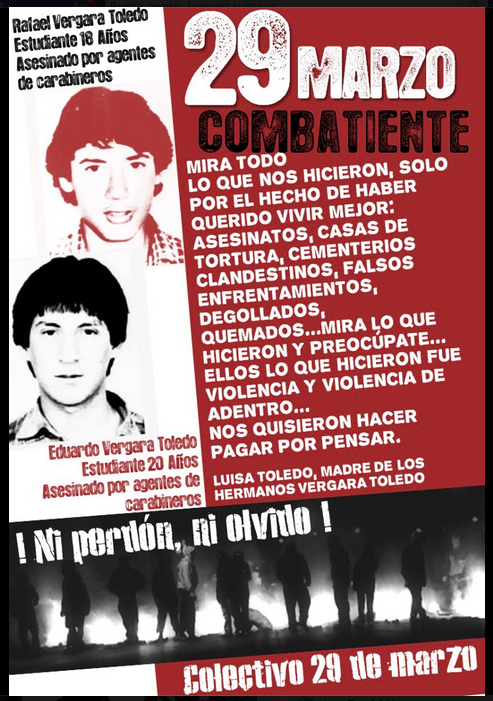
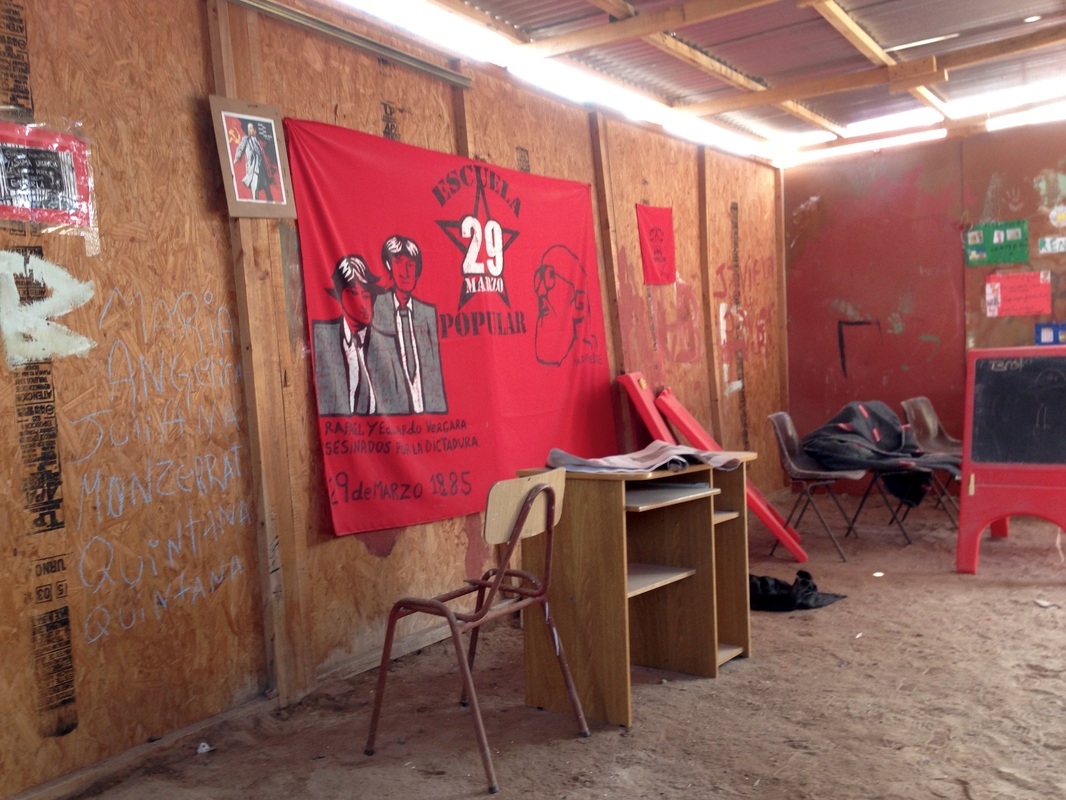
My prime example of this is an afterschool tutoring program that Juan and Raquel introduced me to. Less than a year ago, a group of about 10 university students in Iquique built from scratch a building the neighborhood where Juan grew up and now offer tutoring on Tuesday and Saturday afternoons for kids who live nearby. The school is called Escuela Popular 29 de Marzo after two brothers that were assassinated by the Pinochet regime on that date. Their pictures appear on a large banner on one wall, and the first time I attended everyone was making t-shirts with their faces and the school’s logo.

Picture
A painting of the 2 assassinated brothers, Rafael y Eduardo Vergara Toledo, takes up left side of the banner and the likeness of Paulo Friere, author of Pedagogy of the Oppressed, occupies the right. In the photo above, next to the banner is a small picture of Vladmir Lenin. On another wall is a similar small photo of Subcomandante Marcos of the Ejercicio Zapatista Liberacion Nacional (Zapatistas). This is in contrast to photos in the one official colegio I have entered in Alto Hospicio, which is a Jesuit institution. There, like in all official schools in Chile, a picture of President Piñera is prominently displayed in the lobby and in each classroom. These pictures of political figures in the Escuela Popular, along with its name, clearly communicate allegiance to a different sort of politics than the nationalism displayed in official schools. 

Picture
0 Comments

521 years of resistance

12/10/2013

0 Comments

 
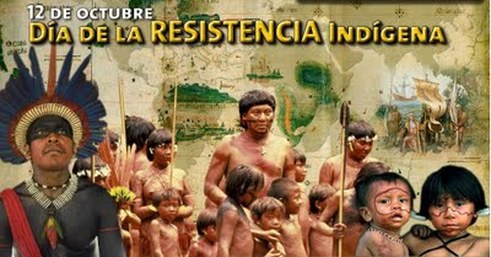
Today is 12 of October. In the Midwest, where I went to elementary school, this is known as Columbus Day. Later, as I gained a bit more worldly perspective I came to call it Indigenous People’s Day or Genocide Day under my breath. A few days ago, I got upset when my mother, who is a second grade teacher, mentioned she had Columbus Day off—partly because it is still institutionalized and partly because she called it Columbus Day without a hint of critique. But I’ll cut her some slack. When I’m in central Illinois she usually lets me come talk to her class about colonization. And the amazing thing is, when you explain that colonization was simply a bunch of Europeans who wanted to take the resources on another continent and felt it was necessary to murder, enslave, rape, and destroy the residents of that place in the process, even 8 year olds are pretty quick to realize that this is not something to be celebrated.

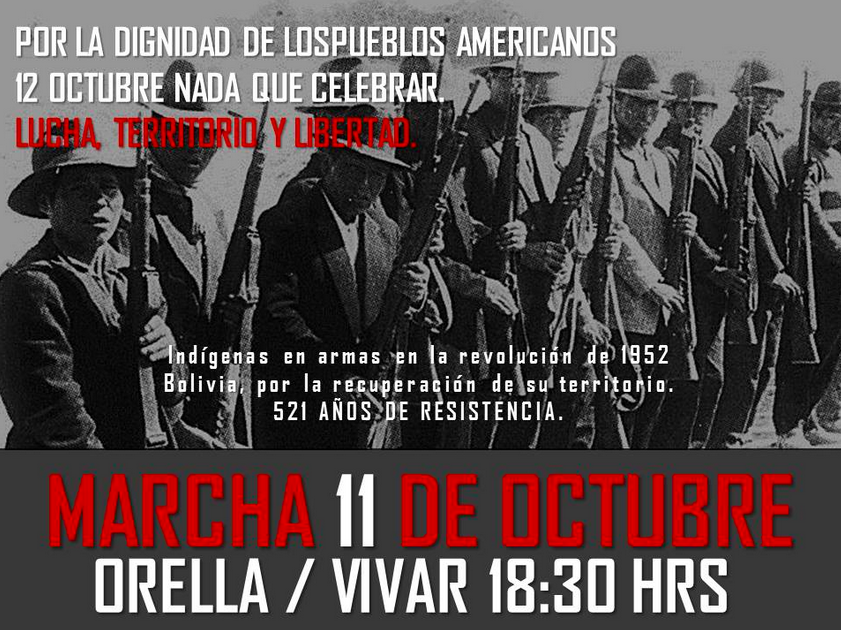
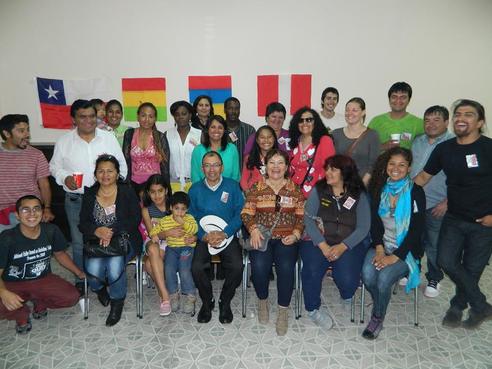
I arrived at the Preuniversitario where it was held around noon and was immediately asked where I’m from. I felt a little defensive and said that Raquel had invited me and hoped it would be ok if I could just stand in the back and watch. And then I realized the woman had asked me because all of the other audience members had pin on badges that announced what country they are from. Chile and Peru dominated the group of 50, but there were a few small nametag-sized Bolivian, Ecuadorian, and Colombian flags pinned to shirts as well. Unfortunately there were no United States pins on hand, but they were happy to have me. The chairs were all full, so I stood along the back and watched a slide projection on the front wall. There were pictures of Alto Hospicio and various local groups interspersed with graphical slogans such as “12 de octubre, 2013: 521 años de resistencia” [521 years of resistance] and “Por la dignidad de los pueblos americanos, 12 de octubre nada que celebrar” [For the dignity of american peoples, 12 October is nothing to celebrate].
 
Picture
The program began with a Chilean Cueca dance performed by two pairs adolescent boys and girls. Then the Ecuadorian woman who had greeted me earlier performed a pop song from her country. Representatives from the Colombian and Ecuadorian immigrant associations in Iquique spoke. An Afro-Peruvian woman sang two more songs, and several community figures and political candidates spoke briefly. Scattered throughout all of these various performances were discourses about the unity of the Americas against Europeans and Gringos (“that’s me!” I thought…). The Peruvian singer shouted several times over the boombox that accompanied her “America Latina es una sola!”

As the last local leader was speaking, Raquel came and stood next to me at the back. She asked if I could stay for the reception afterwards because she’d like to introduce me to a few people. I accepted and met several of the people she works with at the Preuniversitario along with being coerced into eating plenty of bocadillos, ceviche, and grilled shrimp.

As the reception was ending, Raquel’s friend Juan called everyone to the back room to take a photo. I lingered in the front room, but he singled me out saying “You too, Nell. You’re from the Americas. We need our representative from the United States present.” So I followed the crowd to the back, where we rearranged ourselves a number of times against a backdrop of handpainted paper flags, and finally got a decent shot (well, you can be the judge). 

Picture
There is certainly some multicultural pride here in Alto Hospicio, at least when it comes to public presentation. And the mix of anti-colonial and multi-cultural discourses was interesting, but not surprising given what I’ve seen here so far. But what I find most interesting is the memorialization that occurs through such events. Though the focus is on celebration and community, it is framed by this discourse of resistance to colonization and a memorialization of a past that continues to influence present events. One of the SocNet themes of focus is on the way memorialization occurs through social networks (see Shriram Venkatrama's account from India here). I’ve been keeping my eye out for Facebook pages dedicated to individuals who have died, but perhaps more important are these ways of memorializing political events and figures, not only online but in real life events, and the naming of institutions (more on that in the next post!). 

0 Comments

heroes para bolivia

24/6/2012

0 Comments

 
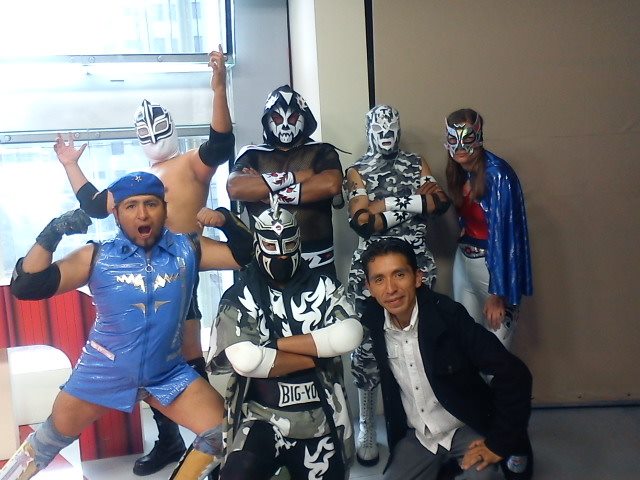
_ This morning several Super Catch stars went to Palenque TV (canal 48) to record some messages aimed at children. The channel is going to start airing lucha libre, under the name Tigres del Ring, and the promo spots recorded will come at the end of commercial breaks. 

Picture
picture from appearance on Unitel, not Palenque TV

_ Palenque TV is a project of Veronica Palenque, daughter of the late Carlos Palenque Avilés. Carlos was a presidential candidate in 1989 and 1993, running for the CONDEPA (Conciencia de Patria or National Conscience) party. In 1993, he received just over 14% of the vote, putting him in second place behind Goni (who garnered about 35.5%). Perhaps more interestingly, Carlos spent his time in the 1960s singing social-protest songs and cultivating long hair. He then became part of Los Caminantes, a pop-folk group that quickly became one of the most popular bands of time in La Paz. He eventually went solo, and the Bolivian National TV station (the only TV station in Bolivia at the time), asked him to do a weekly live music show aimed at indigenous and rural-origin peoples living in La Paz. He solicited Remedios Loza, or Comadre Remedios, to be his cohost on La Tribuna Libre del Pueblo [The Community’s Open Forum]. Remedios identified more closely with indigeneity than Carlos and dressed de pollera. She and Carlos remained close, and after his death, so ran for President in his place in 1997. However, it seems that Remedios had sharp tensions with Veronica, and left the program (for more information see Moore's piece here). 

Veronica herself then served in the Bolivian National Congress from 1997-2000. She first formed a radio station in 2000, with the objective to continue the line of social welfare, information, education, and training that Compadre Palenque (referring to her father) left behind as his principles, precents, and ideology.

“Red Palenque Comunicaciones, fue creada el años 2000, con el objetivo de continuar la línea de ayuda social, información, educación y entretenimiento que el Compadre Palenque dejara bajo sus principios, preceptos e ideología.”

In 2011 Veronica began the TV station, in response to the proliferation of pain, suffering, bad news, disasters, catastrophes, and negative news usually available on television. She decided to create a channel that emphasizes fun, entertainment, laughter, joy and positive aspects of life. Veronica explained, “El control remoto tiene que convertirse, a partir de hoy, en una ‘varita mágica’ que transporte al televidente a un oasis de entretenimiento y diversión, porque aquí sólo verá felicidad” [As of today, the remote control has to become a ‘magic wand’ to transport viewers to an oasis of entertainment and fun, because we only see happiness].

Picture
_ And, then, enter the luchadores: bastians of fun, entertainment, laughter, joy, and positive aspects of life (?). We started out recording a clip where we (attempted to) say “Hola Amigitos! Somos Tigres del Ring. Pronto por Palenque TV!” in unison. We pretty much failed and ended up just saying “Hola Amigitos” together, with Luis announcing who we were and Edgar promoting the station.

After our group recording, we each each recorded a short PSA style message for kids. These messages were not our own of course, but were scripted and handed to us to memorize about half an hour before recording. I am unfortunately left to talk about the scripts in a passive sort of voice, because they arrived to us on little pieces of yellow notepad, handwritten by someone other than the camera guy who passed them off. We did have to wait around for Veronica to arrive, and my previous experiences with her have shown that she is quite involved in most aspects of the station. So I would venture to say she was the source of the scripts, but I can’t say for certain. I would also guess that the handwriting was a woman’s, but I’m no expert on gendering based on script.

My little script was written in Spanish as “Practicar deportes, alimentarse sanamente, y alejarse de vicios son las claves de una vida exitosa. Ustedes pueden ser heroes. Es un mensaje de Lady Blade, junta con los Tigres del Ring. Estaremos pronto por Palenque TV.” But of course Omar wanted me to do it in English (I didn’t mind), so I translated it as “Practice sports, eat healthy, and stay away from drugs are the keys to a successful life. You can be a hero! This is a message from Lady Blade and the Tigres del Ring on Palenque TV.”

So yes, my little bit was chock full of certain moralizing messages that seem to conflate bodily health with some sort of emotional or social decency. And I suppose this is not surprising given the social welfare, information, education, and training espoused in the radio station’s mission statement. But what was especially interesting were the references to “our country” most of the other luchadores had in their scripts.

Luis’s was the most explicit. His went something like: “To support our beautiful country, Bolivia, we need to work hard and stay healthy.” Carlos’s began with “Drugs and alcohol destroy your life! But we can be heroes for our country, Bolivia by staying fit and respecting each other.” Edgar’s concentrated on keeping Bolivia beautiful by recycling, caring for water, and not polluting. Finally SuperCuate’s was short and simple, “The values of respect, education, and consideration make us heroes for Bolivia.”

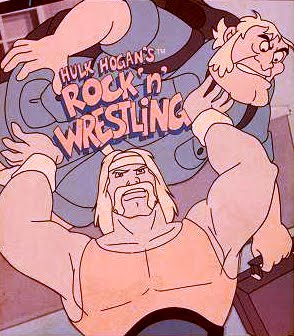
This reminded me quite a bit of the “lessons” of Hulk Hogan’s Rock n’ Wrestling show from the 1980s. Indeed, US wrestling is often fraught with nationalist storylines which help to delineate heels from faces (villains from good characters). And nationalism has certainly had its place in my experiences wrestling in Bolivia. Primarily, I’ve had to walk a fine line promoting the US, but maintaining my status as a technica (good character). I wave at the kids, and they seem to love me, which helps. But when E came to visit and made an appearance as my partner on the program “La Revista," he played the rudo well, telling the Bolivians they had a lot to learn from the US where “real” wrestling takes place.

Picture
_ But mostly its always struck me as strange that wrestlers, people who enter the ring and seemingly commit acts of violence, are poised as role models. As Nick Sammond writes, “Wrestling is brutal and it is carnal. It is awash in blood, sweat, and spit, and…depends on the match—the violent and sensual meeting of human flesh in the ring” (Sammond 2005:7). Is this really the way to teach values like respect, education, and consideration?”

But I suppose meeting “them” where they’re at is a viable approach. And if luchadores are icons that kids look up to, encouraging them to take care of themselves, each other, their country, and the earth isn’t all bad. Especially given the fair amount of inferiority complex some Paceños I've met have about their country, perhaps encouraging a little nationalism isn’t entirely bad (though still complicated).

0 Comments

closer to home

13/10/2011

0 Comments

 
In Orin Starn’s 1991 article, “Missing the Revolution,” he chastised anthropologists for missing signs of the rise of Sendero Luminoso [Shining Path], the Peruvian Maoist insurgent organization. He suggests anthropologists were too absorbed in Andeanism, a term he borrows from Edward Said’s Orientalism, to mean depictions of life in the Andes that portray contemporary peoples as outside the flow of modern history (395). Because of their narrow focus, they missed the important politics and historical dynamics that fomented the rise of groups like Shining Path. As he wrote, for hundreds of anthropologists…the rise of the Shining Path came as a complete surprise” (395).

Many anthropologists took this call to heart, and much recent work on the Andes has indeed centered on working-class and rural peoples’ protest, political work, and revolution. Scholars such as Forrest Hylton and Sinclair Thomson highlight the “revolutionary spirit” of indigenous and mestizo Bolivians. Indeed, strong movements opposing neoliberal economic policies and multinational corporations’ ownership of many of Bolivia’s natural resources have been politically effective. One of the most heightened moments of this movement was the inauguration of Evo Morales, Bolivia’s (and the hemisphere’s) first indigenous president. In speeches celebrating his inauguration, Evo emphasized both his indigeneity and revolutionary ideology with statements such as “I say to you, my Indian brothers and sisters from America concentrated here in Bolivia, the 500 year campaign of resistance has not been in vain. This democratic, cultural fight is part of the fight of our ancestors; it is the continuity of the fight of Tupaj Katari, of Che Guevara.” In this small statement, he links himself and his supporters not only to leftist revolutions in Latin America of the last century, but also to a much longer lineage of anti-colonialism, anti-imperialism, and anti-exploitation that has existed since subaltern Bolivians resisted their colonial exploiters. Revolution then is not something that happened in the past, but something that is the continuity between “then” and “now.”

Picture
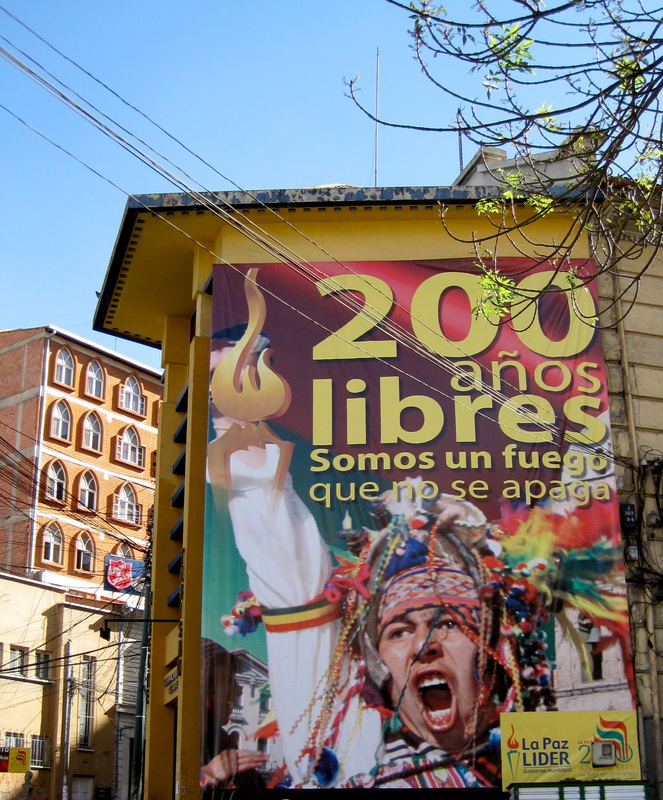
These historical revolutions penetrate many citizens’ understandings of “Bolivianness” today. When I arrived in La Paz for the first time in July 2009, I did so on the eve of the annual celebration Día de La Paz. All over the city banners were hung in celebration of  “200 Años Libre.” In 1809 several uprisings against royalist forces began in La Paz. Though insurgent troops did not succeed in a decisive victory over Spanish forces until 1825, it is the beginning of the campaign that is remembered as the year of freedom. On July 16, 1809 Pedro Domingo Murillo famously declared that the Bolivia revolution was igniting a fire that no one could put out. Though Murillo was hung in the Plaza de los Españoles that night, the plaza was renamed for him and he is remembered as a voice of the revolution. In 2009 banners around La Paz proclaimed, “Somos un fuego qué no se apaga!” [We are a fire that cannot be extinguished].

And so, to me, Bolivia lived up to its reputation as a hotbed of revolution. I had always (though self-consciously) romanticized Bolivian revolution a bit. [I've also written about Bolivian protest here and here]. I was continually impressed by the ways miners, teachers, and health workers could simply block off a road could and force the president into negotiations for salary increases, as had happened a few weeks after I arrived in La Paz in April 2011. I was awestruck at the “revolutionary pride” Hylton and Thomson had described, and always wondered why Bolivians were so effective at protest, while people in the US just seemed totally incapable.

Well, now, perhaps, times…they are a’changin…

Picture
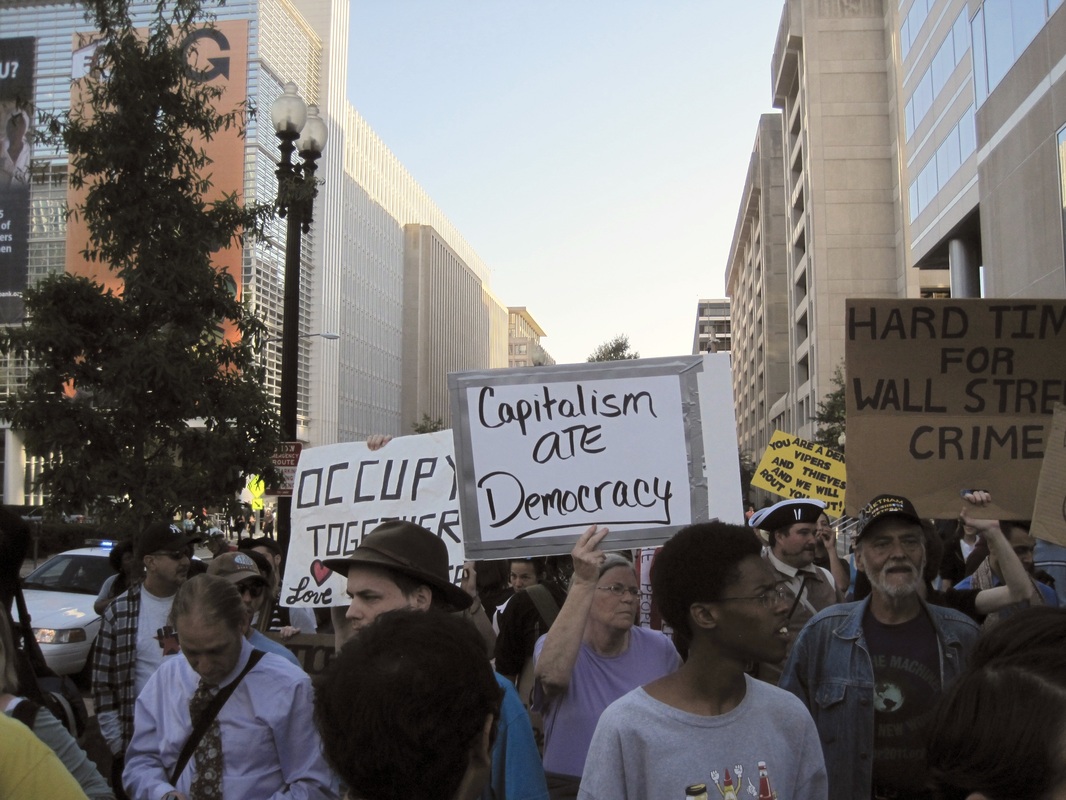
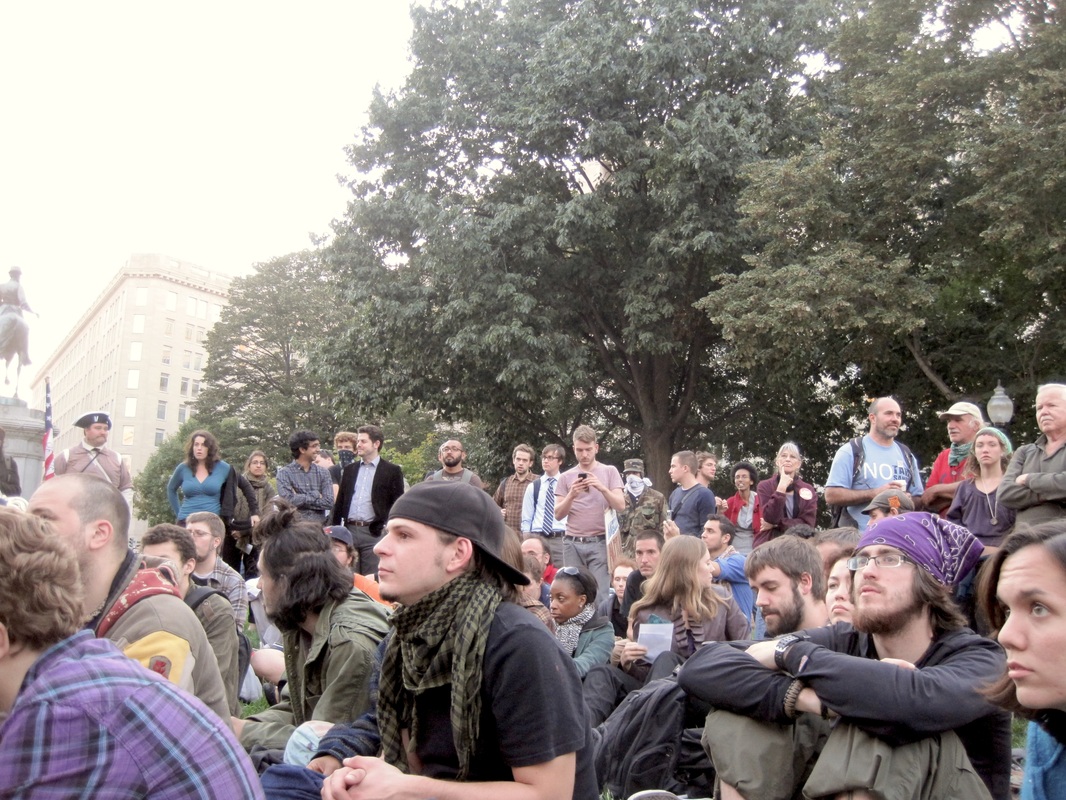
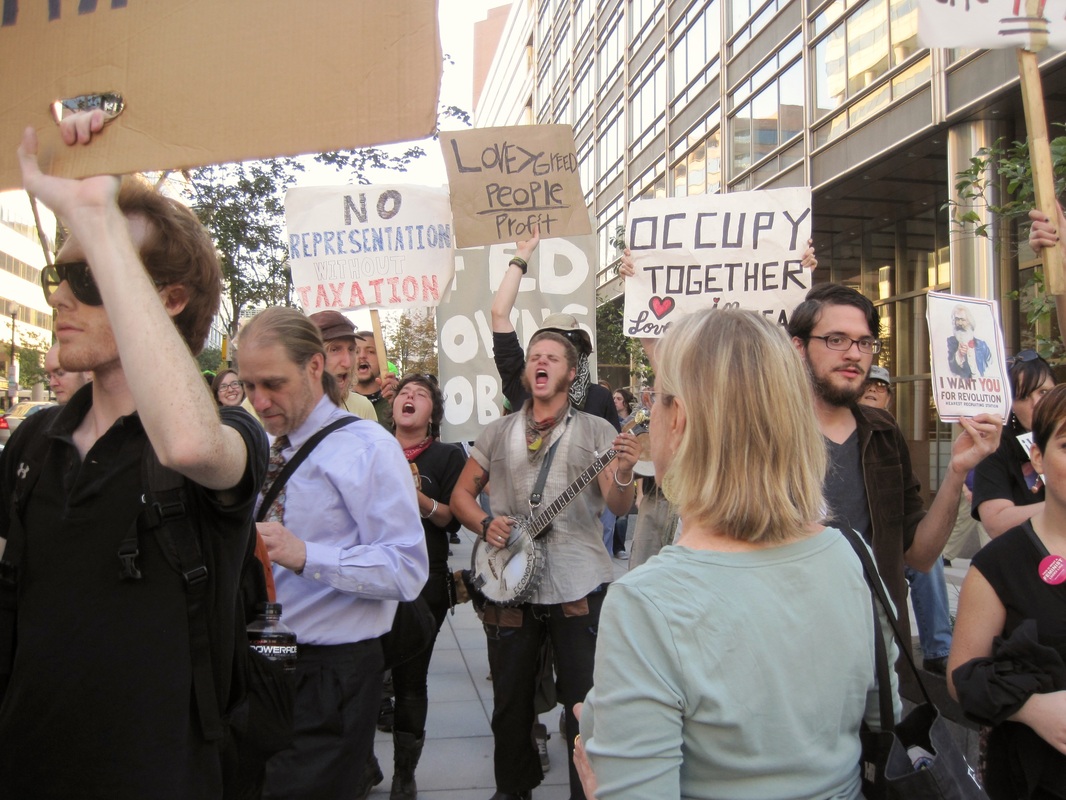
Occupy Wall Street is now almost a month old, and cities like Boston, Chicago, Philly, and Madison, and Minneapolis, (and of course my beloved DC's Occupy K Street) have similar occupations afoot. I’m still my cynical self and despite my semi-sporadic presence at DC General Assembly meetings, I’m not 100% convinced the REVOLUTION is immanent. I’d still consider myself hopeful though.

I’ve been taking fieldnotes on what I’ve experienced. I guess its just habit these days. But after reading a conference paper of mine on the representation [and/or imaginary] of Bolivian protest, my advisor suggested I develop it into a longer article for publication and incorporate some stuff on the Arab Spring and Occupy Movement. I’m still unsure if I will actually do that, but its made me think more critically about what is going on.

Picture
But here, I’m going to take time to comment on what to me has seemed the biggest debate associated with occupations: Specific Demands vs. Problematizing the Status Quo. From big news outlets such as the New York Times, and Wall Street Journal down to small scale political bloggers all emphasize the major weakness of the(se) movement(s) being a lack of specific demands. And much of the grassroots organizing communities (though certainly not all) have countered that essentially, it is not their job to write laws, and if the government had been doing their job all along, we wouldn’t be in this mess [I saw this summed up in a photo of a man with a sign at some occupation somewhere and now for the life of me can’t find the picture].

I’m still unsure where I fall in this debate. But the most cogent examination of this I’ve seen thus far has suggested we must “Turn the Shame Around.”

An unjust system’s first line of defense is shame. As long as we’re ashamed to admit that we’re victims, as long as we’re ashamed to identify with the other losers, we’re helpless.

It would be great to have a 10-point plan that solves everything. It would be great to have a party that endorses that plan and a get-out-the-vote movement to put that party into office. But none of that is going to happen until large numbers of us cast off our shame, until we turn the shame around: We need to stop being ashamed that we couldn’t crack the top 1%, and instead cast shame on an economic system that only works for 1%. The people who defend that immoral system and profit from it — they should be ashamed, not us.


He compares this movement to those of LGBT rights and Feminism, suggesting that before specific aims can be approached, a politics of visibility must emerge. He of course links to We are the 99%, which may be considered the first (or at least best publicized) online repository of shame shifting. [see also Matt Taibbi’s piece on Common Dreams]

He concludes

The old rules still apply. We’re going to need policies. We’re going to need agendas and lists of demands. We’re going to need leaders to represent us and armies of volunteers to knock on doors and make phone calls and write letters to the editor. We’re going to have to register millions of voters and get them to the polls. None of that is going to happen automatically just because people lose their shame about being victims of an economy run by and for the 1%.

But I don’t believe that stuff is going to happen at all — not on the scale we need — until people lose their shame about being victims and losers. It’s just a first step, but I don’t think we can skip it.


Picture
And so, I bring us back to the materiality of representation. As Butler (1998) and Fraser (1997) famously (for nerds like me) hashed out, representation is not “merely cultural.” Representations carry material consequences. For the luchadoras, using the image of the chola not only exploits but also reproduces indigenous women’s vulnerability to physical and structural harm, at times furthing the cycle of violence and subordination. For Occupiers, representation either grants legitimacy, leading to increased attention and solidarity, or delegitimizes the movement as fringe. So, to use Spivak’s (1988) notion that representation may be conceived of in two senses, the “re-presentation” of a group deeply impacts their ability to be spoken for in political representation.

So, yes, we Occupiers must eventually demand specific actions. But given the states of visibility and representation at the moment, we must still work on building solidarity, and strength. If we narrow our demands too early, they will not be heard. At the moment, the Nation is Waiting for Protesters to Clearly Articulate Demands Before Ignoring Them.

see more of my pictures on J & M's "letter to an @narquista in the oven"

0 Comments

"bolivia falta mucho"

3/9/2011

0 Comments

 
The country of Bolivia, nestled high in the Andes near the center of South America is considered to be one of the poorest and least developed countries in the hemisphere. After losing its coastal region to a Chilean military pursuit in 1879, it is begrudgingly land-locked. The 2001 National Census placed poverty rates at fifty-nine percent. Protest is quotidian in Bolivia. Indigenous groups frequently block off main inter-city routes creating shortages in food or petroleum, and interrupting daily life for those who live in the capital city. Bolivia is the world’s third largest cultivator of coca, which is chewed by locals as a mild stimulant, but also processed into cocaine making the nation a key target for international anti-drug campaigns. While many of the country’s service industries (like internet provider Entel) have been nationalized, many Bolivians  complain this has resulted in poor quality of service and slow improvements. (and indeed, posting this fieldnote from the US is proving to take just a fraction of the time it took for the notes posted from Bolivia). Moreover, many Bolivianos joke that Bolivia's claim to fame is not picturesque landscapes or even Che's assasination, but rather the incipent corruption that exists in both local and national government. Though Bolivia boasts a number of natural resources such as hydrocarbons, lithium, and silver, laws imposing high royalties have discouraged foreign investment, keeping these industries small. In essence, it is a country that both Bolivians and foreigners perceive as exuding shortcomings. “Bolivia falta mucho” many young Bolivians told me.

I spent one Saturday night in early July watching movies with my new friend Alé. I met him when our mutual friend Amanda suggested we help each other with a language exchange. My Spanish forever falls short of “fluent” or possibly even “coherent” and he needed to learn more English for his job as a tattoo artist. After high school Alé started studying Law and Human Rights at Universidad Mayor San Andres, the largest and best-known university in the city. But he struggled with the assignments, and after two years decided to quit and pursue art. Still living with his parents, they had something to say about this. Amidst questions about how he would ever earn a living making art, Alé decided to apprentice as a tattoo artist.

At first sight I assumed we had nothing in common. He wore skater-style sneakers, baggy jeans, and a black t shirt with some sort of tattoo-related design on the front. He usually wore a leather jacket with a hooded sweatshirt poking out the collar. He had a shaved head and dark stubbly facial hair. I, on the other hand generally looked rather bookish in collared shirts and cardigans. But our first conversation, over daily specials at Mr. Pizza in Sopocachi, made clear we thought very similarly about the world.

So on this evening in July, after watching Black Swan on a pirated DVD, we started talking politics. Like many political discussions in Bolivia, the subject of Ernesto “Che” Guevara arose. Suddenly, Alé declared “Oh, you should see this DVD I have.” He was already rustling through his collection of movies when he asked “Do you have time? It's getting late?” I agreed to watch it if he would drive me home afterwards. He put Siglo XX into the DVD player and we watched the collection of short documentaries on Che.

In the car, as he drove me back to my apartment in the San Pedro neighborhood, we started discussing Che’s brand of socialism in relation to Evo’s current presidency. And then, Alé caught me off guard. He told me that he, like many of his friends, admired the United States because social change could happen without violence. There was never bloodshed. No soldiers riding through the streets. No tear gas.

“Yes, but nothing ever really changes in the US” I responded. His comments surprised me because I had always (though self-consciously) romanticized Bolivian revolution a bit. I was continually impressed by the ways simply blocking off a road could force the president into increased salary negotiations with miners and health workers, as it had a few days after I arrived in La Paz. But later, as I thought about it, it all made perfect sense. Alé had experienced presidents like former military dictator Hugo Banzer who allegedly killed around 200 political opponents, and Gonzalo “Goni” Sanches de Lozada who was living about 4 miles from my home in Washington, DC, unable (or unwilling) to return to Bolivia where he would face human rights abuse charges. As a young child Alé lived through the fourth largest hyper-inflation ever recorded in the world, as part of the larger Latin American debt crisis of the 1980s. In 1994, when Alé was 10, the president’s chief aid was jailed on corruption and drug trafficking charges. As a young adult Alé experienced the Water War of 2000, Gas War of 2005, and the political violence of October 2003 when Goni’s troops killed dozens of protesters outside the city of La Paz. Yes, perhaps I could see why the stability of US democracy seemed alluring.

And Alé was not the only young person I met that imparted similar sentiments. From Rodolfo, who had always lived in El Alto, to Franco, who grew up in Zona Sur and had recently earned his B.A. at a private University in the US, the sentiment that the US government was a good model to follow was popular.

0 Comments

el día de la paz

15/7/2009

0 Comments

 
Today was a city-wide holiday. This on the brink of the national bicentenial (sort of-its 200 years since a declaration of independence. which failed, at first). I saw a bit of a parade, and a strange protest i couldn't make sense of. masked young people holding hands in 4 or 5 rows, walking slowly through a plaza.
Picture

my only accomplishment was getting a slightly better sense of the city, and i made myself a nice google map. i also set up a time to meet with a friend on friday for beers. oh, and i figured out the hot water in the shower. that is certainly an important accomplishment.

but the lonliness has set in. its always hard to figure out a new place by yourself. especially when people like leap have high expectations of what you'll come back with. and its nothing new. it happened in austria, on the rez (yes, even with bii jih bah around), in lima, in carbondale, even in dc. but the ability to predict it does little to prevent it.

i'm convinced that a partner would change things drastically. i'm certainly more adventurous with a partner. its easier to walk into a bar and strike up a conversation. its easier to explore new areas. sit in a coffee shop without looking conspicuous (well, of course a couple of gringas look a little conspicuous). try new food. go to museums.

and certainly all these things are possible alone. they're just harder. especially for someone shy like me. especially for someone who's not so confident in their spanish like me. in essence, i need a field wife. someone who's up for a little adventure, but are willing to go along with my whims as related to my "research." the husbands of those like furnea, wolf, and turner don't know how good they had it. maybe this is just all whining and without merit, but i think there's something to be said for collaborative research, especially in the beginning. though i am most certainly not advocating people be arbitrarily stuck together based on common interests, and grant makers certainly wouldn't want to pay double for plane tickets and lodging, i think it might open doors more quickly.

in essence i'm jealous of those people like the jag, hgill, & rumagin that have an in. maybe i should stick with small town karaoke. i've certainly got the background for that. but oh now....i have to go out on a limb to a place where i don't speak well, and try to make something of it. sigh. i hope this gets better (i mean, i know it will, but it didn't get THAT much better in peru)
0 Comments
Forward>>


    themes

    All
    Aesthetics
    Authenticity
    Body
    Bolivia
    Chile
    Chola
    Class
    Disaster
    Drugs
    Food Studies
    Gender
    Globalization
    Indigeneity
    Inequality
    Lucha Libre
    Methods
    Migration
    Neoliberalism
    Performance
    Politics
    Protest
    Social Media
    Sport
    Tattoo
    Tourism
    United States
    Violence

    archives

    September 2026
    August 2022
    July 2020
    November 2019
    October 2019
    July 2018
    May 2018
    April 2018
    October 2017
    September 2017
    July 2017
    March 2017
    February 2017
    December 2016
    September 2016
    August 2016
    May 2016
    August 2015
    July 2015
    June 2015
    May 2015
    March 2015
    February 2015
    January 2015
    December 2014
    November 2014
    October 2014
    September 2014
    August 2014
    July 2014
    June 2014
    May 2014
    April 2014
    March 2014
    February 2014
    January 2014
    December 2013
    November 2013
    October 2013
    September 2013
    August 2013
    July 2013
    March 2013
    January 2013
    December 2012
    November 2012
    October 2012
    September 2012
    August 2012
    June 2012
    May 2012
    April 2012
    March 2012
    February 2012
    January 2012
    December 2011
    November 2011
    October 2011
    September 2011
    July 2011
    June 2011
    May 2011
    April 2011
    August 2009
    July 2009

    RSS Feed

Powered by Create your own unique website with customizable templates.