nell haynes
  • home
  • bio
  • publications
  • projects
  • fieldnotes
  • teaching
  • contact
  • español

what security teaches us about private & public 

24/1/2014

0 Comments

 
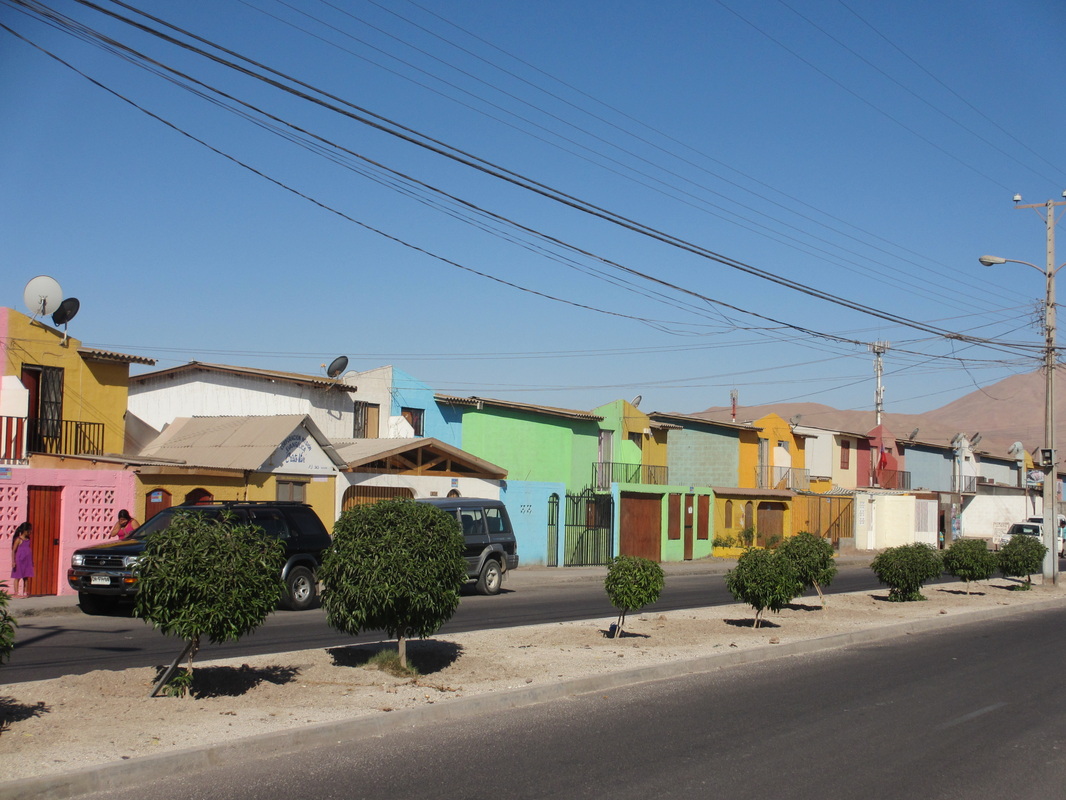
My colleague and senior research partner, Daniel Miller was visiting my fieldsite earlier this week. He had just arrived from his own fieldsite in Trinidad, and as I took him on a walking tour of Alto Hospicio, he kept remarking how different the two places are. They share certain aspects. They are quite warm. There is a beach nearby. People are not afraid to show some skin. Houses have gates. And yet, he told me after seeing Trini house fences, these just wouldn’t do. There is no cut glass or barbed wire on the top. They are not high enough to keep anyone out. Anyone with a friend to boost them up could be in without a problem. 
Picture
photo by Daniel Miller

Later, as we sat in my apartment discussing dissemination strategies, the usual evening dog barking and car alarm ringing began. I complained about the alarms with something like “if there’s one going off every three minutes they don’t seem to be actually providing any security.” He gave me a knowing look. There’s something about the feeling of security here. The desire to have the appearance of safety even if they only function as a symbol. It’s something like the little sticker on the window that says “This house is protected by ADT security.” Danny said he’d like to get a sticker made that says “This house is protected by a sticker.”

A few days later, after Danny left, Miguel drove over to my apartment to help me with my fish tank (that I inherited with the apartment--and these fish are most definitely Chilean). With the sliding door to the balcony wide open, the car alarm sounds drifted in quite regularly. For a moment, he stopped and listened. “Is that your car?” I asked. “No, no…I don’t think so,” he responded. And we went about changing the water some more. I always assumed car alarms functioned by simply drawing attention-anyone’s-to something amiss. Yet, what Miguel was teaching me was that the car alarms did serve a purpose. People listened for their own. They took individual responsibility for the security of their own vehicle rather than relying on others to come to their rescue. And I suppose the fences may do the same. Though Danny is probably right that a serious criminal wouldn’t have much problem getting over one, it may communicate a certain individual capability to handle their own security. As a local priest told me, "neighbors like each other, but there's not much trust between them, anymore." There is no neighborhood watch group here.

In a lot of ways this explains the ways I have been warned about safety here. People just don’t seem to trust what might happen in public space. And the fences around houses may in fact be a way of delimiting the private from the public in a way that leaves no questions as to where the boundaries lie. And by claiming the space as private rather than public, perhaps that makes it a little safer.

One of the benefits of having Danny here was that it meant I was speaking English in public. This attracted even more attention than my usual simple fact of being noticeably white. While we walked through the market near the municipal gymnasium a few days ago, a group of vendedores asked where we were from. As we chatted, asking about all things digitally related from snapchat to international call centers, one woman, who sells clothing in the market told us people never have their phones out in public because they are afraid someone will come by and swipe it. The most recent statistics I could find were from 2008, when 1,236 non-violent robberies (the type that might result in having their cell phone stolen from their hands as they sit in the plaza, or their pocket in a busy market). This is not particularly high, roughly matching national statistics, yet I am given pause that perhaps many such thefts go unreported. About a year ago, Iquique Radio reported that online security company ESET found almost 60% of Latin American residents have had at least one cellular phone stolen. The Catholic priest also told me that the most recent statistics he has seen suggests that about 40% of Alto Hospicio residents have had some personal effect stolen in the last year. "Probably because their billfold or phone is sticking out of their pocket in a public place." While statistics like "40%" and "1,236 reported" might not necessarily reveal much, I do sense that cellular phone theft is quite common and the vendedora is correct: people know this and protect themselves by not using their phone in public. 

So, I wonder then, if there is a certain “privateness” to the cell phone. And perhaps to the internet in general. Though one may interact with their friends though social media, that is generally something done while in private space. Even the local call center/internet café provides patrons with rather large cubicles while they use the computers. Though you might be airing your dirty laundry on facebook for all of your friends, the person physically next to you wouldn’t (or shouldn’t) know.

So these walls, these fences, these alarms, and these cubicles…they provide a sense of delineation. A car alarm may be tripped just as easily by someone doing a bad parking job or a ball thrown amiss as by someone trying to steal it. Fences can be jumped. Cubicles can be peeked around (at least one young man quickly turned off his porn as Danny and I walked by in the internet center). But that is not the point. The point, perhaps, is to say this is mine, and this is private. If you touch this, walk past it, or look at my screen, you are transgressing a boundary. So however social, social media might be, it ideally retains a sense of the private. 
0 Comments

how to dress like an anthropologist

4/12/2013

0 Comments

 
As the AAA (American Anthropological Association) annual conference descended upon Chicago a few weeks ago, the blogosphere and twittersphere (are those words?) were abuzz with everything even remotely anthropological. My favorite post of all, not surprisingly came from Savage Minds, and was titled “Conference Chic, or, How to Dress Like an Anthropologist.”
Picture
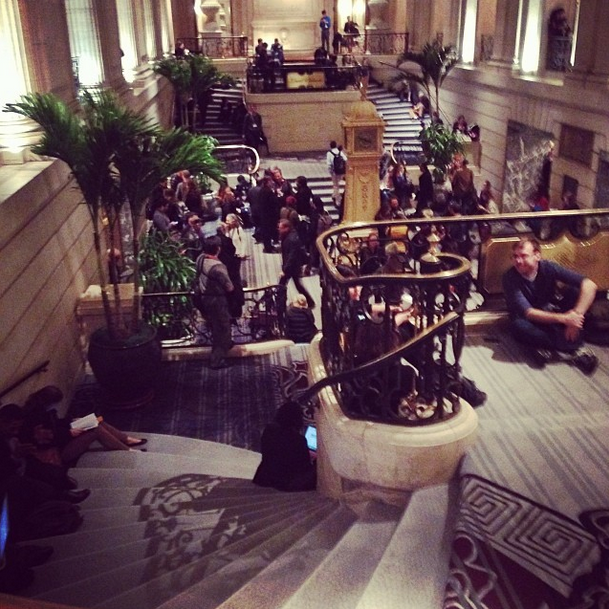
anthropologists buzzing around the hotel lobby at AAA

Now, this is not the first time I’ve scooped Savage Minds (the post in question)...But back in February 2012, I wrote a fieldnote titled “How to Dress like a Tattoo Artist.” Therein, I analyzed, discussed, and lightheartedly critiqued the ways my tattoo artist friends in La Paz dress. I concluded that “their bodies, in some ways more than other [people’s bodies], are obviously constructed…but though the specifics might differ, their bodies are constructed through the same processes as everyone else’s.” 

These processes include, as outlined by Donald Lowe (2005), the work we do, the commodities we consume, and the politics of gender and sexuality [and I would add religion, race, class, etc, etc] to which we ascribe or aspire. In other words, these bodies (all bodies) flexibly accumulate markers through consumption, production and processes of identification. And though obviously much of this works through commodified symbols, most anthropologists are aware of, if not actively critiquing, the contradictions of the capitalist system and the social problems associated with consumptive practices of the late modern era. In short, many of us would not be caught dead in the middle of an anthro conference wearing something that everyone knows was made under unfair labor conditions, mass-marketed, cost more than a day’s salary, or looks too ‘mainstream.’ 

Thus, the non-commodified symbols carry perhaps more weight with anthropologists than with many other groups (though even with both tattoo artists and backpackers in South America, these are incredibly important). Savage minds lists six categories of anthropological fashion/fashion concern: “anthropological” fieldsite flair, professional-but-not-too-professional balance, critique of capitalism and consumerism, career-stage, subdisciplinary distinctions, and scarves. 

Yes, scarves get their own category, as they well should.

Picture
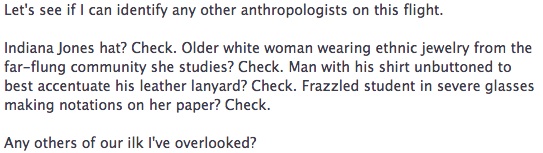
a colleague’s facebook post about her flight from DC to Chicago for AAAs

For me, the two that most reflect what I wrote about tatuadores are fieldsite flair and the critique of consumptive practices (though I think professional balance could be a subset of this). Both are in the service of authentification, but work in different ways. 

Firstly, to keep in mind the problems that arise from the ubiquitous consumptive practices of late-modern capitalism is not only about acknowledging global inequalities and all of the exploitation (of people, non-human animals, and natural resources) that is necessary to produce and sustain such a system of production and consumption (and that obviously is a very important part of it), but is also about performing as a person who is concerned about these things. Because as anthropologists, at least in this century, we are concerned with issues of social justice, to be ignorant or dismissive of these problems would mark one as uncritical, and thus something of a not so great anthropologist. Thus, to dress smartly, thoughtfully, but not entirely professionally, and certainly not in a way that overtly supports unjust productive and consumptive conditions, is to perform authentication (Bucholtz and Hall 2005:500) as an anthropologist. 

The flair component of dress performs authentication of another requirement of anthropology: fieldwork. Because anthropology prides itself on use of ethnography, long-term engagement with a fieldsite, and integration into communities in which we study, to wear things that come from or reflect the places we work becomes an important performance as well. Of course at times these things remind us of those to whose kindness and help we owe our information and lifework. But they also are something of a symbol to show to others not only where we work, but it’s importance to us, and that yes, we actually spent enough time in the field to find a beautiful stone necklace, to acquire a beautifully embroidered blouse, or even to be given a tshirt promoting a local business. 

And so, in the ways we dress, anthropologists often reflect the twin pillars of anthropology: theory and practice. Savage Minds quotes Carla Jones: “I suppose it is unsurprising that anthropologists are invested in what we wear at AAA, after all this is our social community. Who better than we understand that social meaning is generated through symbols?” Like the very tattoos that tatuadores wear, some symbols are important because of the social capital they connote, rather than their economic worth (use value rather than exchange value to put things in Marx’s terms).

And scarves are just important because they are awesome.
Picture
I show off fieldsite flair with my bolivian necklace, and of course, it’s paired with a scarf

And now, as a nod to perhaps my only consistent blog reader, I shall end with a question. What do you wear (at academic conferences or otherwise) that involves some sort of symbol? Is it conscious or ingrained that you do so? And what do you definitely not wear because of what it symbolizes?


References:

Bucholtz, Mary and Kira Hall
2005 Identity and Interaction: A Sociocultural Linguistic Approach. Discourse Studies 7(4-5):585-614.

Lowe, Donald M.
1995 The Body in Late-Capitalist USA. Durham: Duke University Press.

Further reading:

Adkins, Lisa and Celia Lury
1999  The Labour of Identity: Performing Identities, Performing Economies. Economy and Society 28(4):598-614. 

Atluri, Tara
2009  Lighten Up?! Humour, Race, and Da Off Colour Joke of Ali G. Media, Culture, & Society 31(2):197-214

Halberstam, J.
1998  Female Masculinity. Durham: Duke University Press.

Mort, Frank
1998  Cityscapes: Consumption, Masculinities and the Mapping of London since 1950. Urban Studies 35(5-6):889-907.
1995  Archaeologies of City Life: Commerical Culture, Masculinity, and Spatial Relations in 1980s London. Environment and Planning D: Society and Space 13:573-590. 
0 Comments

521 years of resistance

12/10/2013

0 Comments

 
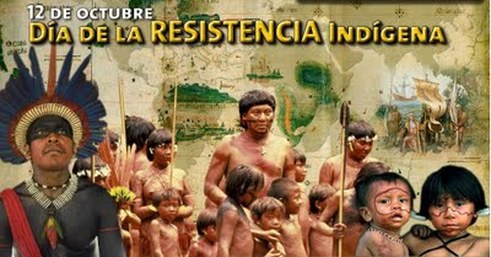
Today is 12 of October. In the Midwest, where I went to elementary school, this is known as Columbus Day. Later, as I gained a bit more worldly perspective I came to call it Indigenous People’s Day or Genocide Day under my breath. A few days ago, I got upset when my mother, who is a second grade teacher, mentioned she had Columbus Day off—partly because it is still institutionalized and partly because she called it Columbus Day without a hint of critique. But I’ll cut her some slack. When I’m in central Illinois she usually lets me come talk to her class about colonization. And the amazing thing is, when you explain that colonization was simply a bunch of Europeans who wanted to take the resources on another continent and felt it was necessary to murder, enslave, rape, and destroy the residents of that place in the process, even 8 year olds are pretty quick to realize that this is not something to be celebrated.

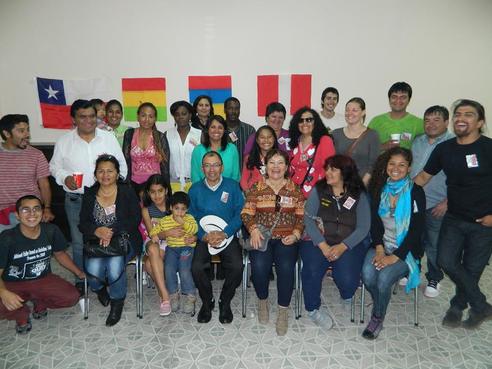
I arrived at the Preuniversitario where it was held around noon and was immediately asked where I’m from. I felt a little defensive and said that Raquel had invited me and hoped it would be ok if I could just stand in the back and watch. And then I realized the woman had asked me because all of the other audience members had pin on badges that announced what country they are from. Chile and Peru dominated the group of 50, but there were a few small nametag-sized Bolivian, Ecuadorian, and Colombian flags pinned to shirts as well. Unfortunately there were no United States pins on hand, but they were happy to have me. The chairs were all full, so I stood along the back and watched a slide projection on the front wall. There were pictures of Alto Hospicio and various local groups interspersed with graphical slogans such as “12 de octubre, 2013: 521 años de resistencia” [521 years of resistance] and “Por la dignidad de los pueblos americanos, 12 de octubre nada que celebrar” [For the dignity of american peoples, 12 October is nothing to celebrate].
 
Picture
The program began with a Chilean Cueca dance performed by two pairs adolescent boys and girls. Then the Ecuadorian woman who had greeted me earlier performed a pop song from her country. Representatives from the Colombian and Ecuadorian immigrant associations in Iquique spoke. An Afro-Peruvian woman sang two more songs, and several community figures and political candidates spoke briefly. Scattered throughout all of these various performances were discourses about the unity of the Americas against Europeans and Gringos (“that’s me!” I thought…). The Peruvian singer shouted several times over the boombox that accompanied her “America Latina es una sola!”

As the last local leader was speaking, Raquel came and stood next to me at the back. She asked if I could stay for the reception afterwards because she’d like to introduce me to a few people. I accepted and met several of the people she works with at the Preuniversitario along with being coerced into eating plenty of bocadillos, ceviche, and grilled shrimp.

As the reception was ending, Raquel’s friend Juan called everyone to the back room to take a photo. I lingered in the front room, but he singled me out saying “You too, Nell. You’re from the Americas. We need our representative from the United States present.” So I followed the crowd to the back, where we rearranged ourselves a number of times against a backdrop of handpainted paper flags, and finally got a decent shot (well, you can be the judge). 

Picture
There is certainly some multicultural pride here in Alto Hospicio, at least when it comes to public presentation. And the mix of anti-colonial and multi-cultural discourses was interesting, but not surprising given what I’ve seen here so far. But what I find most interesting is the memorialization that occurs through such events. Though the focus is on celebration and community, it is framed by this discourse of resistance to colonization and a memorialization of a past that continues to influence present events. One of the SocNet themes of focus is on the way memorialization occurs through social networks (see Shriram Venkatrama's account from India here). I’ve been keeping my eye out for Facebook pages dedicated to individuals who have died, but perhaps more important are these ways of memorializing political events and figures, not only online but in real life events, and the naming of institutions (more on that in the next post!). 

0 Comments

on privilege (including mine) pt 1

1/7/2013

0 Comments

 
Friday was the birthday of my friend Carrie (who I met in Potosí), a Canadian woman who is a graphic designer in La Paz. To celebrate, I met she and her friend Lisa who had flown in for the occasion at 2pm to get massages. They had just climbed Huayna Potosí, a 6000+ meter mountain, and their bodies were aching. I had been promising myself since finishing the final draft of my dissertation that I would relieve the aches of hunching over a laptop for months with a massage. We had reservations at a small local beauty shop on Calle Linares for 2:30, but as we were about to start walking they called us back. “Necesitamos cancelar la cita porque apagó la electricidad.” Well, what should one suspect in La Paz? Instead we walked to Hotel Europa, where my friend who works for the Inter American Development Bank always stays when he is in the city for business. 

Picture
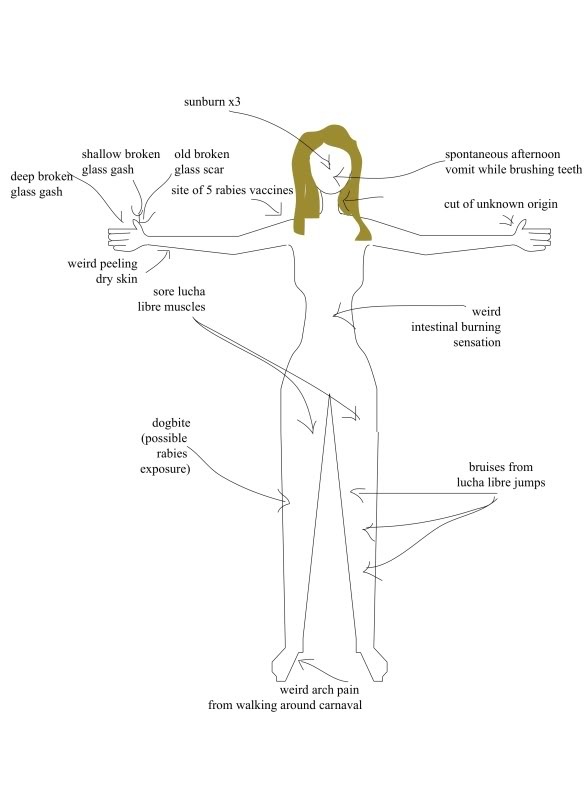
We walked through the giant automatic revolving door and the climate was immediately different. Warm and slightly humid. I wouldn’t have been surprised if they were pumping oxygen into the building as well. After consulting the front desk, we walked through the lobby to the pool and spa and asked for massages. They could only accommodate one every 15 minutes, so Carrie began first, while Lisa and I used one of the saunas. We chose the “wet” sauna (labeled in English), thinking that some humidity might be nice in contrast to the usual dry altiplano air. This was a corporeal experience I had never had in La Paz. My body has been exposed to sunburns, dog bites and subsequent rabies vaccines, many scars from cut glass, back spasms, dislocated knees and other various injuries from wrestling, constant colds, constant shivers, a month-long undiagnosed illness I swear was typhoid, and what must be at least 90% of the parasites known to humans—not to mention the general lack of oxygen one lives in every day here. 

Picture
image from february 2012

But in the sauna it was hot, wet, and smelled of lovely herbs. Water droplets pooled on my skin and I couldn’t tell if it was sweat or condensation. Either way, the outside air is never moist enough for either to happen. At first I didn’t like the sensation of the hot wet air I pulled into my lungs, but after five minutes I breathed more deeply, hoping it would clear away any mucus that might be stuck in the respiratory system waiting to make me resfriada (or worse). After ten minutes it was time to start my massage. 

I was completely naked beneath my towel and slightly embarrassed in the brief moments between hanging it up and having my but covered as I laid face down on the table. But the young Bolivian woman didn’t flinch, and she set to work rubbing the backs of my thighs. I thought about how she might have learned to be a masseuse. How she came to work at this hotel. What neighborhood she lives in. Whether she lives alone, with her partner, with her parents. If she has children. If she takes a trufi or minibus back to her neighborhood after work. If she prefers tucumanas or salteñas. How she celebrates her birthday. 

After forty five minutes I wrapped my towel around me again and went to the shower with the small pack of shampoo and soap I was given. It was a nice hot shower and I wondered if the women who work in the hotel ever shower there, or if they’re stuck with the electric showers in their frigid bathrooms at home. Do they even notice, having grown up in this place that is always cold?

0 Comments

re-adjusting 1: consumerism...or...why its a bad idea to return to the united states just in time for the holidays

4/12/2012

0 Comments

 
It had been over a month since the last pair of jeans I brought to La Paz got one too many holes and I had been subsisting on one ill-fitting too-low-rise pair and leggings with dresses combinations as long as I could. And finally I arrived in Lima. The beautiful neighborhood of Miraflores. The Pacific Ocean was four blocks in one direction, and the Fallabella department store at Parque Kennedy six blocks in the other direction. After a shower, a nap, and a falafel sandwich, just as the sun was setting over the ocean, I made my way to the glowing building on Avenida Jose Pardo.

Picture


This was the first department store I ever went to in South America. I remember walking through the door in 2006, wondering if they might have scarves, sweaters, or something of the like to keep me warm that first July I spent in Lima. It always seemed like it was five degrees too cold no matter how many layers of clothes I wore or layers of blankets I piled on. The only purchase I made that day was a Perú track jacket for my sister (which I've since restaked claim to).  

On this early November day though, my mission was different: Jeans. I tried on at least 15 pairs and studied the waistline, torso length, and leg cut of exponentially more. In the end my favorites were a pair of Bennetton jeans that were the equivalent of $70. I ended up buying a pair or S/70 skinny jeans instead. And even they were far, far better than any jeans I had tried on in a year.

Picture

I arrived in La Paz last January with two pairs of jeans: my favorite, slightly baggy, six year old gap jeans, and a newer, but still broken in pair of straight leg jeans. The baggy ones were the first to go. A few months in the knees were wearing then. and then they ripped. But on warm days or evening when I didn't leave my apartment they worked just fine. Then the right back pocket withered away. and finally, just below the right back pocket a but hole began to erupt. I declared them dead.

But they lived on in the patch I made from them to cover the newly emerging hole in the straight leg jeans that resided on my right hip bone. This held up quite well. But then around September the knees of those started disappearing as well. and then suddenly on both upper thighs there were rips every few inches.

And so, off to the El Alto market I went. I was in search of cheap jeans, and cheap used jeans there were. Most in what seemed to be my size were American Eagle or Aeropostale brand. But without fitting rooms I just didn't trust that the "low rise" waists would be sufficient on my long torso. So I went to my old standby, the second hand store on Calle Commercio. There my fears about these Juniors sized jeans were confirmed. Not a single pair fit me appropriately. So I thought I'd try a new pair at Shopping Norte (the centro commercial in Zona Central), just a few blocks away. I tried on what felt like every pair of jeans in at least 10 stores and finally, in a moment of exasperation bought a pair at Zap. But even these, which seemed to be made for real adult women had a very shallow crotch area, and after wearing them for a week couldn't bear it any more.

My birthday was approaching so I decided to treat myself-I walked over to the Levi's store. But to my surprise, the largest waist size they carried was 28. It seemed a 29 or 30 would have been fine, but I decided if I were going to buy jeans that cost about a quarter of the average Bolivian police man's monthly salary, they sure better fit me well. And the 28s did not. So I gave up. Back to the ZAP jeans (only for a few hours at a time), yoga pants, and skirts with leggings.

Picture

And I got on like that until Lima. Lima has always been a good, transitional city for me. It was my first South American city. And now, coming from La Paz it feels like a vacation in North America, only closer and speaking Spanish. But there is Starbucks, Chili's, McDonalds, Dunkin Doughnuts, department stores, fancy sushi restaurants, cheap falafel joints, more pizza places than you could imagine, music stores, book stores. "Its a proper city." Amanda once told me in an effort to get me to visit on a long weekend. So I thought spending five days there between Bolivia and the US would ease me into la vida norteamericana. But it didn't work out so well.

I arrived at LAX around midnight on the 11th, and J and her husband picked me up. We drove to J's parents' house where I was given the pull-out bed in the office room, complete with a TV and cable. Amused by this luxury I ended up watching some true crime show and marveling at how silly the late-night Made for TV offer commercials were. The next day we had lunch at a little cafe, we took a hike in the hills, drove over a windy road, walked to the beach, and had tacos and margaritas to finish it all off. The next day we arose early and hopped in the car to drive to San Francisco, stopping first for bagels, then pizza, then just to see the Madonna Inn, later at In 'n Out Burger, and finally at our hotel near Union Square in San Francisco. We walked across the street and had a few $7 beers (expensive, but not outrageous for big pints of local Anchorsteam). We went to bed early to get up for the conference the next morning.

After seeing J's panel, I decided I should try to do something about my lack of communication device (ie phone), and walked over to the T Mobile store. And along the way I noticed a line to get into the UNIQLO store. And then a giant clapping crowd huddled both inside and outside the door to the Apple Store. I just didn't understand...why would anyone wait to get into a store?

And then I started looking around some more. There were stores everywhere! H&M, Gap, Old Navy, not one, but 2 Forever Twenty One shops within a four-block radius. There was Nordstrom, Bloomingdales, Target, Best Buy, and Banana Republic. There was just so much to buy. And so many places to buy it.

And even a month after leaving La Paz, I still marvel at this. I'm now in a town of 2,000 people. An exhaustive list of the businesses here includes: 3 gas stations, 4 bars, 2 restaurants (if Subway counts as a restaurant), 1 pizza delivery place, 1 hardware store, 1 Dollar General Store, 3 Barbershops/Hair salons, 2 car washes, 1 bank and 1 grocery store. But the opportunities for consumption still run rampant. Its the holiday season, so the morning newspaper comes with a stack of department store advertisements whose pages outnumber those of the news. The television blares with some snappy song advertising brightly colored pants at old navy. I somehow find emails in my inbox with special seasonal sales. It feels unescapable. And it almost feels normal again. That's the scary part.  

0 Comments

how to dress like a tattooer

22/2/2012

0 Comments

 
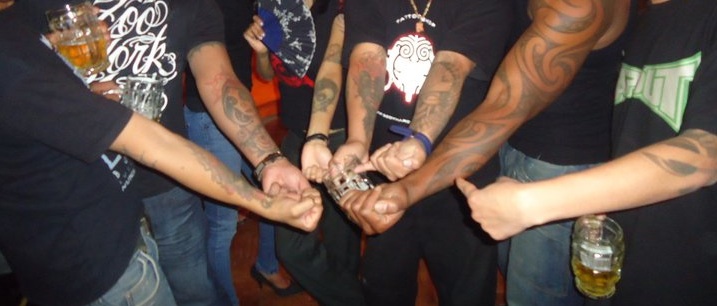
So the Tito’s guys walk into the bar in their certain affected ways, dripping with meaning. But they are not naked fusions of heads and limbs. They are not just bodies. They are bodies that are covered in various ways.

Gonz wears a black Pantera shirt over a black turtleneck. He has long, thick wavy hair pulled back in a ponytail. He has two lip piercings (of the sort I’ve heard my sister call “snakebites”), along with a few silver hoops in his ears.

Alé often wears an Ed Hardy shirt with a tiger on it that he told me he bought at the El Alto market one Sunday. He wears baggy light colored jeans and black Adidas shoes that often have the laces untied. His dark brown leather jacket has a sweatshirt hood poking out the collar. He shaves his head to the second lowest setting once a week. He has small black flesh plug earrings, and his right hand has a tattoo in black and red of a rotary tattoo machine that says “calibración.”

Edwin, the owner, in many ways looks the least menacing of them all. His medium sized flesh tunnel earrings are the most obvious visible nod to his career. He wears glasses that hover in the space between hipster and dorky. The night that Gonz surprised me with his energy, Edwin wore a white tshirt with the DC skateboarding logo on it. After 2 beers, he lifted it up to reveal the tattoo of a classic 1950s auto. He said, “and it’s a transformer!” I was puzzled. Then I started laughing hysterically as he puffed out the stomach and it resembled more of a VW bug than a long lean car.

Diego, I always picture in his “Johnny Walked” shirt—with the Johnny Walker logo, only in a wheelchair. He has black spiky hair and fairly large flesh tunnel earrings. He almost always wears ray ban sunglasses outdoors. He has a goatee and tattoos peak out of his shirt on his neck and his arms.

Picture
Their bodies, in some ways more than others,’ are obviously constructed. The piercings (many of which take time to stretch) and tattoos are visibly “unnatural.” But though the specifics might differ, their bodies are constructed through the same processes as everyone else’s. Donald Lowe (2005) lists, among other things, that processes of bodily construction include the work we do, the commodities we consume, and the politics of gender and sexuality to which we ascribe or aspire. In other words, these bodies (all bodies) flexibly accumulate markers through consumption, production, and identity practices.

What they have accumulated, among other things, is the ability to perform as authentic tattoo artists. Much has been written on the ways that both dress (Adkins and Lury 1999, Atluri 2009, Halberstam 1998), and purchase of goods (Mort 1995, 1998, Tomlinson 1990) work to perform authenticity of identity. Because they rely on social scripts (the ones that tell us not to trust a barber with a bad haircut or a tattoo artist with no tattoos), over time these symbols congeal to produce appearance of naturalness (Butler 1999:44). (Well, of course my tattoo artist wears a leather jacket. What would you expect? A tweed sport coat?)

As Bucholtz and Hall explain, authenticity (or as they say, “authentication,” to emphasize its active and processual nature) is about realness in contrast to artifice. Certain accumulations (clothing, tattoos and piercings for the Tito’s guys, or boyfriends from Travestis in India) provide validation for identities (2005:500).

Often authentication of identity is achieved through connection to valued symbols (Bucholtz and Hall 2005:500). But as Lowe writes, “All body practices [production practices, consumption practices, social reproduction practices, practices of sexuality and gender construction, and practices of psychopathology] have become commodified to such an extent, that the satisfaction of our diverse bodily needs is reconfigured by the requirements of flexible accumulation" (1995). Thus the “valued symbols” of today are often connected to certain brand names: Ed Hardy, DC, Pantera (yes I, along with other more respectable figures, argue bands at times may constitute a brand in and of itself).

Picture
Through juxtaposed images and signs, advertising connects product characteristics with prevailing social and cultural values. As a result, we no longer consume commodities to satisfy relatively stable and specific needs, but to reconstruct ourselves in terms of the lifestyle associated with the consumption of certain commodities.

Much like the travelers at the Ekko bar, the tattooists flexibly accumulate symbols of their identities: t shirts that reference “alternative” subcultures related to music or skateboarding, piercings of various sizes, visible tattoos, and bodily comportment that indexes an atagonistic attitude toward the world (authority?). And like the tourists, this accumulation, though it relies on certain forms of consumption, is not simply about buying specific products, but includes the accumulation of non-commodified symbols. Alé’s image of the tattoo machine on his hand is a clear example. Even his Ed Hardy tshirt, which likely cost less than 5Bs (75 cents) in El Alto is a product that is purchased, but is important for its social capital rather than its economic worth. 

However, as Carolan (2005) argues, in this new era of conspicuous consumption, surrounding oneself with "nice things" is insufficient … rather we are striving to become the 'Nice thing" itself, to literally embody our consumption. He suggests this is visible in the ways bodies are dressed, fed, comported, and even their apparent "health.” The outward appearance of one's body is considered to be a window to one's inner worthiness. Thus we arrive back at the body, a vehicle for brands and symbols. Litterally punctured. Literally written upon. And yet, perhaps it is the (somewhat) irreversible nature of these two latter processes that provides the sense of authenticity. A gate can be altered. A shirt can be changed. I know that Alé has a suit hanging in his closet. But that “calibración” on his hand is still going to be visible. And is still going to reference a very specific identity. 


Adkins, Lisa and Celia Lury
1999  The Labour of Identity: Performing Identities, Performing Economies. Economy and Society 28(4):598-614.

Atluri, Tara
2009  Lighten Up?! Humour, Race, and Da Off Colour Joke of Ali G. Media, Culture, & Society 31(2):197-214

Bucholtz, Mary and Kira Hall
2005 Identity and Interaction: A Sociocultural Linguistic Approach. Discourse Studies 7(4-5):585-614.

Butler, Judith
1999 Gender Trouble. New York: Routledge.

Carolan, Michael S.
2005 The Conspicuous Body: Capitalism, Consumerism, Class and Consumption. Worldviews 9(1):82-111.

Halberstam, Judith
1998  Female Masculinity. Durham: Duke University Press.

Lowe, Donald M.
1995 The Body in Late-Capitalist USA. Durham: Duke University Press.

Mort, Frank
1998  Cityscapes: Consumption, Masculinities and the Mapping of London since 1950. Urban Studies 35(5-6):889-907.
1995  Archaeologies of City Life: Commerical Culture, Masculinity, and Spatial Relations in 1980s London. Environment and Planning D: Society and Space 13:573-590.

Tomlinson, Alan
1990  Consumption, Identity, and Style: Marketing, Meanings, and the Packaging of Pleasure. New York: Routledge.

0 Comments

how to walk like a tattooer

21/2/2012

0 Comments

 
Last Thursday, I found myself in the Ekko bar, when Gonz, Luis, and Edwin from Tito’s Tattoos sauntered in. They stayed near the door, and there was part of me that wanted to go talk to them, but I didn’t want to appear to be some sort of groupie or something. They were on the couches in the vestibule, and I was just past the inner doorway by the bar. I played coy for a while, hoping they’d see me, but eventually when they wandered closer to replace their Paceña bottles with fresh ones, I tapped Gonz on the shoulder.

I expected a very cool, reserved response, but he actually got quite excited to see me. When I touched his shoulder, he slowly turned my direction, but upon recognizing me gave a little skip-like hop in my direction and gave me a hug.

This reaction surprised me. I expected something more reserved. More cool, calm, and collected. More “oh, I’m a cool tattoo dude, and you’re some gringa I’ve met twice before so I’ll say ‘hola’ and kiss you on the cheek, but no need to dwell.” But instead I got what felt like a genuinely excited reception. And I think the reason I expected something different, lies in the corporeality I’ve come to associated with the Tito’s guys.

Primarily meaning, Alé’s embodiment. He is calm and collected. Too cool, in many ways. Quiet, but brooding. He stands calmly, as if his feet are fastened to the floor and his chest is magnetized to the sky. His shoulders are back and down, as if he could wipe his hands across his chest and it would seem natural. He is slow and sustained. And a bit strained. He pulls his head back a little. He is tired. He is bored.

Edwin, the owner of Tito’s, is slow too. The way “cuando llegaste?” pulled out of his mouth the first time we saw each other this January, made an impression on me. Like taffy. Sweet and slow. But never overly enthusiastic. 

Diego, my first friend from Tito’s, is slow too, though with flourishes like Gonz, at times (though mostly out of anger). But he is heavy and tied to the ground. Diego, Edwin, & Alé all have a certain slowness. A liquidity. A gravity.

And Gonz in some ways is their opposite. He is jumpy, easily excited. He smiles wide and wags his hands. He moves his head forward when he listens. He has a weight to him. It is not as if he will float away at any moment. But one has the feeling that he could jump without warning, and land sloppily but with ease.

Picture
So all of this got the cogs in my brain turning, thinking about bodily movement. Marcel Mauss—perhaps the father of anthropological thought on embodied movement—suggested there is no "natural" way to walk, but only socially mediated and transmitted forms of moving. He called these learned forms of movement the "techniques of the body"-stances, postures, physical habits of body use that are acquired like language and that are equally communicative (1973). Patterns of action “do not just vary with individuals and their imitations, because “they vary especially between societies, educations, proprieties, and fashions, prestiges.” (1979:101). Bodily movement is learned. At times children are explicitly instructed in etiquette or manners, other times it is less explicit (but just as important). Indeed, from Goffman’s “Presentation of the Self” (1959) to Butler’s “performative repetition” (1999), one does not need to look hard to sociological explorations of the ways that bodily movement is not only learned but made to represent aspects of personhood, identity, or social position.

Perhaps one doesn’t need to theorize all this. Perhaps we all understand that the way one moves in the world says something about the person. She who walks with her head held high and a swagger in her step announces her confidence (and so much more), and we all understand. But I take time here to explain, because sometimes it is so seemingly natural that we barely notice. As Bourdieu explains: “When habitus encounters a social world of which it is the product, it finds itself ‘as fish in water’; it does not feel the weight of the water and takes the world about itself for granted” (in Wacquant 2004:43).

But as much as movement may seem natural, both the actor and the observer organize moves into meaningful action. I see the gravity and liquidity of most of the Tito’s guys and I interpret it as gestures toward “badass,” “too cool,” and “aloof.” In my head I hear Snoop Dog playing...

I cannot speak to what their motivations are (consciously constructed or subconsciously created), but David Best writes "One cannot specify an action, as opposed to a purely physical movement, without taking into account what the agent intended, that is there are reasons for, and purposes to, actions" (Best 1974:193). To put it in terms of Clifford Geertz’s interpretive anthropology, we must “sort winks from twitches and real winks from mimicked ones” (1973:16). That is to say, what I know or learn from their actions is not just about looking at physical movement, but includes understanding action in context (Best 1978:79). To understand body movement as socially relevant, its not just about “muscles, bones, and angles of displacement, locomotor patterns, or positional behaviors” (Prost 1996). Its about Bolivian chicos in their twenties, who for various reasons make a living as tattoo artists, entering a gringo bar. Their swagger is laden with the politics of language (they speak Spanish in an English speaking place in a Spanish speaking country). Their speaking patterns are influenced by cosmopolitanism and globalization of travel. It is about globalization of imagery and pop culture. It is about the fact that the sign outside the shop says “Tito’s Tattoos and Piercing,” not “Tito’s Tatuaje y Perforación.” It is about a performance of gender that is utterly globalized in ways that are far from uni-directional. No, it is about performances of gender that range from Megadeath tshirts to VW bugs. And it is about sexuality. It is very very much about sexuality.   

Picture
And as these factors mold the body, the body molds the person is as well. Our bodies are intimately implicated in our identities. Our race, class, gender, sexuality, ability, age, religious afiliation, political stances, and whatever else, may be written upon the body, but also mutually constitute the body as well. As Mauss wrote, the body is simultaneously the object upon which culture works, as well as the tool with which that work is achieved (1973).

So then, this all begs the question…do the Tito’s guys conceive tattooing as a mental creative process or as a physical skill? Most likely it’s a combination, but what is privileged? What is heightened and what is obscured? Which is the attractive part? And what does that tell us about embodiment?


Best, David
1974  Expression in Movement and the Arts. Lepus Books, London.

Butler, Judith
1999  Gender Trouble. New York: Routledge.

Geertz, Clifford
1973  Interpretation of Cultures. New York: Basic Books.    

Goffman, Erving
1959  The Presentation of Self in Everyday Life. Garden City: Prentice Hall.

Mauss, Marcel
1979  Sociology and Psychology: Essays. Ben Brewster, trans. Boston, MA: Routledge 1973  Techniques of the Body. Economy and Society 22(1):70-88.

Prost, J.H.
1996  Review Essay: Body Language in the Context of Culture. Visual Anthropology 8(2-4):337-43.

Wacquant, Loïc
2004 Body and Soul: Notebooks of an Apprentice Boxer. New York: Oxford University Press.

  
0 Comments

closer to home

13/10/2011

0 Comments

 
In Orin Starn’s 1991 article, “Missing the Revolution,” he chastised anthropologists for missing signs of the rise of Sendero Luminoso [Shining Path], the Peruvian Maoist insurgent organization. He suggests anthropologists were too absorbed in Andeanism, a term he borrows from Edward Said’s Orientalism, to mean depictions of life in the Andes that portray contemporary peoples as outside the flow of modern history (395). Because of their narrow focus, they missed the important politics and historical dynamics that fomented the rise of groups like Shining Path. As he wrote, for hundreds of anthropologists…the rise of the Shining Path came as a complete surprise” (395).

Many anthropologists took this call to heart, and much recent work on the Andes has indeed centered on working-class and rural peoples’ protest, political work, and revolution. Scholars such as Forrest Hylton and Sinclair Thomson highlight the “revolutionary spirit” of indigenous and mestizo Bolivians. Indeed, strong movements opposing neoliberal economic policies and multinational corporations’ ownership of many of Bolivia’s natural resources have been politically effective. One of the most heightened moments of this movement was the inauguration of Evo Morales, Bolivia’s (and the hemisphere’s) first indigenous president. In speeches celebrating his inauguration, Evo emphasized both his indigeneity and revolutionary ideology with statements such as “I say to you, my Indian brothers and sisters from America concentrated here in Bolivia, the 500 year campaign of resistance has not been in vain. This democratic, cultural fight is part of the fight of our ancestors; it is the continuity of the fight of Tupaj Katari, of Che Guevara.” In this small statement, he links himself and his supporters not only to leftist revolutions in Latin America of the last century, but also to a much longer lineage of anti-colonialism, anti-imperialism, and anti-exploitation that has existed since subaltern Bolivians resisted their colonial exploiters. Revolution then is not something that happened in the past, but something that is the continuity between “then” and “now.”

Picture
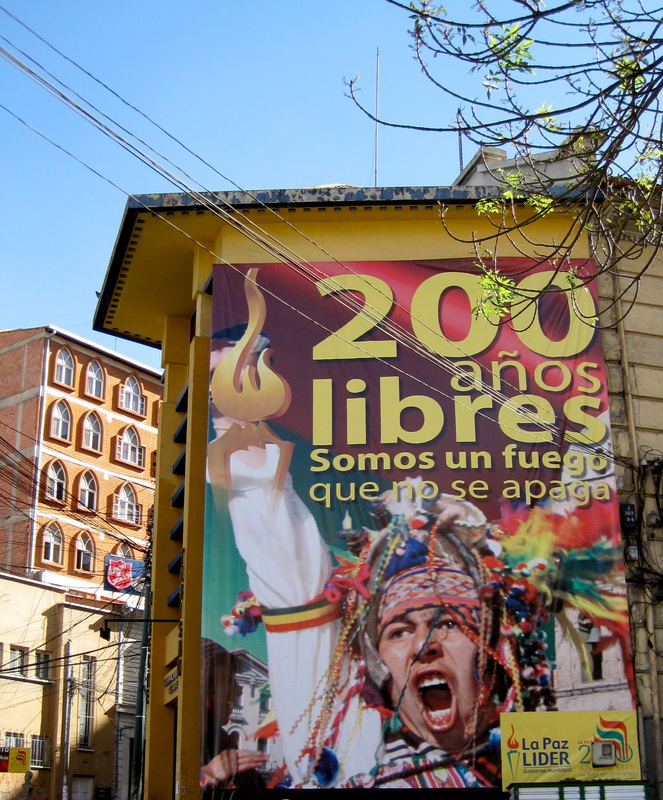
These historical revolutions penetrate many citizens’ understandings of “Bolivianness” today. When I arrived in La Paz for the first time in July 2009, I did so on the eve of the annual celebration Día de La Paz. All over the city banners were hung in celebration of  “200 Años Libre.” In 1809 several uprisings against royalist forces began in La Paz. Though insurgent troops did not succeed in a decisive victory over Spanish forces until 1825, it is the beginning of the campaign that is remembered as the year of freedom. On July 16, 1809 Pedro Domingo Murillo famously declared that the Bolivia revolution was igniting a fire that no one could put out. Though Murillo was hung in the Plaza de los Españoles that night, the plaza was renamed for him and he is remembered as a voice of the revolution. In 2009 banners around La Paz proclaimed, “Somos un fuego qué no se apaga!” [We are a fire that cannot be extinguished].

And so, to me, Bolivia lived up to its reputation as a hotbed of revolution. I had always (though self-consciously) romanticized Bolivian revolution a bit. [I've also written about Bolivian protest here and here]. I was continually impressed by the ways miners, teachers, and health workers could simply block off a road could and force the president into negotiations for salary increases, as had happened a few weeks after I arrived in La Paz in April 2011. I was awestruck at the “revolutionary pride” Hylton and Thomson had described, and always wondered why Bolivians were so effective at protest, while people in the US just seemed totally incapable.

Well, now, perhaps, times…they are a’changin…

Picture
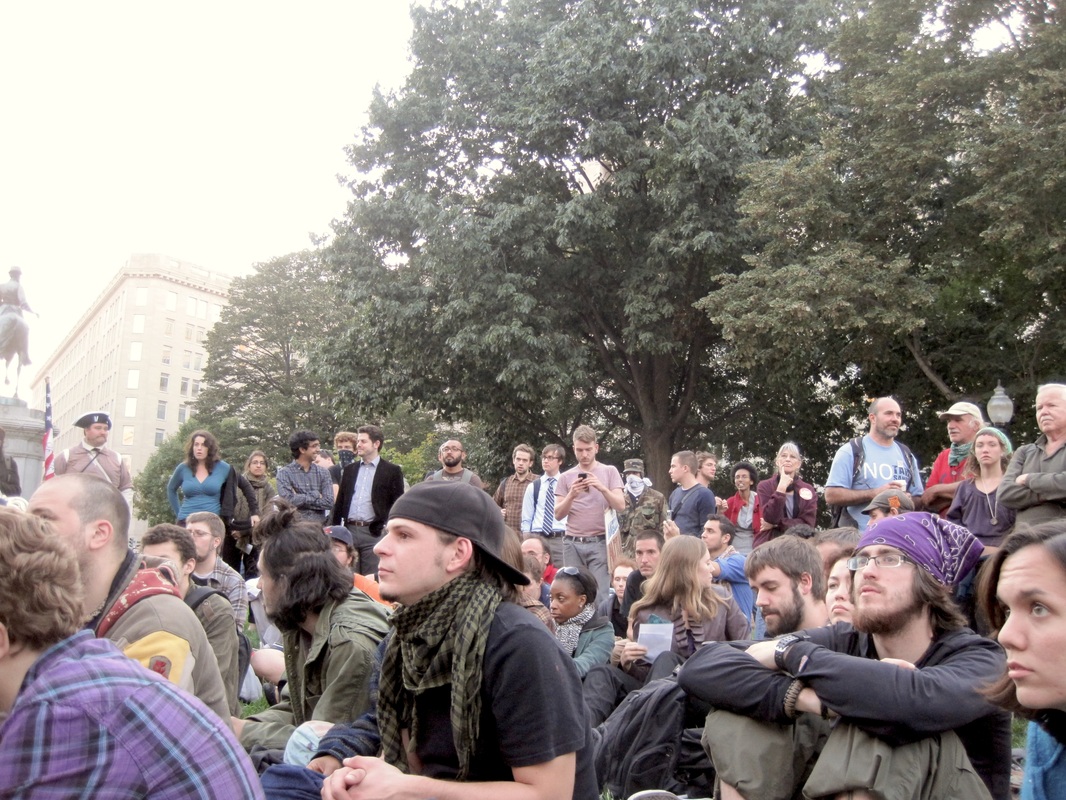
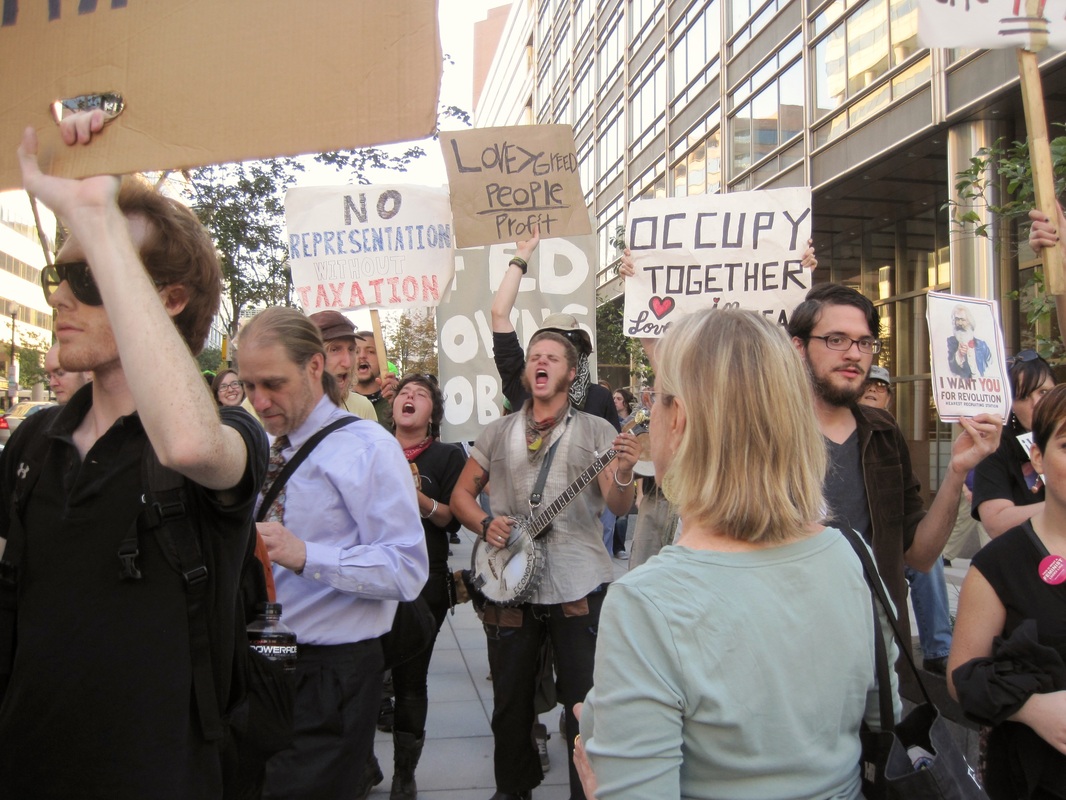
Occupy Wall Street is now almost a month old, and cities like Boston, Chicago, Philly, and Madison, and Minneapolis, (and of course my beloved DC's Occupy K Street) have similar occupations afoot. I’m still my cynical self and despite my semi-sporadic presence at DC General Assembly meetings, I’m not 100% convinced the REVOLUTION is immanent. I’d still consider myself hopeful though.

I’ve been taking fieldnotes on what I’ve experienced. I guess its just habit these days. But after reading a conference paper of mine on the representation [and/or imaginary] of Bolivian protest, my advisor suggested I develop it into a longer article for publication and incorporate some stuff on the Arab Spring and Occupy Movement. I’m still unsure if I will actually do that, but its made me think more critically about what is going on.

Picture
But here, I’m going to take time to comment on what to me has seemed the biggest debate associated with occupations: Specific Demands vs. Problematizing the Status Quo. From big news outlets such as the New York Times, and Wall Street Journal down to small scale political bloggers all emphasize the major weakness of the(se) movement(s) being a lack of specific demands. And much of the grassroots organizing communities (though certainly not all) have countered that essentially, it is not their job to write laws, and if the government had been doing their job all along, we wouldn’t be in this mess [I saw this summed up in a photo of a man with a sign at some occupation somewhere and now for the life of me can’t find the picture].

I’m still unsure where I fall in this debate. But the most cogent examination of this I’ve seen thus far has suggested we must “Turn the Shame Around.”

An unjust system’s first line of defense is shame. As long as we’re ashamed to admit that we’re victims, as long as we’re ashamed to identify with the other losers, we’re helpless.

It would be great to have a 10-point plan that solves everything. It would be great to have a party that endorses that plan and a get-out-the-vote movement to put that party into office. But none of that is going to happen until large numbers of us cast off our shame, until we turn the shame around: We need to stop being ashamed that we couldn’t crack the top 1%, and instead cast shame on an economic system that only works for 1%. The people who defend that immoral system and profit from it — they should be ashamed, not us.


He compares this movement to those of LGBT rights and Feminism, suggesting that before specific aims can be approached, a politics of visibility must emerge. He of course links to We are the 99%, which may be considered the first (or at least best publicized) online repository of shame shifting. [see also Matt Taibbi’s piece on Common Dreams]

He concludes

The old rules still apply. We’re going to need policies. We’re going to need agendas and lists of demands. We’re going to need leaders to represent us and armies of volunteers to knock on doors and make phone calls and write letters to the editor. We’re going to have to register millions of voters and get them to the polls. None of that is going to happen automatically just because people lose their shame about being victims of an economy run by and for the 1%.

But I don’t believe that stuff is going to happen at all — not on the scale we need — until people lose their shame about being victims and losers. It’s just a first step, but I don’t think we can skip it.


Picture
And so, I bring us back to the materiality of representation. As Butler (1998) and Fraser (1997) famously (for nerds like me) hashed out, representation is not “merely cultural.” Representations carry material consequences. For the luchadoras, using the image of the chola not only exploits but also reproduces indigenous women’s vulnerability to physical and structural harm, at times furthing the cycle of violence and subordination. For Occupiers, representation either grants legitimacy, leading to increased attention and solidarity, or delegitimizes the movement as fringe. So, to use Spivak’s (1988) notion that representation may be conceived of in two senses, the “re-presentation” of a group deeply impacts their ability to be spoken for in political representation.

So, yes, we Occupiers must eventually demand specific actions. But given the states of visibility and representation at the moment, we must still work on building solidarity, and strength. If we narrow our demands too early, they will not be heard. At the moment, the Nation is Waiting for Protesters to Clearly Articulate Demands Before Ignoring Them.

see more of my pictures on J & M's "letter to an @narquista in the oven"

0 Comments

"bolivia falta mucho"

3/9/2011

0 Comments

 
The country of Bolivia, nestled high in the Andes near the center of South America is considered to be one of the poorest and least developed countries in the hemisphere. After losing its coastal region to a Chilean military pursuit in 1879, it is begrudgingly land-locked. The 2001 National Census placed poverty rates at fifty-nine percent. Protest is quotidian in Bolivia. Indigenous groups frequently block off main inter-city routes creating shortages in food or petroleum, and interrupting daily life for those who live in the capital city. Bolivia is the world’s third largest cultivator of coca, which is chewed by locals as a mild stimulant, but also processed into cocaine making the nation a key target for international anti-drug campaigns. While many of the country’s service industries (like internet provider Entel) have been nationalized, many Bolivians  complain this has resulted in poor quality of service and slow improvements. (and indeed, posting this fieldnote from the US is proving to take just a fraction of the time it took for the notes posted from Bolivia). Moreover, many Bolivianos joke that Bolivia's claim to fame is not picturesque landscapes or even Che's assasination, but rather the incipent corruption that exists in both local and national government. Though Bolivia boasts a number of natural resources such as hydrocarbons, lithium, and silver, laws imposing high royalties have discouraged foreign investment, keeping these industries small. In essence, it is a country that both Bolivians and foreigners perceive as exuding shortcomings. “Bolivia falta mucho” many young Bolivians told me.

I spent one Saturday night in early July watching movies with my new friend Alé. I met him when our mutual friend Amanda suggested we help each other with a language exchange. My Spanish forever falls short of “fluent” or possibly even “coherent” and he needed to learn more English for his job as a tattoo artist. After high school Alé started studying Law and Human Rights at Universidad Mayor San Andres, the largest and best-known university in the city. But he struggled with the assignments, and after two years decided to quit and pursue art. Still living with his parents, they had something to say about this. Amidst questions about how he would ever earn a living making art, Alé decided to apprentice as a tattoo artist.

At first sight I assumed we had nothing in common. He wore skater-style sneakers, baggy jeans, and a black t shirt with some sort of tattoo-related design on the front. He usually wore a leather jacket with a hooded sweatshirt poking out the collar. He had a shaved head and dark stubbly facial hair. I, on the other hand generally looked rather bookish in collared shirts and cardigans. But our first conversation, over daily specials at Mr. Pizza in Sopocachi, made clear we thought very similarly about the world.

So on this evening in July, after watching Black Swan on a pirated DVD, we started talking politics. Like many political discussions in Bolivia, the subject of Ernesto “Che” Guevara arose. Suddenly, Alé declared “Oh, you should see this DVD I have.” He was already rustling through his collection of movies when he asked “Do you have time? It's getting late?” I agreed to watch it if he would drive me home afterwards. He put Siglo XX into the DVD player and we watched the collection of short documentaries on Che.

In the car, as he drove me back to my apartment in the San Pedro neighborhood, we started discussing Che’s brand of socialism in relation to Evo’s current presidency. And then, Alé caught me off guard. He told me that he, like many of his friends, admired the United States because social change could happen without violence. There was never bloodshed. No soldiers riding through the streets. No tear gas.

“Yes, but nothing ever really changes in the US” I responded. His comments surprised me because I had always (though self-consciously) romanticized Bolivian revolution a bit. I was continually impressed by the ways simply blocking off a road could force the president into increased salary negotiations with miners and health workers, as it had a few days after I arrived in La Paz. But later, as I thought about it, it all made perfect sense. Alé had experienced presidents like former military dictator Hugo Banzer who allegedly killed around 200 political opponents, and Gonzalo “Goni” Sanches de Lozada who was living about 4 miles from my home in Washington, DC, unable (or unwilling) to return to Bolivia where he would face human rights abuse charges. As a young child Alé lived through the fourth largest hyper-inflation ever recorded in the world, as part of the larger Latin American debt crisis of the 1980s. In 1994, when Alé was 10, the president’s chief aid was jailed on corruption and drug trafficking charges. As a young adult Alé experienced the Water War of 2000, Gas War of 2005, and the political violence of October 2003 when Goni’s troops killed dozens of protesters outside the city of La Paz. Yes, perhaps I could see why the stability of US democracy seemed alluring.

And Alé was not the only young person I met that imparted similar sentiments. From Rodolfo, who had always lived in El Alto, to Franco, who grew up in Zona Sur and had recently earned his B.A. at a private University in the US, the sentiment that the US government was a good model to follow was popular.

0 Comments

on playing a distinctly midwestern card game in a distinctly andean city within a distinctly globalized neolibreral context

28/7/2011

0 Comments

 
I don’t really know who taught me the game, but I imagine it was some upperclassperson my freshman year of high school. We all learned: the nice, jenz, jb, bs, and I. And we, in turn, taught our fair share of freshmen as we got older.

Picture
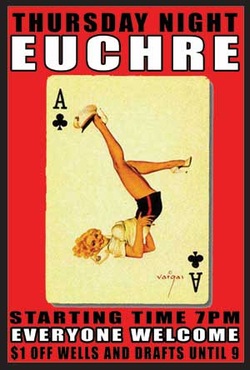
The game of Euchre is similar to Spaids and Hearts, but to me is better. It requires more thought and strategy. And knowing how your partner plays can make or break a trick if not the game. It is a distinctly Midwestern game; I’ve never met anyone who knows the game who didn’t spend a significant amount of time in the Midwest. At least as far as wikipedia can tell me, it was brought by German settlers to Michigan and spread from there. And maybe, just a little, I like it because its distinctly Midwestern. It is to be taken very seriously. It is not a game of luck but a game that tests your stamina, your sharpness, your insight. It is not a recreational game. In fact, it reminds me of the way Chuck Klosterman describes Midwest Power Drinking:

People in the Midwest drink differently than everywhere else I’ve ever been; its far less recreational. You have to stay focused, you have to work fast, and you have to swallow constantly.

I once dealt the perfect hand of Euchre. I was playing on a bus to some nerdy interscholastic event with jenz as my partner. Jb and massman were our opponents. I distributed the cards and flipped over a 10 of spaids. Massman, who was sitting to my left told me to pick it up. Before I could even discard he had said he was going it alone and displayed his full hand: right bower, left bower, ace, king, queen. All trump. Otherwise known as a Ray Charles.

And not long after I went to college and the ubiquity of Euchre disappeared from my life. Now, those of you who know a bit of my history (or have read my cv) may note that I attended university in the heart of the Midwest. And yet, apparently, the student body had enough geographic diversity that Euchre never became a mainstay. I do remember playing it once, while camping on a Chicago-suburban living room floor after shooting a student film all day. But even then, the two of us that knew the game had to teach everyone else (from places like New York, Atlanta, and LA). I continued to play occasionally, usually only with high school friends while home for a holiday, or after a wedding rehearsal dinner. But these times have become so few and far between that the game rarely crosses my mind.

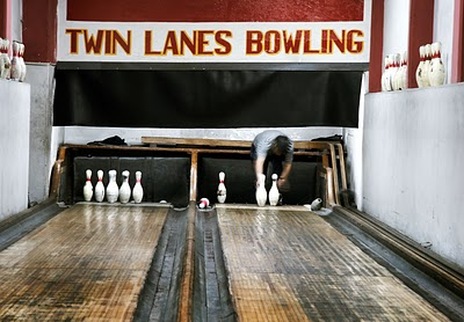
And then, Tuesday night, it popped into my head. Some of the Death Road guide guys were going bowling and invited me along. As instructed I walked along the Prado until I was across from the Post Office. I found the hotdog cart and squeezed past it. I went down the narrow staircase and past the scantily occupied lunch tables and found the two hand-set lanes. I was late and had to bowl five frames in a row to catch up. First bowl a gutterball. Second bowl 8 pins. Second frame, a spare. Third frame, a strike. Fourth frame, a respectable 8. After that I don’t really recall. The remainder of the game involved plenty of complaining that the pin-setting guys were setting like they were on acid, and sarcastic claims of being a “gentleman” when taking the lane that was less warped. The guys also did a fair amount of farting, sometimes directly on one another, and even on Tasha, the only other woman in attendance, but never on me. However, when one of the guys I hadn’t met before suggested to Justin that he shouldn’t fart so close to me, his comment strikingly reminded me of Steve’s 7th grade comment, “Yeah, but Nell doesn’t count as a girl.” Justin replied “Its ok, Nell’s one of the guys.”  


Picture
But that’s not important. That’s not the point of the story.

After finishing the game (in 4th place of 7, with 109 points), the three guides that had Wednesday off decided to go to the brewery with Tasha and I. We arrived, ordered fancy drinks (white Russians and long island ice teas), and settled down at a table with a deck of cards. It was Pete that suggested we play a game, and suddenly it dawned on me. Pete is from Indiana. Indiana is in the Midwest. People in the Midwest who play cards play Euchre. I could barely get the question out of my mouth without squealing: “Do you play Euchre?”

And of course he said yes.

So we had to teach Tasha and Justin the game while Rick put his head down and slept. And in the end we didn’t even finish because everyone was tired. This also kept Justin and I from officially losing (the score was 8-6 when we quit). So it was not any spectacular game of Euchre. It had been several years since I last played and I think I’ve lost a bit of my intuition about the game. I did, however, manage to take 3 tricks with the Ace, King, and Queen of trump by leading with a 10 of trump out of the gate—a highly unorthodox move. But in the end, it was just a slow learner’s game.

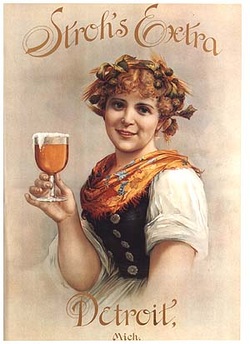
What was incredible about it though, was the fact that I was in Bolivia, playing a game that is generally confined to the Midwestern United States with 2 Kiwis. And I started thinking about the processes that brought us to this point. First, German immigration to the Midwest, and specifically Michigan, began around 1820 but intensified due to unsuccessful European revolutions around 1848 (which coincidentally is right around when ol’ Bernhardt Stroh set up shop in Detroit...See, I knew Klosterman’s thoughts on Midwestern Power Drinking were somehow connected).

Picture
Then there was the proliferation of the game throughout the Midwest. As the decades elapsed, farmers moved to cities. Children moved to university towns, and the Euchre players from Michigan radiated out across the Midwest due to no small number of economic and migratory processes. And by the 1990s (though probably long before), high school kids in places like Heyworth, Illinois and Carmel, Indiana were playing Euchre.

But that is only half the story. Bolivia is also important. Tourism in Bolivia is not a big business relative to many of its surrounding nations. Bolivia garners roughly 300,000 tourists per year, while neighboring Perú attracts more than 2 million tourists a year (Library of Congress 2006). This vast difference is attributed to Bolivia’s political instability and lack of first-class accommodations (Library of Congress 2006), but may also be a product of the fact that the government of Bolivia pays little attention to tourism, in contrast to Peru (Ypeij and Zorn 2007). So while Bolivia is a major stopping point between the Andes of Perú, Lake Titicaca, and destinations in Argentina or northern Chile (Ypeij and Zoomers 2006)., it retains a sense of being somewhat “undiscovered” for many of the travelers. Those travelers that do spend time in La Paz, tend to be those seeking outdoor trekking opportunities. Hyuana Potosi, “the world’s easiest 6000 meter mountain,” is nearby, as well as hiking opportunities on Chacaltaya Mountain, or treks to more jungle-like areas such as Coroico. And this market for outdoor, adventure, tourism is no doubt what created an opportunity for biking down Death Road. Ten years ago, a New Zealander who had been living in La Paz started the first company, the one Pete, Justin, and Rick work for. 

And all of these processes--different modes of Globalization since european Colonialism, Economic Migration, Revolution in europe, Urbanizatio in the midwest, "Instability" and Economic Sanctions related to the Drug Trade in bolivia, Neoliberalism in la paz, expat Flexible Citizenship, Cosmopolitanism of travelers and tourist companies, Flexible Accumulation of microbrewed beer, and the Friction of it all--come together in the most unexpected of ways.

I told you Euchre is a game that must be taken seriously.
0 Comments
<<Previous
Forward>>


    themes

    All
    Aesthetics
    Authenticity
    Body
    Bolivia
    Chile
    Chola
    Class
    Disaster
    Drugs
    Food Studies
    Gender
    Globalization
    Indigeneity
    Inequality
    Lucha Libre
    Methods
    Migration
    Neoliberalism
    Performance
    Politics
    Protest
    Social Media
    Sport
    Tattoo
    Tourism
    United States
    Violence

    archives

    September 2026
    August 2022
    July 2020
    November 2019
    October 2019
    July 2018
    May 2018
    April 2018
    October 2017
    September 2017
    July 2017
    March 2017
    February 2017
    December 2016
    September 2016
    August 2016
    May 2016
    August 2015
    July 2015
    June 2015
    May 2015
    March 2015
    February 2015
    January 2015
    December 2014
    November 2014
    October 2014
    September 2014
    August 2014
    July 2014
    June 2014
    May 2014
    April 2014
    March 2014
    February 2014
    January 2014
    December 2013
    November 2013
    October 2013
    September 2013
    August 2013
    July 2013
    March 2013
    January 2013
    December 2012
    November 2012
    October 2012
    September 2012
    August 2012
    June 2012
    May 2012
    April 2012
    March 2012
    February 2012
    January 2012
    December 2011
    November 2011
    October 2011
    September 2011
    July 2011
    June 2011
    May 2011
    April 2011
    August 2009
    July 2009

    RSS Feed

Powered by Create your own unique website with customizable templates.